Category: NBA Draft (Page 32 of 55)

#4 Pitt upsets #1 UConn

It’s funny how draft stock doesn’t always have a whole heck of a lot to do with how good a player is. For example, take the two big-name big men in tonight’s Pitt/UConn matchup. One guy is projected to go as high as #2 in some mock drafts and the other is supposed to be a mid- to a late-first round pick. One guy is 7’3″, long and athletic and is one of the nation’s best shot blockers. The other is an undersized power forward who is maybe 6’7″ if you’re feeling generous. How did these to players perform tonight? One guy scored 22 points and grabbed 23 rebounds and the other managed just five points and four boards.

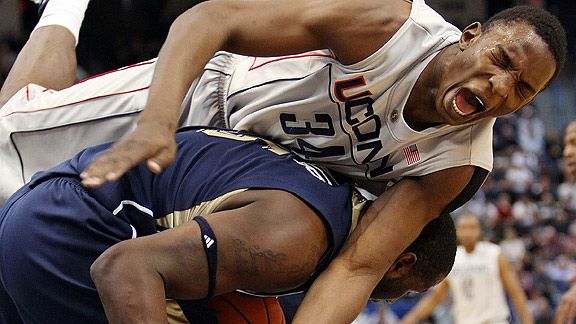
Who’s who? Well, the 7’3″ Hasheem Thabeet is projected to go in the top 5 in most mock drafts and he was thoroughly outplayed by 6’7″ strongman DeJuan Blair. In fact, Blair is so strong that he nearly broke Thabeet’s arm early in the first half (an event which was captured in the above picture).

The game was a back-and-forth affair until late in the second half. With 3:11 to play and the game tied, 61-61, Levance Fields made the first of back-to-back three pointers to put the Panthers up six. He went on to hit four straight free throws to put the Huskies away. The Panthers upended the Huskies, 76-68.

Sam Young — another NBA prospect — led the Panthers with 25 points, hitting 4 of his 6 three-pointers. A.J. Price posted 18 points and eight assists.

The key to beating UConn is to limit Thabeet’s impact on both ends of the court. Pittsburgh kept him from dunking and he was just 3-6 from the free throw line. On the other end of the court, Blair was very physical with the big man, pushing him back underneath the basket before using a plethora of post moves to finish at the rim. It’s hard to block shots when the offensive player is pushing you back, and that’s exactly what Blair did tonight.

Another #1 falls. Pittsburgh is a tough team and they won’t be an easy out come March.

Brandon Jennings says that all is not rosy in Europe

Remember Brandon Jennings? He’s the #1 basketball recruit of the class of 2008 that decided to forgo college (due to trouble with the admissions tests) to sign with a professional team in Rome.

We brought you some excerpts from his blog just after Christmas that stirred up some controversy but weren’t all that controversial. Now he’s on record (via email to the New York Times), and it seems like his frustration level is rising.

“I’ve gotten paid on time once this year,” Jennings said in an e-mail message. “They treat me like I’m a little kid. They don’t see me as a man. If you get on a good team, you might not play a lot. Some nights you’ll play a lot; some nights you won’t play at all. That’s just how it is.”

“I don’t see too many kids doing it,” his e-mail message said. “It’s tough man, I’ll tell you that. It can break you.”

“My role is to play D and take open shots — that’s it,” he said. “And I’ve accepted that role.”

I can’t imagine that these quotes will endear him to the coaching staff in Rome. My guess is that he’ll be running a few extra sprints after practice. And this is one of the advantages (or disadvantages, depending on how you look at it) of the internet, blogs and email. These athletes are so accessible now, even ones that are living in Italy, that journalists can get a quote without flying around the world or having to track them down via telephone. Maybe the Times caught him at a bad time or maybe this is just how it is playing for Lottomatica Virtus Roma.

But even though his minutes are inconsistent and he’s only averaging eight points a game, it doesn’t look like Jennings’ time in Rome will hurt his draft stock, at least according to one anonymous NBA assistant coach.

An N.B.A. assistant coach who has been to Europe and has watched Jennings play said his potential draft standing had not been harmed. The coach requested anonymity because he was discussing a player currently ineligible for the draft.

“I think it is good for him,” he said. “He was getting a defensive component that he needed. If I was a scout and I needed a point guard, I would be extremely impressed with what he has done over there.”

Sonny Vaccaro, who in many ways brokered the deal for Jennings to go to Europe, also commented.

But Vaccaro said there had been a change from last summer, when he worked on the deals for Jennings. Economic conditions in Europe are just as difficult as they are in the United States, and he said he underestimated the emotional strength a player needed to compete overseas.

“A less-driven kid would have come home,” Vaccaro said. “They practice twice a day, and the Europeans play everybody. It is not like one of these silly college games where the same seven guys play every minute of every game. When it’s over, the fact he was able to handle it is going to be more landmark than him just going over there.”

What is Vaccaro smoking?

“It’s not like one of these silly college games where the same seven guys play every minute of every game.”

I’ve played and watched a lot of basketball in my life and the best teams have a regular rotation of guys. Some coaches use a six- or seven-player rotation, and some can find eight or nine guys that they trust. Rarely do teams regularly play a full 12-player roster. With that many guys going in and out of the game, it is impossible for most of the bench players to find any kind of rhythm. I’m not sure why Vaccaro felt the need to use the term “silly” as it just makes him sound foolish.

At the end of the day, I don’t think Europe will be a viable option for most high school seniors. As long as the NBA age-limit stays at 19, most players will prefer to play at the college level due to its comfort and familiarity. But for players like Jennings, who have difficulty getting into college, Europe will remain an option. It just may not be as attractive of an option as it was a year ago.

Related content: Brandon Jennings

UConn snaps Notre Dame’s 45-game home winning streak

Hasheem Thabeet raised some eyebrows earlier this season when he talked some trash about Notre Dame’s Luke Harangody.

Thabeet got off the best line, which was prominently displayed on the Mag’s cover for the world to see. Asked who he thought were the toughest big men in college, Thabeet said, “Nobody’s better than me, only more experienced. I played Luke Harangody and he was not tough. Tyler Hansbrough? I don’t see nothing.”

The 7’3″ Thabeet didn’t play particularly well against the Irish — nine points, 11 rebounds, five blocks and three turnovers — and he allowed Harangody to rack up 24 points and 15 boards, but the rest of the Huskies picked up the slack and pushed #3 UConn to a 69-61 win, which broke #19 Notre Dame’s 45-game home winning streak.

The game was back-and-forth until about nine minutes remaining in the second half when the balanced Huskies went on a 13-1 run to put the game away. Harangody didn’t get any offensive help. The Irish shot 33% from the field, but Harangody accounted for 10 of Notre Dame’s 25 made field goals. His teammates shot a woeful 28% from the field, and just 26% from long range. The key was Kyle McAlarney; he hit his first three three-pointers, and proceeded to miss his next 12 shots. Ouch.

From an NBA perspective, Harangody is the better player right now, but Thabeet is the better prospect. He is much better defensively than he is offensively. He is weak with the ball, often having it stripped or losing it when going up for a shot. At 7’3″ he was clearly bothering Harangody on defense, but Thabeet still allowed him to score 24 points. In the NBA, Thabeet will be as good of a player as he wants to be. Based on his comments about his competition, he clearly doesn’t have much respect for the opposition, but the big question is — will he be willing to put the work in to become a NBA star?

As for Harangody, I’m not sure what kind of NBA player he will make. He’s 6’7″ and is kind of a tweener at the forward position. He could be a David Lee type, but he doesn’t quite have Lee’s athleticism and seems a little slow getting up and down the court. His jumper is ugly but effective and he is able to score in a multitude of ways. However, I just don’t see an NBA team allowing him to have the freedom to be the creative scorer he is in college.

Currently, NBADraft.net has Thabeet projected to go #2 overall, while they don’t even project Harangody to be drafted. If I were an NBA GM, I’d definitely want to take a look at Harangody and see how he fares against NBA competition. One thing’s for sure — he’s a hard worker that parlayed limited athleticism and gritty determination into the Big East Player of the Year as a sophomore last season. I think he could have a successful career as a bench player in the NBA.

The Top 10 NBA Rookies by PER

John Hollinger’s Player Efficiency Rating is a nice way to compare players without having to account for the number of minutes each guy gets. It’s an efficiency statistic, so just about everything is included. A PER of 15.00 is average for the position.

Let’s take a look at the top rookies. I’m only going to list guys that are getting more than 20 minutes per game…

1. Kevin Love, T-Wolves
PER: 16.39
Surprised? I am…a little. I really liked Love coming out of college, but he got off to a slow start and the trade Minnesota made (sending O.J. Mayo) to Memphis wasn’t looking too good early on. He’s not shooting the ball well (41%), but he’s rebounding like a champ (8.4 rpg in 22.7 mpg).

2. Greg Oden, Blazers
PER: 16.35
Technically, Oden is still a rookie since he missed all of last season due to injury. After Love, he has the second best rebound rate of all first-year players.

3. Brook Lopez, Nets
PER: 16.26
Rebounding is the stat that most easily translates from college to the pros, so it’s no surprise that three good rebounders top this list. In 29.5 minutes, Lopez is averaging 11.4 points and 8.2 rebounds, and he has more blocks per minute than Oden.

4. Rudy Fernandez, Blazers
PER: 16.25
Rudy has had no problem adjusting to the NBA game. His three-point shooting 39% is outstanding and he’s averaging 11.0 points, 3.0 rebounds and 2.1 assists in 26.5 minutes per game. Plus, he was even voted into the Slam Dunk Contest as well.

5. Marc Gasol, Grizzlies
PER: 15.40
The other Gasol is getting starters minutes (30.6) in Memphis and is averaging 11.3 points and 7.3 rebounds per game.

6. Russell Westbrook, Thunder
PER: 15.74
In January, Westbrook is averaging 15.7 points, 6.2 assists and 4.8 rebounds in 34.9 minutes of action. He got off to a slow start, but seems to be figuring things out now.

7. O.J. Mayo, Grizzlies
PER: 15.66
Of all the guys on this list, Mayo might be the guy that asked to do the most. He got off to a blistering start, but defenses are adjusting and his numbers are falling.

8. Derrick Rose, Bulls
PER: 15.45
He and Mayo play more than 37 minutes per game, which is by far tops on this list. It’s hard to argue with the 16.9 points and 6.4 assists that Rose produces every night. Point guard is arguably the toughest position in the NBA to learn as a rookie, and this guy sure looks like a keeper.

9. Michael Beasley, Heat
PER: 15.23
Beasley is getting better as the season wears on. He’s averaging 14.9 points (on 50% shooting) and 6.0 rebounds in January. He’s also as good as expected from long range (39%).

10. D.J. Augustin, Bobcats
PER: 13.75
It’s not easy being a point guard under Larry Brown, but Augustin is getting big minutes (28.4) and is producing 12.1 points and 4.1 assists per contest. His shooting (40%) is pretty suspect, though he’s very solid from long range (39%).

Notes:

– Marreese Speights leads all rookies in PER (20.44) but only plays 15.9 minutes per game.

– Anthony Morrow and George Hill just missed the minutes per game cutoff. Otherwise, they would have been on the list.

– Given how tough it is to play point guard in the NBA, Derrick Rose still gets my vote for Rookie of the Year. The Bulls are asking him to play huge minutes, which is going to take its toll over the course of the season.

Andrea Bargnani is starting to “get it”

Remember Andrea Bargnani? He was the 20 year-old Italian that the Raptors picked #1 overall in the 2006 NBA Draft. During his first two seasons, he struggled with his shot — 43% in 2006 and 39% in 2007 — and didn’t rebound very well for a seven-footer (< 4 boards a game). Some even started to throw around labels like "disappointment" or even "bust." But even with those shooting struggles, Bargnani managed to score double-figures in each of his first two seasons, so the potential was clearly there. After a pretty strong start to the 2008-09 season -- 14.7 ppg in the first seven games -- Bargnani had his ups and downs coming off the Raptor bench. It wasn't until Jermaine O'Neal's injury that he really started to flourish. Since O'Neal has been out of the lineup (Dec. 29), Bargnani has averaged 22.3 points and 7.1 rebounds, while shooting 55% from the field and an amazing 58% from long range. O'Neal may return as early as tonight and it's unclear what kind of effect this will have on Bargnani and/or his minutes. Bargnani's emergence has started some rumors about the possibility of trading O'Neal, who hasn't been a great fit in Toronto. His contract runs for another season at the tune of $23 million (wow!) but expires before the infamous summer of 2010. One idea would be for the Raptors to swap O'Neal for Shawn Marion, who could play small forward alongside Bargnani and Chris Bosh, but the Heat would probably prefer to let Marion's deal expire and use the cap space this summer or next on a free agent like Carlos Boozer (or even Bosh). O'Neal just hasn't been able to stay healthy over the last few seasons and I'm sure his giant contract has more than a few owners wary of trading for him.

« Older posts Newer posts »