Category: College Football (Page 185 of 296)

Six Pack of Observations: BCS National Championship Game

Here are six quick-hit observations on Florida’s 24-14 victory over Oklahoma in the BCS National Championship Game.

1. These were the best two teams in college football?
One game shouldn’t make or break how teams are perceived for an entire season (Florida and Oklahoma had tremendous years). But if college football refuses to implement a playoff to determine what teams are the best in the country, than the BCS needed a better showing than that. That was one hell of a sloppy football game, complete with stupid penalties, ugly turnovers and bad decisions by both players and coaches. To say that that wasn’t a cleanly played game would be a gross understatement and anyone from the BCS that can unequivocally state that Florida and Oklahoma were the two best teams in college football after that mess should be embarrassed. This game did nothing to support the notion that college football doesn’t need a playoff system.

2. Utah could play with both of these teams.
There’s no question that Utah’s performance over Alabama was more impressive than Florida’s win over Oklahoma. Again, without a playoff system, how can anyone from the BCS say without question that Utah isn’t the best team in the nation? They were the only team to go undefeated, beat two teams that did/will rank in the top 10 (Alabama and TCU), and they won their BCS game in convincing fashion. The Gators, who absolutely bulldozed everyone in their path after losing by one to Ole’ Miss earlier in the season, lost a game and didn’t look particularly sharp in their BCS victory. Who knows, maybe Florida would shit-stomp Utah on a neutral field next week. Maybe the Utes would run the Gators over like they did ‘Bama. We’ll never know and that’s the problem with the current college football system – it leaves too much to debate.

3. What happened to the shootout?
One word: pressure. Both of these teams did a great job of pressuring the quarterback and disrupting the rhythm of the opposing offense. Oklahoma didn’t see a defense as good as Florida’s all season. But you know what? Florida didn’t see a defense as good as the one Oklahoma trotted onto the field tonight, either. While the offenses played awfully sloppy, you have to give it to the defensive minds on both sides for coming up with great game plans. Tebow and Bradford could hardly set their feet and that’s the main reason why the final was 24-14 instead of 44-38 like most people expected. (Of course, Oklahoma’s struggles inside the red zone played into the low score, too.)

4. Percy Harvin was more valuable to Florida tonight than Tim Tebow.
Harvin (9 carries, 122 yards, 1 TD) was the best athlete on the field tonight – period. And the funny thing was, he played on a bum ankle. With all due respect to Tebow, without Harvin the Gators don’t win tonight. He provided a spark to an offense that seemed to be off all night, he provided Florida with its biggest plays and he opened the door for Tebow in the running game in the second half. Oklahoma’s defense was pretty damn good tonight, but Harvin was even better. I shutter to think how well he would have played if he was completely healthy.

4A. Chris Brown is lighting in a bottle.
Percy Harvin’s play out shadowed him, but Brown was absolutely phenomenal tonight. He was the backbone of Oklahoma’s offense and he picked up some much-needed first downs in the second half. Too bad Bob Stoops and the OU coaching staff decided to run what looked like the same damn play on the goal line when he was stuffed on consecutive 3rd and 4th down plays, because I would have loved to see if he could have scored on a screen pass. He’s so quick.

5. Sam Bradford is the real deal.
Bradford’s final numbers (26 of 41 for 256 yards, 2 TDs, 2 INTs) certainly weren’t as dazzling as they have been all season. But it doesn’t take a pro scout to see that this kid is loaded with talent and doesn’t get rattled. Florida drummed up some decent pressure at times and Bradford often starred down the heat and delivered the ball in a timely manner. And the two interceptions he threw were hardly his fault considering they both hit his receivers in the hands. I think he should stay at least one more year at school to hone his skills and try for a national title again next year. But it’s pretty clear that he has the intangibles to play at the next level. (I’ll let the people in the know determine whether or not he’s got everything else.)

6. Every team would be fortunate to have a Tim Tebow.
He might have annoyed a lot of Sooner fans tonight with his sideline antics, but Tebow is the kind of emotional leader I’m sure every football coach wish he had. He’s got so much fight and determination that he’s easy to root for and I’m sure he has no problem rallying his team, too. I also love how he’ll lower his shoulder and head to fight for just one more inch – there’s no way he’s running out of bounds. I don’t know if he can be a pro quarterback or not, but there’s no question that he’s quite the football player and has a future playing on Sundays (at whatever position).
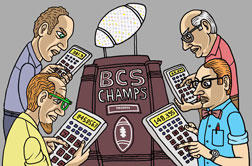
A statistical analyst calls for a boycott of the BCS

Regular readers know that numbers are near and dear to my heart. Maybe it comes from my background — my degree is in industrial engineering — or maybe I just like the cold, objective finality of statistics.

So when a quantitative analyst like Bill James stands up and says that all quantitative analysts should boycott the BCS, I take notice.

The entire article is a good read — and don’t worry, James doesn’t delve too deeply into the numbers. He outlines the problem with the BCS this way:

1. That there is a profound lack of conceptual clarity about the goals of the method;

2. That there is no genuine interest here in using statistical analysis to figure out how the teams compare with one another. The real purpose is to create some gobbledygook math to endorse the coaches’ and sportswriters’ vote;

3. That the ground rules of the calculations are irrational and prevent the statisticians from making any meaningful contribution; and

4. That the existence of this system has the purpose of justifying a few rich conferences in hijacking the search for a national title, avoiding a postseason tournament that would be preferred by the overwhelming majority of fans.

James then goes into each topic with more detail, but this section stands out:

In the 1990s there was a strong movement, within the NCAA, to organize a national postseason football tournament. The problem was, had the NCAA in fact organized such a championship, two other events would almost certainly have followed:

1. The smaller schools, which outnumber the big football powerhouses about 5-to-1, would have voted to send a lot of the money to the smaller schools that in fact had not participated in the national championship contest in any meaningful way.

2. The big football schools would have bolted and revolted. They’d have walked out of the NCAA and formed their own organization. The two-tiered system of NCAA and NAIA schools would have been replaced by a three-tiered system with the NCAA occupying the middle tier.

The creation of the BCS system was simply a less dramatic revolt. And, as I said, the BCS schools were right: There is no reason why schools that don’t fund programs to participate in the battle for the national championship should share in the proceeds of the contest.

There are two ways to get around this problem. First, the NCAA could pass a unanimous or nearly unanimous resolution, promising not to try to steal the proceeds of a national title contest and give the money to small schools, deserving nephews, or the church poor box. The BCS could then dissolve and be replaced by an NCAA Football Tournament involving eight to 16 teams, and the big football schools would wind up with just as much money or a little more.

Or, if that doesn’t work, we can pass a law creating a new National Collegiate Sports Collaborative and requiring all schools receiving federal funding to join and participate. And if we have to do that, we’ll decide how to split the money.

I didn’t realize that fear over the small schools milking too much money from a playoff system was the reason that we don’t have a playoff system. If that’s the case, and as James outlines, it’s not a difficult fix.

I can only hope that we can make some progress towards a legitimate playoff in the next four years, even though the ESPN VP of Programming is completely happy with the current format.

You sir, are an idiot

Here’s what Dave Brown, who vice president of programming on ESPN, had to say about college football implementing a playoff system:

“The next four-year cycle is done, so a playoff is not a consideration at this point,” Brown said. “I wouldn’t want to see the bowls changed because I don’t want to create meaningless games during the regular season. I don’t think that would be good for college football.”

Besides, Brown said, this bowl season has been one of the most successful ever, even if some people complain that 34 games is a few more than necessary.

“This season’s bowl results have been great for us,” Brown said. “Our ratings on ESPN and ESPN2 have been up, so business continues to be very good.”

You don’t want a playoff system because you don’t want to create meaningless games during the regular season, yet you’re perfectly fine with creating meaningless bowl games? Come on Dave – come on Dave!

None of the bowl games matter except for the national championship game. And the only reason why people watch non-BCS bowl games is because 1) they’re off because of the holidays and would rather watch a bowl game than Oprah 2) they went to whatever school that’s playing or 3) they bet on the game just so it had some kind of importance to them. That’s it. Don’t fool yourself into thinking that the system in place is working just because ESPN is making money.

Hey, ESPN is making money so f*ck the fans and what they want, right? This kind of shortsightedness really chaps my ass.

BC fires Jagodzinski – ridiculous or breath of fresh air?

Jeff JagodzinskiBoston College A.D. Gene DiFilippo warned head coach Jeff Jagodzinski that if he interviewed for the New York Jets’ head coaching vacancy, he would be fired. Jagodzinski did interview with the Jets and DiFilippo went through with his word, firing his head coach after only two seasons.

There seems to be two schools of thought on this situation. On one hand, it’s pretty ridiculous to fire someone trying to advance his career. Every man has the right to move up the corporate latter and in the cases of college head coaches, they have to interview for NFL positions when they become open.

On the flip side, this is exactly the wake up message that college coaches need to adhere to. Athletic directors have a hard enough time trying to build a consistent winner without worrying about whether or not their coach is going to fly the coup on them after just one or two years.

Jagodzinski did a hell of a job in his two years at BC. In his first season, the Eagles went 11-3, won the ACC Atlantic Division Championship and finished No. 10 in the polls after beating Michigan State in the Champs Sports Bowl. Not much was expected of the program this year after they lost Matt Ryan to the NFL, but Jags led a young Eagle team to a 9-5 record, another first place finish in their division and an appearance in the Music City Bowl (a 16-14 loss to Vanderbilt).

Considering he went 20-8 with a 1-1 bowl record and won two ACC Atlantic Division Championships, maybe Jags didn’t deserve to be fired for trying to further his career in the NFL. Maybe he deserved more respect and DiFilippo should have been more courteous to the man who got BC’s program back off the ground again.

But the problem is that when he was hired two years ago, he gave DiFilippo his word that he would stick around at least three seasons. He went back on his word like so many college football coaches normally do, and DiFilippo went through with his. Whether the situation was fair or not, DiFilippo sent a message to head coaches that maybe more A.D.’s should try and follow: try to leave this program after not fulfilling your commitment to it and you’ll be let go.

Jagodzinski will wind up somewhere. If he doesn’t land another position in the NFL (he used to work as an assistant coach for the Packers and Falcons), he’ll certainly take another college football head coaching position somewhere. And it’s sad that such a fine young coach had to be made an example of, but for those who think DiFilippo was in the wrong, try and look at the situation from his perspective. Maybe this was just the first step in ending the way Nick Saban, Bobby Petrino and all the other egotistical college coaches think they can go about things.

Related side note: Defensive coordinator Frank Spaziani is the leading candidate to replace Jagodzinski, but keep an eye on Cincinnati head coach Brian Kelly. Kelly is from the Massachusetts area and rumor has it that BC is his dream job. Of course, Kelly was the one that left Central Michigan before his contract was up for the Cincinnati job, so maybe he’s the last guy DiFilippo wants to work considering the situation he just went through with Jagodzinski.

« Older posts Newer posts »