Category: College Basketball (Page 72 of 153)

Hunting for giant killers

ESPN’s Peter Keating lists a few upset possibilities…

No. 13 Portland State (17.6 percent) vs. No. 4 Xavier (62.7 percent)

Portland State, whose adjusted statistics are only about as impressive as Iowa State’s or St. John’s, isn’t the ideal killer. But Xavier is a textbook example of a giant waiting to be slain by just about anyone: The Musketeers turn the ball over considerably more often than they generate turnovers (21.9 percent vs.18.9 percent of possessions). They are heavily reliant on making more free throws than opponents (9.1 FT margin per 100 possessions), which is always a concern in a one-and-done scenario. And they don’t score enough to blow past their flaws (adjusted offensive efficiency of 111.3). Considering everything working against Xavier, and the fact that Portland State at least has a puncher’s chance, according to our model, this is as good an upset pick as you’ll find in the first round.

No. 11 Temple (32.6 percent) vs. No. 6 Arizona State (27.9 percent)

The Sun Devils play sloooow (61.2 possessions per game, by far the fewest among giants), which means James Harden (20.8 ppg) is even more impressive than he looks. But ASU doesn’t grab offensive rebounds (30.6 percent of possessions, 250th in the country). And they give opponents too many open looks from 3-point land (27.4 percent of all field goals). Temple, on the other hand, keeps foes off the offensive glass, doesn’t turn the ball over and doesn’t rely on free throws to outscore opponents. Also, our model can’t distinguish between dominating scorers who can carry a team through the postseason and those who can be stopped as soon as they run into a good opponent, but senior guard Dionte Christmas certainly was the former in the Atlantic 10 tournament.

I don’t advocate picking either of these underdogs. Arizona State is playing good basketball and I think Xavier will have enough to get past the first two rounds. But it’s interesting to see that someone has developed a formula to predict these upsets. We’ll see how it fares.
Four observations about the East Region

1. Duke is better, but they’re still not good enough.
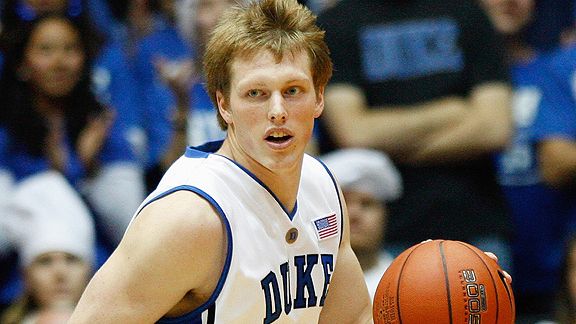
Truth be told, Duke is my favorite team and has been since the days of Johnny Dawkins. But they haven’t had a legit post presence since Carlos Boozer and Coach K has hitched his wagon to the three-ball. The Blue Devils are looking a lot better now that they inserted Elliot Williams into the starting lineup. And now that Nolan Smith is back from missing some time with a concussion, Duke can throw an athletic, perimeter-oriented lineup at their opponent. If Gerald Henderson, Kyle Singler and Jon Scheyer (who is playing great now that he’s running the point) are all on their games, the Blue Devils are tough to beat, but if they run into Pittsburgh in the regional final, they might be in trouble. The only time Pitt loses is when DeJuan Blair gets into foul trouble — he averaged 4.8 fouls in Pitt’s four losses — and Duke just doesn’t have the post presence to challenge him down low. The Blue Devils might have to run Singler at center and hope that he can get a couple of cheap ones on Blair early in the game. And Duke will be challenged before then — Texas and the potential UCLA/Villanova winner are more than capable of sending the Blue Devils home early.

2. The Florida State/Wisconsin matchup is a clash of styles.

I’m not sure what to make of the Seminoles. They flew under the radar all season before upending a Ty Lawson-less North Carolina in the ACC tourney semis. Then looked as if they were asleep for much of the first half of the championship game against Duke. How will they react to flying to Boise to play the Badgers, who love to grind the game to a halt and play tough, fundamental defense? This one might come down to the officials. If they let the two teams play, that should work in Wisconsin’s favor, as they’re used to the physical Big 10 style. But if they call it tight, the Seminoles should be able to get into the lane whenever they want.

3. Good luck beating Villanova in Philly.
Of all the top seeds, the Wildcats are the only team that is actually playing the first two rounds in their hometown. (Okay, nitpickers, Villanova is actually located in Radnor Township, a Philadelphia suburb. Big difference.) If they can get by American University in the opening round, they should have a sizable home court advantage against potential second round opponent UCLA, who is going to have a tough time getting its frontrunning fans (yeah, I said it) to travel cross country.

4. Pitt has what it takes, except tournament experience.
The Panthers have three great weapons at their disposal. Senior point guard LeVance Fields dishes out 7.6 assists per game and can score when he has to, senior swingman Sam Young is averaging 18.7 points and 6.1 rebounds per game, and sophomore big man DeJuan Blair is a double-double machine. But in their last three tournament appearances, the Panthers haven’t advanced past the Elite Eight, losing in the Sweet Sixteen twice. Now that his team has a #1 seed, can Jamie Dixon get Pittsburgh over the hump and into the Final Four? I’m betting my bracket on it.

Four observations about the Midwest Region

1. Louisville is a class above the rest, but they have a serious flaw.
No major conference team comes into the tournament hotter than Louisville. They have won 10 straight games, including wins over Providence (twice), Marquette, West Virginia and Villanova. They even beat a red-hot Syracuse team to win the Big East Championship. They have the country’s second-best adjusted defensive efficiency (points allowed per 100 possessions, adjusted for strength of schedule), and aren’t too shabby offensively, either. But the conventional wisdom is that you need strong guard play to win a title, and the Cardinals don’t have a guard that averages more than 7.8 points per game. However, Louisville’s little guys can really defend, and that might be enough.

2. There are some live dogs.
I doubt there were any coaches out there hoping to get a first round matchup with Arizona this week. With future NBA’ers Chase Budinger, Nic Wise and Jordan Hill in the lineup, the Wildcats can play with anyone. But will they show up? #10-seed USC is hot as a pistol right now and the Trojans actually might be the favorite in their matchup with #7-seed Boston College. Freshman phenom DeMar DeRozan has averaged 19.8 points over the last five games, all USC wins. #13-seed Cleveland State is 29th in the country in adjusted defensive efficiency. What does this mean? The Vikings can really defend. That’s bad news for the Demon Deacons, who shot just 30% in their ACC tourney matchup with Maryland last week.

3. That Kansas/WVU pick is a tough one.

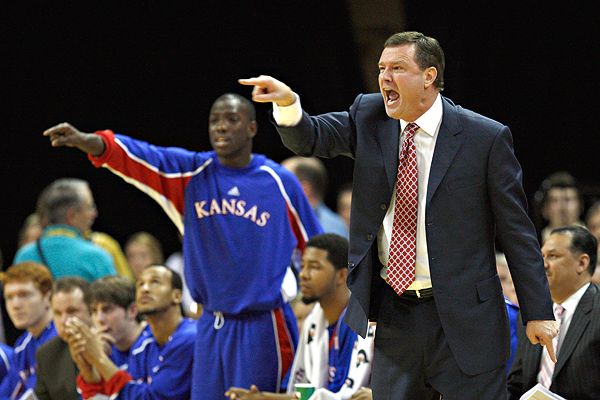
Not only is this a great matchup between two very good teams, but with the winner’s date with the vulnerable Michigan State Spartans in the next round, this one might have huge bracket implications as well. Should we pick the Mountaineers, who recently beat Pittsburgh and Villanova, and lost by five to a hot Syracuse team in the Big East semis? Or do we pick the Jayhawks, who beat Oklahoma, Missouri and Texas before laying an egg against Baylor in the Big 12 tournament? Maybe the best plan to enter two pools so we can pick both.

4. The longshots can shoot the long ball.
The three-point shot is the great equalizer, and the favorites in the Midwest better not fall asleep on the perimeter, or they might be in for a long day. #14-seed North Dakota State has a four-pack of players that make an average of 6.2 three-pointers a game, highlighted by leading scorer Ben Woodside’s 22.8 points per game and 43% accuracy from long range. #15-seed Robert Morris has Jeremy Chappell (2.5 3pg, 41% 3PT) and Jimmy Langhurst (1.9 3pg, 43% 3PT), who can both really light it up. So, Kansas and Michigan State — don’t say you weren’t warned…

Four observations about the West Region

1. #11 Utah State looks like a sneaky smart pick against #6 Marquette.
The Golden Eagles are just 1-5 after losing Dominic James, their fourth-leading scorer and best playmaker, for the rest of the season. Granted, those five losses were to UConn, Louisville, Pittsburgh, Syracuse and Villanova, and they only lost by an average of 7.2 points, but Marquette has to travel to Boise to face #25-ranked Utah State, who had a 19-game winning streak this season. The Golden Eagles better account for Gary Wilkinson and Jared Quayle, who make up one of the best inside-outside combinations west of the Mississippi.

2. The committee didn’t do Mississippi State any favors.
Congratulations on winning the SEC tournament, Bulldogs! Now we need you to make the 2000 mile-trip to Portland, Oregon by Thursday, where you’ll play the Pac-10 champions in their neighboring state. Good luck, and enjoy the Pacific Northwest!

3. UConn shouldn’t be seriously challenged until the Elite Eight, but this is UConn we’re talking about.
If the Huskies come out with a singular focus, no team on their side of the bracket should be able to keep up. Washington, Purdue and BYU are nice teams, but they don’t have the star power or coaching experience of the Huskies. Nor do they have anyone to matchup with Hasheem Thabeet on the inside. However, UConn is known for having tournament ADHD, so its entirely possible that one or more of these teams make the Huskies sweat late into the second half.

4. Missouri/Memphis should be a good one.
The Utah State/Marquette winner could easily give Mizzou a run, and Memphis might be challenged by the winner of the Cal/Maryland game, but if the Tigers face the…um…the other Tigers in the Sweet Sixteen, it’ll be a nice matchup. Memphis hasn’t played a good team since early February (when they blew out Gonzaga in Spokane) and Missouri just won the Big 12 tourney in convincing fashion. Both teams are stellar defensively, but Mizzou has an advantage on offense with DeMarre Carroll and Leo Lyons on the front line.

« Older posts Newer posts »