Category: College Basketball (Page 11 of 153)

Sweet 16 Sagarin & Pomeroy data

If you’ve read my annual March Madness bracket column or if you are a stathead in general, you’ll know what the title of this post means. If you don’t, check out my column and come back.

Here are the next eight matchups representing Sweet 16 of the NCAA Tournament. The Sagarin advantage represents the spread in Jeff Sagarin’s predictor ratings. If the number is positive, it means that Team A is the Sagarin favorite. If the number is negative, then it means Team B (and the lower seed) is actually the favorite.

The Pomeroy % represents the chances that Team A will win the game according to Ken Pomeroy’s Pythagorean calculation.

Over the last four years, teams with a 2+ point advantage in Sagarin’s “predictor” rating have won 156 of 198 games (78.7%). Over the last two years, if a team had at least a 65% expected win rate according to Pomeroy’s Pythagorean calculation, they won 61 of 76 games (80.2%).

I’ve also included the spread for each game at the World Sports Exchange. Oftentimes the spread is very close to the Sagarin spread.

Team ATeam BSag AdvPom %Spread
San Diego StateConnecticut1.459.4%+1
FloridaBYU-2.543.7%-2.5
DukeArizona8.983.8%-9
WisconsinButler7.480.0%-4
North CarolinaMarquette3.063.6%-5
KansasRichmond9.782.0%-10.5
Ohio StateKentucky6.276.0%-5
Florida StateVCU3.964.7%-4

It’s interesting that Florida is a 2.5-point favorite according to the sportsbook even though they are a 2.5-point underdog according to Sagarin. That probably has to do with the sportsbook trying to take into account the loss of Brandon Davies, but his absence sure didn’t hurt BYU against Gonzaga.

Conversely, SDSU is a 1.0-point underdog despite being a Sagarin favorite.

Ref blows Syracuse over-and-back call [video]

It’s been a tough day to be a ref, but the officials blew another one, this time in the Syracuse/Marquette game.

The rule (4.3.8) states:

After a jump ball or during a throw-in, the player in his/her front court, who makes the initial touch on the ball while both feet are off the playing court, may be the first to secure control of the ball and land with one or both feet in the back court. It makes no difference if the first foot down was in the front court or back court.

Notice that both feet of Scoop Jardine are off the court, and as he catches the ball his foot lands on the line. This should have been a play on, but the ref called a backcourt violation.

The game was tied at 59-59 with 0:52 to play and Marquette hit a three-pointer on the next possession to take control of the game. Marquette won, 66-62.

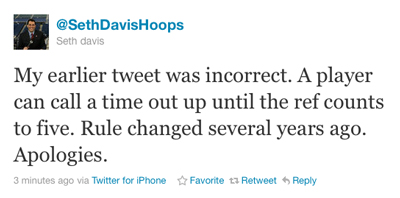
Official counts to four, then calls a five second violation; Texas loses

With the Longhorns up two with under 10 seconds to play, Texas was attempting to inbound the ball. Watch as the official hands the ball to the Texas player and counts to four. He starts his five count when the Texas player indicates a timeout, but the ref instead calls a five second violation. Texas led by two at the time, but Arizona had a three-point play to take the lead and win the game.

According to the CBS studio crew, the rule states that you can’t call a timeout after four seconds, but after a quick search, I couldn’t find anything regarding this situation in the NCAA rulebook. (Let me know if you can.) Here’s what I found:

Section 12. Timeouts Not Granted
Art. 1. No timeouts shall be granted:
a. To the opponents of the throw-in team after the throw-in starts.
b. During an interrupted dribble.
c. To a player or coach when an airborne player’s momentum is
carrying him/her out of bounds or into the backcourt.
d. Unless there is player control by the requesting team. Exception:
Rule 5-12.1.c.
e. Until after the jump ball that begins the game and the conditions as
described in Rule 5-10 are in effect.

Again, I can’t find anything about the four second rule.

I clocked this on my stopwatch three times and came up with 4.2-4.5 seconds each time when starting with the beginning of his first arm swing. I’m not sure why you can’t call a timeout after four seconds, but supposedly that’s the rule.

Update: Seth Davis clears it up for us…

So it’s official, Texas got jobbed.

Refs bungle end of UNC/Washington game

Washington Huskies guard Isaiah Thomas (2) walks off the court after losing against the North Carolina Tar Heels during their third round NCAA men’s basketball game in Charlotte, North Carolina March 20, 2011. REUTERS/Chris Keane (UNITED STATES – Tags: SPORT BASKETBALL)

North Carolina outlasted Washington, 86-83, in Charlotte, but most of the talk after the game was how the officials determined the amount of time remaining on the last play of the game.

Washington’s Venoy Overton heaved a half-court shot (with his off hand, no less) and the ball hit John Henson’s hand before it went out of bounds. The replay clearly showed it hit the floor out of bounds with 1.2 seconds remaining, yet when Washington’s coaching staff asked the refs to check the time, they said it was fine and play proceeded with 0.5 seconds remaining. Washington didn’t have much time to get a good look and ended up taking a contested two-pointer that wouldn’t have changed the outcome of the game even if it had gone in.

The NCAA director of men’s officials, John Adams, told CBS after the game that the officials acted correctly since there’s a lag time between when the ball hits, when the official blows his whistle and when the scorekeeper stops the clock.

Fine. But there’s an elephant in the room — why didn’t the officials bother to go to the video? They don’t have to check the video, but if the Washington coaching staff did indeed ask about the time, then the officials should have double-checked. With the Sweet Sixteen on the line, why not take a minute and make sure you got it right?

Who knows, had Washington had an extra 0.7 seconds, maybe they would have had time to get a better shot.

« Older posts Newer posts »