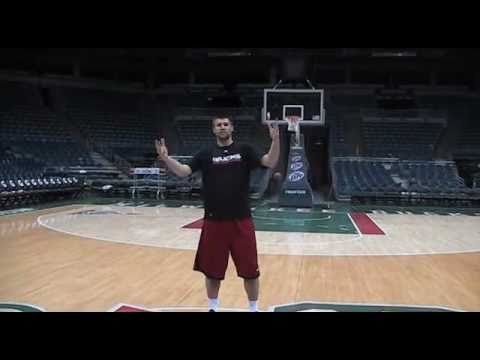
Check out Jon Brockman’s assortment of trick shots.
Author: John Paulsen (Page 55 of 937)

We hear it all the time. NBA analysts call one point guard “pass-first” and another “shoot-first.” Or they say one guy is “turnover-prone” while another “takes care of the ball.” But really, what makes a player a “pass-first” point guard? How carefree must he be with the ball to be considered “turnover-prone”?
I first tackled this subject two years ago, and settled on the shot-to-assist ratio to determine whether a player is “pass-first” or “shoot-first.” The higher the number, the more of a “shoot-first” player he is. To determine whether or not a player is “turnover-prone,” I calculated each player’s assist-to-turnover ratio. The higher the number, the better the player is at taking care of the ball.
I narrowed the list of players to 33, one for each team plus a few extra for teams like Cleveland, Sacramento and Denver, who have a couple of players manning the position. I also added eight prospects (indicated in green) just to see where a few of the younger guys land. Here’s the graph — it’s small, but if you click it, you’ll get to a bigger version:

So the pass-first/shoot-first aspect goes left to right, and the turnover-prone players will be towards the bottom, while the guys that take really good care of the ball will be up top. Players indicated with a blue diamond are in the Top 10 in this group in Efficiency Per Minute. I set the axis for each category at the average of the 33 players in question, so 1.97 for FGA-to-assist and 2.70 assist-to-turnover.
Two years ago when I conducted this study, seven of the top 10 EPM performers were in the top left quadrant (pass-first, takes care of the ball). This year, only five of the top 11 (I included both Rondo and Calderon, since they tied for #11) are in that quadrant. This is due to the emergence of three shoot-first, (fairly) turnover-prone guards who are emerging as stars: Derrick Rose, Russell Westbrook and Stephen Curry.
A few takeaways:
Derrick Williams played a nearly perfect first half, and then his supporting cast played a nearly perfect second half.
It’s really that simple.
If not for Williams, Duke might have blown Arizona out in the first 20 minutes. The sophomore forward went 8-for-11 from the field (5-of-6 from 3PT) for 25 points to go along with six rebounds, three steals and a block. That’s all in a half, people. Not a game. A half. His deep three as time expired cut the Duke lead from nine to six, and gave Arizona some momentum heading into intermission.
One category that coaches and statheads both look at is offensive efficiency, which is the number of points per possession that an offense scores in any given game. Since each offensive rebound starts a new possession, one stat I like to look at is the number of points per trip. In the second half, the Wildcats scored 55 points on 35 trips, or 1.57 points per trip. The sign of a good offense is generally 1.0 point per trip, so Arizona’s work in the half was nothing short of outstanding.
Arizona missed just 16 shots in the second half (making 21), but gathered 12 (twelve!) offensive rebounds, so along with three turnovers, the Wildcats only had eight scoreless trips in the second half. That means that they scored on 27 of their 35 (77%) trips in the final 20 minutes. That’s a truly an amazing half of basketball.
Arizona made nearly all its open shots and hit several tough leaners and fadeaways that aren’t typically high percentage shots. They took care of the ball — remember the aforementioned three turnovers — and made every correct decision when Duke’s defense came over to help or trap.
That said, Duke still had a chance to make a run with about six minutes to play. The Blue Devils cut the lead from 14 to 11 and forced an Arizona miss, but Nolan Smith couldn’t convert a semi-tough layup to get the lead under 10. Had that shot gone in, the pressure would have been back on the Wildcats, and the game might have been tighter at the end. But it didn’t fall and Arizona went on a 5-0 run to push the lead back to 16. Wheels off. Game over.
UConn 74, SDSU 69
Kemba Walker scored 36 and Jeremy Lamb chipped in 24 (and was big down the stretch) as the Huskies overcame a partisan SDSU crowd in Anaheim.
Florida 83, BYU 74 (OT)
Jimmer went cold in OT (0-2 FG, two turnovers) and the Gators pulled away with a balanced attack.
Arizona 93, Duke 77
Duke led by six at halftime, but Arizona’s played near-perfect ball in the second half, outscoring the Blue Devils 55-33 over the final 20 minutes. Derrick Williams had 32 points and 17 rebounds, while Lamont Jones added 16 points. The SDSU fans stayed and rooted for Arizona, which made it even tougher on the Blue Devils.
Butler 61, Wisconsin 54
The Badgers were down 20 in the second half, but cut Butler’s lead to four with 1:40 to play. Shelvin Mack and Shawn Vanzant brought the Bulldogs home.
My buddy LaRusso got us tickets to the West Region Sweet 16 games, and I’ll be tweeting throughout the SDSU/UConn and Duke/Arizona games (@FantasyShrink). Join the conversation!
FOLLOW US!

CATEGORIES
© 2026 The Scores Report – The National Sports Blog
Theme by Anders Noren — Up ↑