Author: John Paulsen (Page 464 of 937)

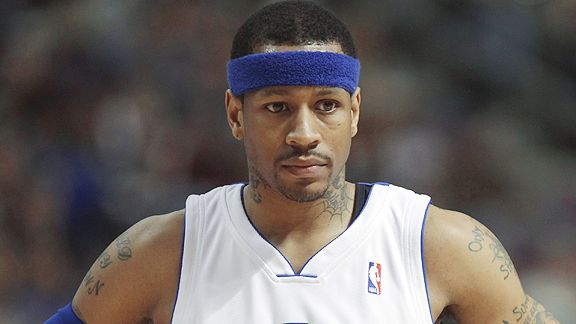
Grizzlies make an offer to AI

It’s that time of year in the NBA. Free agency is winding down, training camps are still a few weeks away and the news is generally slow.

So when the worst team in the league makes an offer — doesn’t sign, mind you, only makes an offer — to a 34-year-old former MVP whose best years are behind him, it becomes the lead story on ESPN’s NBA page.

Iverson is one of the most high profile, unrestricted free agents remaining on the market, and there were reports in recent days that he was leaning hardest toward reuniting with his old coach, Larry Brown, with the Charlotte Bobcats.

But the Bobcats are for sale and are under severe financial constraints, and Iverson’s other strongest suitor — the Miami Heat — is already more than $3 million into luxury tax territory and has not been willing thus far to make Iverson a substantial financial offer.

Memphis is approximately $3.5 million under the salary cap for the 2009-10 season and thus could easily outbid Charlotte and Miami for the services of the 10-time All-Star, whom Grizzlies owner Michael Heisley sees as a strong gate attraction.

Iverson could help a contender, but his stint in Detroit leaves the impression that he doesn’t play well with others. This is why teams like Charlotte and Memphis are in the running for his services.

How Nick Van Exel once had 23 assists in a game

Per Deadspin…

Not long ago, we brought you the story of a stat-padding NBA scorekeeper who, one day in 1997, awarded 23 assists to Lakers guard Nick Van Exel, mostly for the hell of it. That was Alex. (He is now an officer in the Navy and asks that I not use his last name.) From 1995 to 1998, he headed up the Vancouver Grizzlies’ stat crew.

Alex quickly found that a scorekeeper is given broad discretion over two categories: assists and blocks (steals and rebounds are also open to some interpretation, though not a lot). “In the NBA, an assist is a pass leading directly to a basket,” he says. “That’s inherently subjective. What does that really mean in practice? The definition is massively variable according to who you talk to. The Jazz guys were pretty open about their liberalities. … John Stockton averaged 10 assists. Is that legit? It’s legit because they entered it. If he’s another guy, would he get 10? Probably not.”

The bias is plain to see. Just look at the home-road splits. Last season, home teams leaguewide scored 101.58 points per game; road teams, 98.32. That’s to be expected: Teams play better at home. What’s surprising is that assists and blocks rise disproportionately for home teams — assists by nearly 8 percent, blocks by more than 15 percent. Last year’s Nuggets averaged 25 assists at home, only 19.4 on the road. They recorded 7.3 blocks per game at home and just 4.7 outside Denver. (Hell, Chris Andersen swatted 117 shots in 38 games at home against only 58 blocks in 33 games on the road. It was as if he stepped into the Pepsi Center and suddenly turned into Larry Nance.) The reason? People like Alex.

Then Alex discusses the Nick Van Exel Incident…

Alex decided to act out. “I was sort of disgruntled,” he says. “I loved the game. I don’t want the numbers to be meaningless, and I felt they were becoming meaningless because of how stats were kept. So I decided, I’m gonna do this totally immature thing and see what happens. It was childish. The Lakers are in town. We’re gonna lose. Fuck it. He’s getting a shitload of assists.” If you were to watch the game today, you’d see some “comically bad assists.” Alex’s fingerprints are all over the box score. He gave Van Exel everything. “Van Exel would pass from the top of the three-point line to someone on the wing who’d hold the ball for five seconds, dribble, then make a move to the basket. Assist, Van Exel.”

Why would a team inflate its stats?

“Teams have a legitimate, vested interest in stats being inflated, just like the league does,” Alex says. “Ten assists is way more interesting than eight assists. As humans, those are more appealing and interesting numbers. The NBA benefits and every team benefits from bigger, flashier numbers.”

While this isn’t on the level of PEDs, it’s certainly troubling to read about the way a statistician can fudge the numbers to make certain players look better.

And it will definitely make me think twice when I’m setting my fantasy lineup for the night. Go with the guy playing at home.

A breakdown of the Michael Beasley story

Henry Abbott of TrueHoop analyzes the information and misinformation surrounding Beasley’s rehab.

The more you dig for real information about what’s going on right now, the muddier the picture becomes.

One group of sources swears that Beasley’s off-court life is disastrous. They talk of compounding poor judgment with cars, guns, women and money. They talk of money spent on cars, houses and supporting those around him that far exceeds income. Many tell stories of appointments broken and opportunities lost to a player who seems unable to focus. When word came that he was entering some kind of treatment, several sources said things like “I’m not surprised at all,” and “it could get worse before it gets better.”

This is a good read for those interesting in what’s going on with Beasley, even though the picture isn’t entirely clear.

Industry Insiders Fantasy League: Round 8

To start with Round 1 (and see the scoring system and roster requirements), click here.

My team so far: 1) Chris Johnson, 2) Steve Smith, 3) Ronnie Brown, 4) Marshawn Lynch, 5) Santana Moss, 6) Tony Romo, 7) Greg Olsen

My starting lineup is almost complete. Knowing that I have to start three WR, I was definitely looking to shore up that position as my 8th round pick approached.

Here’s how the first part of Round 8 went: 85) Owen Daniels, 86) Cedric Benson, 87) Chris Wells, 88) Torry Holt

I strongly considered drafting Jerricho Cotchery in the previous round, but I was worried about one of the TEs that I liked not falling to me in the 8th. Luckily, Cotchery fell to me here. The only other player I really considered was Donnie Avery, but he’s coming off an injury and I think Cotchery is the better receiver at this point in time. I’m not thrilled about Mark Sanchez being named the starter, because Cotchery and Kellen Clemens have proven to have a pretty nice rapport at times.

Cotchery was WR23 in 2007 and WR25 in 2008, so he’s not going to set the world on fire, but with Laveranues Coles in Cincinnati, he should see a big increase in targets. He may not convert those opportunities with as much efficiency as in years past, but the extra targets should help his numbers. And with the up-and-coming Dustin Keller roaming the middle and Leon Washington in the flat, defenses will have a tough time focusing on Cotchery.

I wouldn’t feel great about Cotch as my WR2, but as my WR3 on a team that is RB-heavy and already has a solid QB and TE, I feel great about nabbing him here. He is the #35 WR off the board, so if he plays a full season, he is almost guaranteed to outplay his draft position.

Just like in baseball, it’s not always about swinging for the fences. Sometimes you just need a single. And this pick is a single.

Round 8, Pick 5: Jerricho Cotchery, WR

The rest of Round 8 went like this: 90) Visanthe Shiancoe, 91) Matt Cassel, 92) Steve Breaston, 93) Earnest Graham, 94) Donnie Avery, 95) Jamal Lewis, 96) LeSean McCoy

Click here to see all of my round-by-round picks.

« Older posts Newer posts »