Author: John Paulsen (Page 400 of 937)

Waiver Wire Watch: Week 11

Every week, I highlight a few players that you should target in waivers. I use the ESPN league data when filtering players, so the only players eligible for discussion here are those that are available on the waiver wire in at least 50% of ESPN’s leagues. I’ll list each player’s percentage-owned after their name so you have an idea of how available they are in leagues around the country. I’ll always try to mention a few players that are available in 90% of leagues for those of you in 12-team leagues or leagues with big rosters. I’ll rank them in the order I’d pick them up in a league with a high-performance, PPR scoring system.

Please note that these rankings are for total value through the end of the year. Players with particularly good matchups this week are in bold.

Alex Smith (17.0)
Of this group, I’d still take Smith first despite a bad outing against a suspect Bears secondary. He has a great upcoming schedule and has a few good options in the passing game in Vernon Davis and Michael Crabtree.
Vince Young (6.6)
Young has been very solid of late, and with the Texans and Cardinals up next, he has a chance to post decent fantasy numbers.
Mark Sanchez (46.4)
The rookie has been pretty good over the last three weeks, but with the Pats and Panthers up next, that may not last.
Jason Campbell (19.2)
Matthew Stafford (5.8)
Marc Bulger (3.7)
Josh Freeman (3.4)
Chad Henne (5.2)

Continue reading »

Grizzlies, Iverson agree to part ways

Per NBA.com…

The saga of Allen Iverson and the Memphis Grizzlies lasted less than two months. Monday, the two sides agreed to release the 34 year old from his one-year contract, meaning Iverson will become a free agent when he clears waivers.

Iverson, who’d signed a $3.5 million contract in September, had been away from the team for the past 10 days, taking a leave of absence from the team to deal with what both he and the team called a private family matter. But it also was crystal clear that Iverson was not going to abide by the team’s decision that he come off the bench instead of start, and that meant a long-term relationship between the two was ultimately going to be impossible.

Is anyone surprised by this turn of events?

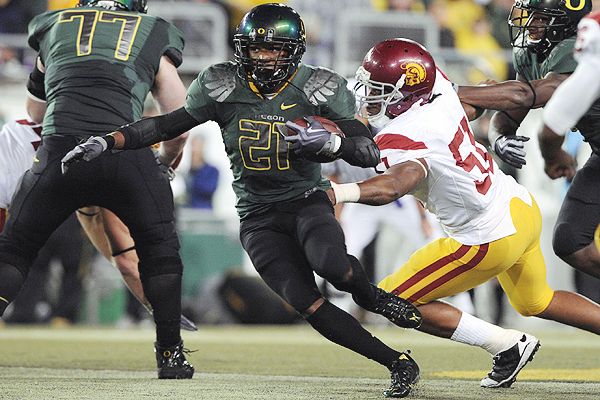
What would a college football playoff look like this year? (Version 2.0)

Last week, I debuted this season’s “what if” college football playoff bracket, and there was one serious flaw — Boise State was left out of the playoff despite being ranked ahead of Oregon and having a head-to-head win against the Ducks. This week, I’ll remedy that.

Here are my assumptions:

1. The six BCS-conference champs get an automatic bid unless they are ranked outside the top 15. There would need to be some sort of ranking system used. For now, we will use the BCS.

2. If a conference champ is ranked lower than #15 in the rankings, they give up their automatic bid and it becomes an at-large bid. (This rule is to ensure that the regular season keeps its meaning and only the elite teams make the playoffs.)

3. Seeds and at-large bids are distributed based on the current BCS standings. Certainly, these rankings need to be tweaked to place more of an emphasis on head-to-head matchups, but they are fine for now. If an at-large team has a better BCS ranking than a conference champion, they will get a higher seed.

4. There will be three rounds of playoffs. The first round will be held at the home stadium of the higher-seeded team. The semifinals and the final will rotate amongst the four BCS cities (Miami, Pasadena, Tempe and New Orleans), so that those cities don’t lose the revenue from the bowl games.

I’m adding a fifth assumption, the “I Drink Your Milkshake” Rule. Last week, Boise State was left out of this playoff despite having a head-to-head win against Oregon and being ranked ahead of the Ducks. So, there is one more caveat for the conference champions: If they are ranked behind a non-BCS school, and have a head-to-head loss to that team, then they give up their playoff bid to that team. I drink your milkshake!

How does this affect our bracket? Let’s take a look…

Continue reading »

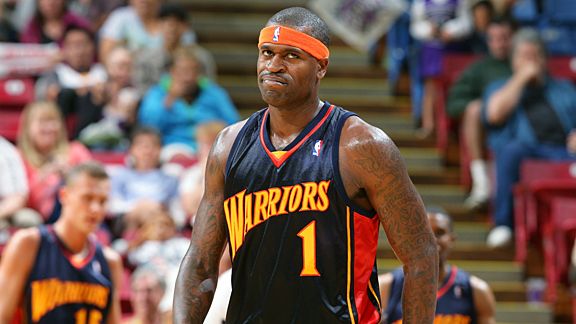
Stephen Jackson traded to…the Bobcats?

So much for Jackson’s wish to be traded to a contender. He’s headed to Charlotte as part of a four-player trade.

In a deal that NBA front-office sources said came together quickly Sunday night and received the needed league approval Monday morning, Golden State sent Jackson and guard Acie Law to the Bobcats in exchange for veteran swingmen Raja Bell and Vladimir Radmanovic.

Let’s see — Jackson has three years left at the tune of $28 million. Radmanovic has one year left for $6.9 million and the other two players (Bell and Law) are free agents after this season. So the Warriors are going to save about $21 million with this move, assuming they don’t re-sign either of the incoming players.

Radmanovic isn’t a bad fit for the Warriors in that he can shoot from long range and can’t play any defense. Bell is known as a hard-nosed defender but his best years are behind him.

Jackson has a reputation for being something of a malcontent, and he asked to be traded to a contender (only he goes to a bottom-feeding Charlotte franchise). If you’re running the Bobcats, why do you make this deal? What are the odds that this works out?

The Bobcats do get a versatile scorer. Charlotte is last in the league in scoring (82.4 ppg) and shooting percentage (39.4%), so he’ll help in the short term, but I don’t see how this improves the franchise in the long term. Jackson turns 32 this season, so he’ll be 35 when his contract expires, and his deal will drastically reduce the team’s cap space in the summers of 2011 and 2012.

« Older posts Newer posts »