Month: June 2009 (Page 38 of 58)

The top 10 first round steals of the last 10 years

Everyone loves to focus on the lottery, but there are good players to be had in the late first round as well. A while back, I put together a list of the top second round picks of the modern era, so now I’m going to focus on those players that were drafted between pick #21 and pick #30 in the first round. (Note: If a player was drafted in the second round, even if they were taken with the #29 or #30 pick overall, they are ineligible to make the list. Sorry, Gilbert.) Since there are more star-quality players available in the 20’s, I’m limiting this list to the last ten drafts (i.e. 1999 through 2008).

It is sometimes tough to rank older players with newer players, but even if a younger player holds more trade value right now, I am going to take into account each player’s entire career. For the young guys, I have to project a little bit, so keep that in mind as you read and react. I feel great about the top eight guys, but there are a few players that missed the list that are pretty interchangeable with #9 and #10.

On with the list…

10. Aaron Brooks, Rockets
26th pick in 2007
I had to decide between Brooks and Nate Robinson here and went with Brooks given his fine performance in the playoffs this season (16.8 ppg, 3.4 apg, 42% from 3PT) and how Robinson’s numbers are a little inflated playing for Mike D’Antoni. Brooks is not a natural point guard, but his sharpshooting is a good fit given Houston’s inside-out attack. He’s small, but he’s quick and is able to score at the rim when given some daylight. The Rockets feel good enough about Brooks to trade Rafer Alston away midseason, so you have to like his upside.

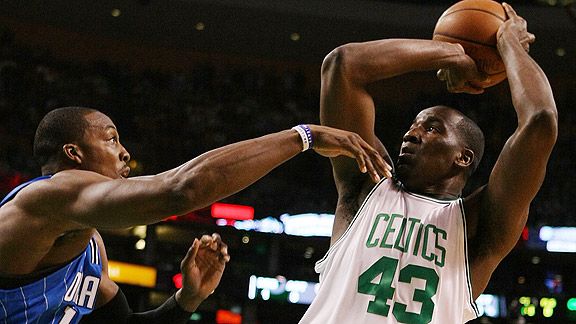
9. Kendrick Perkins, Celtics
27th pick in 2003 (drafted by the Grizzlies)
In the world of “big” guys, I also considered Boris Diaw here, but it’s tough to pass on a 6’10” 24-year-old who averaged 8.5 points, 8.1 rebounds and 2.0 blocks per game on a team loaded with vets. Without Kevin Garnett in the playoffs, the C’s needed Perkins to step up his game and he responded with 11.9 points, 11.6 boards and 2.6 blocks per contest. He also did a pretty good job on Dwight Howard, who had his worst numbers of the playoffs against the Celtics.

8. David Lee, Knicks
30th pick in 2005
Isiah Thomas couldn’t make a good trade to save his life, but he could spot talent in the draft. Lee has turned out to be a steal with the last pick in the 2005 draft. He’s an athletic lefty whose best traits are his hustle and smarts. In just his fourth season, Lee averaged 16.0 points and 11.7 rebounds per game, which made him one of the most consistent double-double guys in the league. His stock is so high right now that the Knicks might be able to use him as trade bait in order to land Chris Bosh or Amare Stoudemire. Maybe they’d be better off sticking with Lee…
Continue reading »

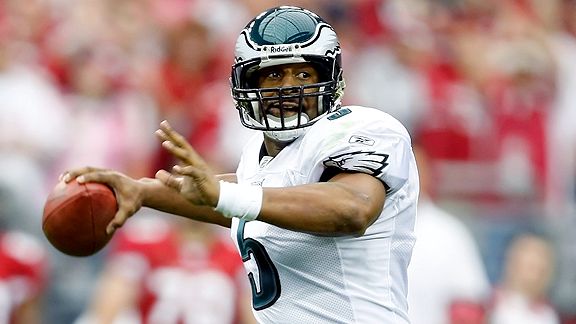
Report: Eagles close to new deal with Donovan McNabb

According to a report by Comcast Sportsnet in Philadelphia, the Eagles are close to signing quarterback Donovan McNabb to a new contract.

Under his current deal, the 11th-year veteran is scheduled to earn $9.2 million this season and $10 million in 2010. The two sides had been discussing an extension before agreeing to focus on reworking the two years remaining on his current deal.

Earlier this offseason, the 32-year-old McNabb reportedly indicated he wouldn’t negotiate a new deal until he saw the moves the team made in the offseason. Apparently, he’s satisfied, although he has yet to hold a press conference this offseason to discuss the matter.

In 2002, McNabb signed a 12-year, $115 million extension that had him under contract through 2013. The last three years of that extension were voided, though, when McNabb reached certain incentive clauses.

Last season, his 10th in the league, McNabb completed 345 of 571 pass attempts for 3,916 yards – all franchise records.

Football fans seem to either love or hate McNabb and I have been someone that has always been in his corner. Some Philly fans have chastised him ever since he was drafted and love to harp on everything and anything that they feel he does remotely wrong. But the guy has been incredibly productive throughout his entire career and outside of a couple brutal games in the middle of the season, he proved last year that he still has the talent and ability to lead the Eagles deep into the postseason.

It looks like all of the Kevin Kolb fans will have to wait a little longer to see the young QB get his shot to be a starter.

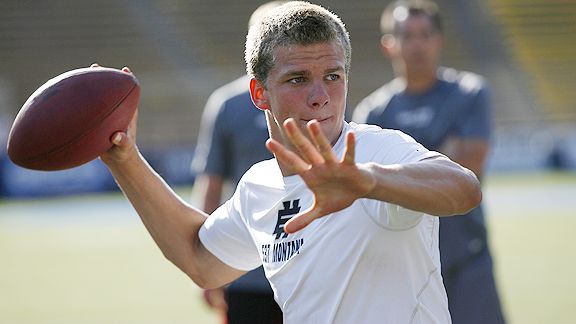
Joe Montana’s son commits to Washington

Joe Montana’s son, Nick, who is entering his senior year at Oaks Christian High School in Westlake Village, California, has officially committed the University of Washington. This news comes on the heels of the Huskies losing out on Skyline High School’s Jake Heaps, who spurned Washington to commit to BYU.

Montana (the son, not one of the greatest quarterbacks to have ever lived) actually had offers from Notre Dame, LSU, Ohio State, Stanford, Alabama and Georgia, but chose Washington despite the Huskies’ brutal 0-12 season in 2008.

Even though the Huskies have a ton of work ahead of them in order to be competitive again, it’s nice to see that Montana wants to help play a role in turning Washington back into the proud program it once was. Nick could have gone to his dad’s alma mater Notre Dame, but that probably would have created unnecessary pressure on him to succeed.

For three SEC programs to be interested in Montana, you know the kid has some immense talent. It’ll be fun to follow him at Washington after he wraps up his senior year of high school.

The MLB draft will never be popular

Joe Posnanski of SI.com wrote an interesting piece about why the MLB draft doesn’t work as a popular television event.

1. The vast majority of players drafted will never get close to the big leagues. Take the 1994 draft … 15 years ago. There were 287 players taken in the first 10 rounds, and 190 of them — two thirds — did not get a single at-bat or throw a single pitch in the big leagues.

2. Even the players who DO make it will not make it for years. If the NFL Draft is, as the cliché goes, like getting presents on Christmas morning, well, the baseball draft is like getting a savings bond from your grandmother that will mature when you turn 18.

I love the analogy Posnanski used in his second point.

Yesterday I DVR’d the MLB draft and was actually looking forward to watching it. The MLB Network had hyped the event up for a couple of weeks and being a Giants fan, I was excited to see who’d they take at pick No. 6.

But once Bud Selig (who was awful, by the way) read Zack Wheeler’s name at pick six, I realized that I could care less about the rest of the first round. Unless you’ve lived under a rock the past couple weeks, you knew that the Nationals were going to take San Diego State pitcher Stephen Strasburg with the top pick and there was a good chance the Mariners would select North Carolina’s Dustin Ackley (arguably the best position player in the draft) at No. 2. So outside of hearing whom your favorite team picked, there wasn’t much excitement to the draft.

Posnanski is right – the MLB draft as a televised event doesn’t work. I applaud MLB for trying to make the event even a smidgen as popular as the NFL draft, but there just isn’t enough quality substance in the end. As Posnanski points out, most (and that’s not an exaggeration) of the players drafted in the first couple of rounds will never see the big leagues and even if they do, as a fan you have to wait three to four years before that happens. By that time, most casual fans have forgotten where those players came from.

Again, I think it’s great that baseball has embraced the idea of making the draft more of an event. But the reality is that I would rather watch the entire third round of the NFL draft than just one pick in the first round of the MLB draft. And I think others feel the same way.

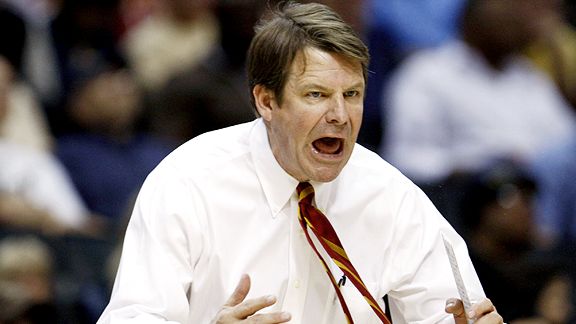
What’s really going on with Tim Floyd’s resignation

Tim Floyd resigned as head coach of the USC basketball program, and SoCal Sports Hub put together a good piece about the real reasons behind his “resignation.”

1. Floyd didn’t resign because he lacked enthusiasm

In his resignation letter, Tim Floyd wrote that he no longer had the level of enthusiasm necessary to remain in coaching. Sorry, but if you actually believe that, than you are about as naive as a third grade schoolgirl. Are we really suppose to believe that Floyd was all of a sudden dispassionate about his job just after he had been complaining about his players’ departures to the pros and saying he wanted to build his own traditions at USC? Ya, right.

The notion that Floyd, who was well-known for his sideline antics, has all of a sudden become an apathetic old man is absolutely ridiculous. This is the same coach that nearly took a rebuilding job at Arizona and had been begging his players to stay at USC in order to make a run at the Final Four. Now, a month later, it seems rather odd than he would be suddenly disinterested in building a basketball program.

Read the rest of the article here.

The program has been on the rise for a while now, but it’s unclear what kind of a tailspin Floyd’s departure will create. Half of his team is leaving to play pro ball, so with the NCAA watching closely, he was going to have a tough time reloading anyway.

« Older posts Newer posts »