Tag: Summer of 2010 (Page 63 of 63)

Is the NBA ’09 free agent class better than ’10?

When I saw the headline — “’09 free agents may be better than ’10 class” — I was ready to jump all over David Aldridge for saying that any free agent class could be better than the one that will likely feature LeBron James, Dwyane Wade, Chris Bosh and Amare Stoudemire. But as I read the full article, he made some sense. I still don’t agree with him, but I see his point.

Here’s a look at the possible free agents in ’09:

Those with asterisks either have options for ’09 or can terminate existing contracts for ’09, and many are expected to do one or the other, for one reason or another:

Kobe Bryant*, Carlos Boozer, Shawn Marion, Ron Artest, Lamar Odom, Hedo Turkoglu*, Mehmet Okur*, Andre Miller, Mike Bibby, Jason Kidd, Allen Iverson, Rasheed Wallace, Kyle Korver*, Anderson Varejao*, Drew Gooden, Stephon Marbury, Grant Hill, Brandon Bass, Joe Smith, Wally Szczerbiak, Zaza Pachulia and Anthony Parker. Jermaine O’Neal could join the group if he walks away from $23 million next season. (Don’t hold your breath. There’s no asterisk by Boozer because he’s already said he’s opting out next summer.)

Aldridge has four major arguments:

1. 2010 is fool’s gold.

It doesn’t take a rocket scientist to figure out that unless seismic changes take place, James is either going to stay in Cleveland in 2010 or go to New York. Maybe Los Angeles. Wade will almost certainly choose between Miami, New York, L.A. and Chicago. Bosh will choose between the preceding cities and, perhaps, Detroit. And that’s it.

Without the Big Three on the market for most NBA cities, the ’10 class loses a good bit of its luster. That’s going to leave a lot of teams with max money to spend on mostly not-max players.

2. Given the recession, owners will not want to spend.

Only seven or eight teams are going to be over the luxury tax threshold this season. That number isn’t going up any time soon. Fewer teams contributing luxury taxes to their fellow competitors will further erode many teams’ bottom lines.

“People have spent (in recent years) not to be a tax payer,” says a CEO of a major market team. “Indiana really can’t afford to spend up to the tax based on their local economy. But they do, because everyone else is doing it … now, I think you’re going to see teams having to make a lot of tough decisions on spending.”

3. Since fewer teams have cap space this summer, ’09 will have more opportunity.

The point is, there will be far fewer ’09 suitors than ’10 teams. And while Bryant is equally not likely to leave L.A. for smaller-revenue teams this summer, those teams are nonetheless in a buyer’s market similar to that of Major League Baseball. There will be solid, veteran players available who may well have to settle for cents on the dollar instead of bigger paydays. A wise team will likely get a whole lot more bang for its reduced buck in ’09.

Says one extremely high-ranking team executive: “This is going to be a nuclear winter for free agents. I would not want to be one this summer. So, if the point is that this summer will be great because there will be bargains galore, you are on the money.”

4. ’10 is loaded with wings, while ’09 has better point guards and bigs.

The ’10 group is lousy with wings — big wings, small wings, fast wings, shooting wings. But so is the whole NBA. The worst teams in the league — Oklahoma City, Washington, Minnesota, Memphis — all have perfectly fine wing players. It’s the point guards and centers that most of them lack, and so does the 2010 class.

Point guards available in two years: Nash. He’s it. And he’ll be 35 on opening night, 2010.

Point guards available next year: Kidd (who, granted, will be 36 on opening night, 2009), Miller and Bibby.

Quality bigs under 35 in two years: Bosh, Nowitzki and Chandler.

Quality bigs under 35 next summer: Boozer, Okur, Varejao, Wallace. Not-great-but good ones include Dallas’ Bass, Chicago’s Gooden and Atlanta’s Pachulia.

I don’t disagree with any of his individual points, but I don’t believe that they combine to make the ’09 class better than the ’10 class. To say that one class is better than another is to say that the collection of talent in one is greater than the other. That’s simply not the case here. It doesn’t matter if only a few cities have a shot at LeBron, D-Wade, Bosh and Amare — those four players hold more value than the entire ’09 class. (All right, maybe they don’t, but you get my point.) Just because the Grizzlies won’t have a shot at LeBron, it doesn’t make the ’09 class better. It might make it better for the Grizzlies, or for any other team with cap space in ’09 and no shot at LeBron, but it doesn’t make ’09 a better class on the whole.

And just because there may more bargains in ’09 than ’10 doesn’t make the former better, it just means that there may be better value available.

Aldridge’s points are all valid, it’s just his conclusion that I don’t agree with. When comparing two free agent classes, the one with more talent is the one that’s better. The other class may have a few traits that will make it appealing to certain teams, but that only makes it better to those individual teams.
The Top 10 NBA Free Agents of 2010

Originally published December 11, 2008.
Updated November 12, 2009.

The phrase “Summer of 2010” has become part of the NBA lexicon. Teams have been tripping over each other trying to clear cap space for next summer so that they can sign an impact free agent (or two). With that in mind, let’s take a look ahead at the free agent crop of 2010.

Below is a list of the top 10 players that are likely to be free agents next summer. I’m ranking them based mostly on talent, but it’s also important to note each player’s age in July of 2010, as that will affect his value and skill. For example, a 31 year-old Paul Pierce holds much more value than a 33 year-old Paul Pierce. Get the drift?

1. LeBron James, SF (26 years-old)
James is the golden boy of this free agent class and is the player that every franchise would love to land next summer. He will have just turned 26 and whatever team is lucky enough to sign him will – barring injury – enjoy four or five years of the best basketball of his career. The Cavs have gone “all in” this season, signing Shaq, Anthony Parker and Jamario Moon, and re-signing Anderson Varejao. In the process, they gave up whatever cap space they would have enjoyed next summer. If Cleveland’s season ends in disappointment once again, it wouldn’t be surprising if LeBron decides to take his game elsewhere. Three teams — the Knicks, Bulls and Nets — jump out as good fits. LeBron has stated that his top priority is to become a “global icon” and playing in Manhattan would serve that purpose. If the Knicks are able to unload Eddy Curry or Jared Jeffries before the trade deadline, then they’ll have the projected cap space to sign two top players on this list, and that might be enough to convince LeBron to sign on the dotted line. Plus, he’s familiar with Mike D’Antoni (via the duo’s work with Team USA) and the Knicks’ up-tempo system would be a near-perfect fit for LeBron’s skill set. The Nets offer a better supporting cast (led by Devin Harris and Brook Lopez) and the (impending?) move to Brooklyn would boost the franchise’s profile. Chicago has a number of pieces already in place (Derrick Rose, Luol Deng, Joakim Noah and Kirk Hinrich) and is bigger market than Cleveland. But would LeBron want to go to the franchise that Michael Jordan built?
Note: Player option (PO)

Continue reading »

The Top 10 NBA Free Agents of 2010

Originally published December 11, 2008.
Updated November 12, 2009.

The phrase “Summer of 2010” has become part of the NBA lexicon. Teams have been tripping over each other trying to clear cap space for next summer so that they can sign an impact free agent (or two). With that in mind, let’s take a look ahead at the free agent crop of 2010.

Below is a list of the top 10 players that are likely to be free agents next summer. I’m ranking them based mostly on talent, but it’s also important to note each player’s age in July of 2010, as that will affect his value and skill. For example, a 31 year-old Paul Pierce holds much more value than a 33 year-old Paul Pierce. Get the drift?

1. LeBron James, SF (26 years-old)
James is the golden boy of this free agent class and is the player that every franchise would love to land next summer. He will have just turned 26 and whatever team is lucky enough to sign him will – barring injury – enjoy four or five years of the best basketball of his career. The Cavs have gone “all in” this season, signing Shaq, Anthony Parker and Jamario Moon, and re-signing Anderson Varejao. In the process, they gave up whatever cap space they would have enjoyed next summer. If Cleveland’s season ends in disappointment once again, it wouldn’t be surprising if LeBron decides to take his game elsewhere. Three teams — the Knicks, Bulls and Nets — jump out as good fits. LeBron has stated that his top priority is to become a “global icon” and playing in Manhattan would serve that purpose. If the Knicks are able to unload Eddy Curry or Jared Jeffries before the trade deadline, then they’ll have the projected cap space to sign two top players on this list, and that might be enough to convince LeBron to sign on the dotted line. Plus, he’s familiar with Mike D’Antoni (via the duo’s work with Team USA) and the Knicks’ up-tempo system would be a near-perfect fit for LeBron’s skill set. The Nets offer a better supporting cast (led by Devin Harris and Brook Lopez) and the (impending?) move to Brooklyn would boost the franchise’s profile. Chicago has a number of pieces already in place (Derrick Rose, Luol Deng, Joakim Noah and Kirk Hinrich) and is bigger market than Cleveland. But would LeBron want to go to the franchise that Michael Jordan built?
Note: Player option (PO)

Continue reading »

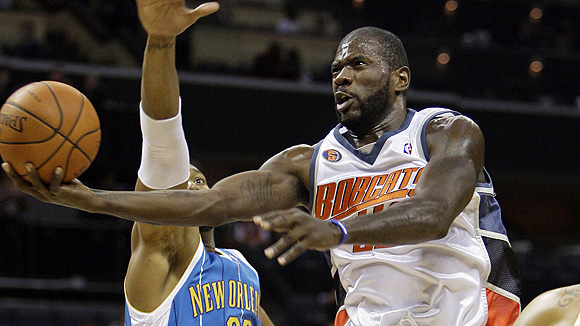
Breaking down the Jason Richarson trade

ESPN’s John Hollinger thinks that the Suns’ deal to acquire Jason Richardson is a veritable steal:

The deal for Jason Richardson, Jared Dudley and a 2010 second-round pick cost him only Raja Bell, Boris Diaw and Sean Singletary, and it immediately restores the Suns’ flagging hopes of breaking back into the West’s upper crust. Phoenix Suns GM Steve Kerr has faced a lot of questions during his short stewardship of the Suns, but the only question to ask after Wednesday’s trade with Charlotte is whether he was wearing a ski mask.

Raja Bell is not the player he was two years ago, so this trade is essentially Jason Richardson for Boris Diaw, so let’s take a look at each player’s numbers:

Richardson: 27 years-old, 18.7 ppg, 4.1 rpg, 2.6 apg, 44% FG%, 46% 3PT% (37% career)
Diaw: 26 years-old, 8.3 ppg, 3.8 rpg, 2.1 apg, 57% FG%

Since Diaw plays fewer minutes (24.5) than Richardson (35.1), it’s wise to compare their Player Efficiency Ratings as well. Richardson (16.97) is the 14th-ranked shooting guard while Diaw (13.47) is #48 amongst power forwards.

Steve Nash and Shaquille O’Neal are a little long in the tooth, so this is a “win now” move for the Suns. The trade doesn’t put them in bad shape for the summer of 2010, when they’ll have to re-sign Amare Stoudemire and try to attract another player to replace O’Neal and Nash, whose contracts expire after the 2009-10 season.

Richardson is a tremendous scorer and will fit nicely if the Suns try to push the tempo again. Currently, they are #14 in the league in pace, so with the arrival of O’Neal, and to a lesser extent Terry Porter, these are not the run-and-gun Suns that we saw under Mike D’Antoni. Even if they keep their current pace, Richardson is a good shooter and should thrive alongside willing passers like Nash, O’Neal and Grant Hill.

As for the Bobcats, I’d say that the Larry Brown Era is not off to a very good start.

Newer posts »