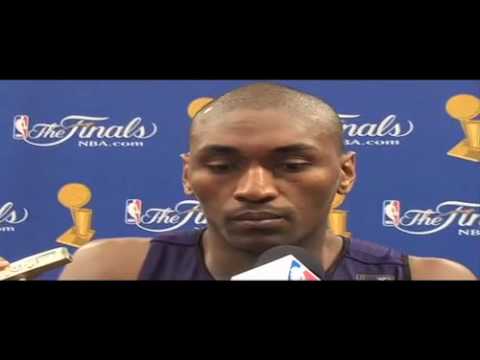
…at least not with the reporter who asked him about it.
Tag: Los Angeles Lakers (Page 15 of 48)

Look for the Lakers to use Kobe Bryant extensively on Rondo, or so says Basketball Prospectus:
There’s been some debate in the last few days about whether the Lakers will deploy Bryant or point guard Derek Fisher to defend Rondo, but to me it’s not even a question. I suspect Jackson was being coy when he told reporters that Bryant would spend some time defending Rondo. Other than the second head-to-head meeting during this year’s regular season, when Bryant was injured, the Lakers have used the same strategy against Rondo the last two years. The belief in backing off Rondo is so strong that Minnesota’s Kurt Rambis, a former Lakers assistant, even employed a similar philosophy when the Timberwolves faced the Celtics this season.
Here’s the funny thing about Rondo’s rapid development over the last two seasons: It has little to do with his shooting. According to Hoopdata.com, Rondo shot 43.0 percent on long two attempts in 2007-08, which is actually pretty good. This year, that percentage plummeted to 33.0 percent. Yes, Rondo is now a tiny bit of a threat from downtown, but really what has happened is that Rondo has learned how to work around his weakness and get into the paint anyway, creating shots for teammates and boosting his assist rate.
We certainly saw that in the game between these two teams at the TD Garden this season. Rondo was 1-of-5 on long twos, but he still shot 9-of-16 from the field and dished 12 assists thanks to his ability to get into the paint. Transition will be big for Rondo in this series, since he can create easy shots in the early offense when the Lakers haven’t yet had a chance to wall off the basket. He can also take advantage of switches that put slower defenders on him on the perimeter.
I’m not sure that Jackson and company will make a switch defensively, because the way they’ve defended Rondo brings other benefits–as Gary Collard pointed out on Twitter, Bryant doesn’t have to chase Ray Allen through screens this way, and his ability to give help can be disruptive to the rest of the Boston offense. Still, don’t expect the strategy of backing off Rondo to be nearly as effective as it was in 2008.
Rondo has a way of making teams pay for playing off of him on the perimeter. His jumper is shaky, but when his defender is off of him, it’s very difficult to box him out, which is why he’s so good at retrieving long offensive rebounds. Playing off of Rondo also allows him to get into the paint with relative ease, which puts pressure on the defense and opens up passing lanes to open shooters or to guys cutting to the basket.
With the “Big 3” all two years older, the onus for the Celtics is on Rondo. If he has a great (Finals MVP-type) series, the Celtics have a good chance of winning their second title in three years.
Photo from fOTOGLIF

WORKING IN THE LAKERS’ FAVOR
The “Big 3” are two years older. (So is Kobe, but he doesn’t look it.)
Kevin Garnett and Ray Allen are 34, and Paul Pierce is 32. They’re not over the hill, but they aren’t spring chickens, either. The way that the schedule is set up, Game 2 is on Sunday and then both teams will have to fly to Boston on Monday for Game 3 on Tuesday. There is also just one day of rest between Game 5 and Game 6. These are going to be tough turnarounds for the 30+ crowd. In terms of play, KG is playing as good as he has in the last two seasons, but he’s still not in ’08 form. After a substandard regular season, Ray Allen has played well in the playoffs. Only Paul Pierce is playing at nearly the same level as in 2008.
The Lakers have home court advantage.
Last time around, the first two games were in Boston. This time, the series starts in L.A., where the Lakers were 34-7 on the season and 8-0 in the playoffs.
They’re starting Ron Artest at SF instead of Vladimir Radmanovic and Luke Walton.
Artest may be a little crazy, but he definitely makes this Laker lineup tougher. Radmanovic, Walton and Sasha Vujacic got major minutes in ’08, but are now either gone or relegated to spot duty. We can debate Ron Artest vs. Trevor Ariza all we want, but there’s no doubt that Artest is an upgrade over the Radmanovic/Walton combo that faced the Celtics two years ago. He’ll also make Paul Pierce work for his points, which will allow Kobe to worry about Ray Allen.
They want revenge.
The Lakers were embarrassed after losing Game 6 by 39 points. Their win over the Magic last year was nice, but if they had any heart, they wanted to face the Celtics again. A win over Boston would squash any talk about how the C’s would have had a dynasty had Kevin Garnett stayed healthy.

…when the Celtics and Lakers last met in the Finals. Celtics Hub refreshes our collective memory:
The presence of Artest as LA’s starting small forward is, on its own, a large enough change to make the 2008 Finals a near-irrelevant precedent. In other words: If both rosters were entirely the same, and everyone’s skill level had remained the same, making the single change of replacing Vladimir Radmanovic with Artest as LA’s starting small forward is big enough to blow up any ‘08/’10 comparisons.
The Lakers started Vlad Radmanovic at small forward in 2008! And he wasn’t a token starter! He played 21.5 minutes per game in the Finals, shooting 39 percent from the floor and playing mediocre defense against Boston’s best offensive player.
Luke Walton played 11 minutes per game in the Finals and shot 31 percent. Trevor Ariza, who supplanted both Rad Man and Walton in ‘09, was a total non-factor, logging just 7 minutes per game in the ‘08 Finals.
Those three players, combined, logged about 40 minutes per game in the 2008 Finals. I realize those minutes sometimes overlapped, but still: Forty minutes per game.
Artest makes this Laker team a very different unit, for the better. We can argue about whether or not he was an upgrade over the less combustible Trevor Ariza, but no one is advocating for a return to the Radmanovic/Walton days.
Here is what Artest has done with Paul Pierce in their last eight meetings:
18.8 PPG, 43 percent shooting (46-of-107), 36 percent from three (14-of-39), 52 free throw attempts.
Plus, he brings a certain amount of toughness that was definitely lacking on the ’08 Lakers. It will be fascinating to watch Artest’s impact on this series.
To get you ready, here’s a link to an inside look at Game 1 of the ’08 Finals.
Photo from fOTOGLIF

Here’s another reason to hate the Lakers…
The Los Angeles Lakers have never been known as a team that takes offensive charges. They are trying to change that. Last series, Phil Jackson called his big men “thin-chested” as a way of goading them into standing strong and taking a hit, and the team has been offering financial incentive — $50 per charge.
The charge-taking competition, however, has yet to involve Ron Artest, who said he learned from growing up on the New York playgrounds, that when you take a charge, fall and then call an offensive foul, well, bad things — like serious bodily harm — can happen.
“I don’t even know how to take a charge,” he said. “To get the charge you have to fall. I’d rather not fall. You call an offensive foul, possibly be a fight. That’s just how we grew up playing basketball.”
Queensbridge!
Photo from fOTOGLIF
FOLLOW US!

CATEGORIES
© 2026 The Scores Report – The National Sports Blog
Theme by Anders Noren — Up ↑