Tag: John Paulsen (Page 7 of 10)

Five things that need to change about college basketball

Despite the rather lackluster 2009 NCAA tournament, March Madness is – historically speaking – the most exciting sporting event in the country. Still, as I watched the games this year, I noticed that a few things need changing. Here are my top five gripes about college basketball:

1. No more one-and-dones.
I understand why the NBA wants an age limit, but the one-year-out-of-high-school rule is hurting the college game. Amongst the major programs, there is little continuity season to season and it has thrown blue-chip recruiting on its head. Some of the best coaches in the college ranks are reluctant to recruit the top players because they know they’re just going to have a hole to fill the following summer.

Players should be able to declare for the draft directly out of high school. But if they decide to enroll in college, they must stay a minimum of two seasons. Typically, high schoolers that are good enough to be drafted are good enough to stick in the league. If a high schooler enters the draft (but doesn’t hire an agent), he can always pull out and enroll in school if it doesn’t look like he’s going to be drafted in the first round. This is the same rule that college players have to follow. (And yes, I realize that this is the NBA’s fault, but it’s still a problem for college basketball.)

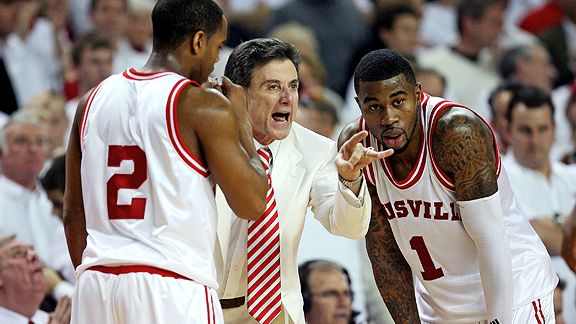
Roy, back up three feet. Your guys will be able to hear you just fine.

2. Get the coaches off the court.
One thing that drives me nuts about college basketball is the leeway that the officials give head coaches. They’re allowed to stomp around the sidelines like petulant children, throwing hissy fits anytime a call doesn’t go their way. Okay, so maybe the refs are instructed to give the coaches some slack on the proverbial leash, but that doesn’t mean that head coaches should be running onto the court to shout instructions to their teams. It seems like every game there is a near-collision between an official running downcourt and a head coach that is stepping on the sideline (or is on the court all together). I’d like to see the official call an automatic technical if he sees the coach step on the sideline – that would clean this up really quickly.

Continue reading »

Final Four Preview & Picks

The Final Four is set. Heading into the Sweet Sixteen, it looked like we might end up with three or four Big East teams heading to Detroit, but Syracuse was blown out by Oklahoma on Friday and Louisville was upended by Michigan State yesterday. So while the Big East has two teams (UConn and Villanova), both the Big Ten (MSU) and the ACC (North Carolina) are represented.

What do these four teams have in common?

They all have a good point guard — North Carolina’s Ty Lawson, Villanova’s Scottie Reynolds, UConn’s A.J. Price and Michigan State’s Kalin Lucas.

It’s often said that guard play is a key component to NCAA success, and this year’s Final Four supports that thinking. Louisville, Missouri and Oklahoma all had some backcourt issues throughout the season (and the tournament) and it’s no coincidence that they ultimately lost to teams with a great point guard.

Let’s take a closer look at each of Saturday’s games…

UCONN VS. MICHIGAN STATE

Tip-Off: 6:07 PM
Sagarin Ratings: UConn (94.40), Michigan State (89.39)
Line: UConn -4

With Hasheem Thabeet, Jeff Adrien and Stanley Robinson, UConn might have the most imposing front line in the country. Thabeet averages 4.3 blocks per game, while Adrien and Robinson are two strong forwards who can score inside and rebound like crazy. A.J. Price anchors the backcourt, but the lightning-quick freshman Kemba Walker is the reason the Huskies survived a scare against Missouri. The Huskies are deep and talented, and other than a few minutes against Purdue and Mizzou, they have looked dominant and focused.

The wild card with this UConn team is how they handle the recruiting scandal of Nate Miles. It’s going to be interesting to see if the media presses the issue or if Jim Calhoun is successful in pushing off any further inquiry until after the tournament. Will the press take “no comment” as an answer? When a program is under attack, there is usually a “circle the wagons” mentality within a locker room, and depending on the makeup of the roster, it can bring a group of players even closer together.

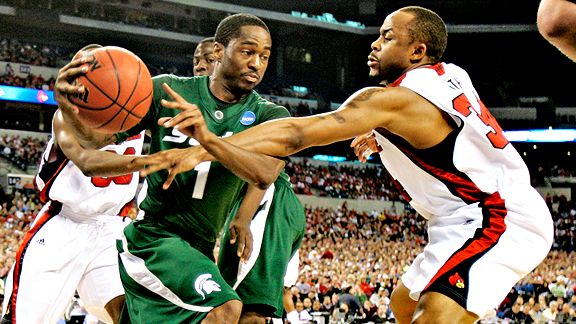
On the flip side, the NCAA tournament has been a pleasure for the Michigan State Spartans. I didn’t think they had the firepower to make it to the Elite Eight, much less the Final Four, but this team has something that many others don’t — chemistry. Every player knows his role but doesn’t shy away when he is asked to make a play. They have the Big Ten POY in Kalin Lucas and group of guys willing to the little things like defend and rebound. The Spartans are an interesting matchup for UConn because of 6’10” center Goran Suton. Since he can hit the long ball, he should be able to pull Hasheem Thabeet out away from the basket, limiting his shot blocking. UConn may counter by putting Robinson or Adrien on Suton and letting Thabeet defend one of Michigan State’s forwards that isn’t a good shooter like Raymar Morgan or Draymond Green.

The Spartans are particularly adept at pulling up in the lane and hitting the 8- to 15-foot jumper which will be crucial if they hope to score consistently on the Huskies. It’s nearly impossible to take it to the rim when Thabeet is in the game, but the middle of the lane is usually pretty open since the Husky defenders are taught to feed their man to Thabeet. Defensively, the Spartans have shown the grit and effort necessary to stay with more talented foes, so Michigan State should be able to keep this one close. I don’t like the line, and I think UConn will ultimately triumph, but this has a good chance to be a game that is nip and tuck down the stretch. It doesn’t hurt that the Spartans will be playing about 75 miles from East Lansing. I’d expect a decent home crowd, though it’s tough to get any kind of home court advantage at the Final Four.

Continue reading »

Bracket update and Sweet Sixteen preview

Those of you that followed my picks, or at least leveraged my analysis to some extent, should find that you’re still alive in your pool. Unless, of course, your pool is so big that even if all of your picks come in, there is someone who’s already ahead of you that has predicted the same outcome.

I’m in three moderately sized pools – 26, 31 and 105 brackets – and I’m still very much alive in each one. Essentially, I need to get three of my Final Four picks – Pitt, UConn, Louisville and Gonzaga – to come in, and Pitt needs to win it all. Granted, with the way the Panthers are playing (and the Bulldogs, to a certain extent), I don’t feel great about my chances, but I’m still alive and that’s all you can ask for. If I had it to do all over again, I think I’d take UConn to win it all. They have been by far the most impressive of the top seeds. Still, if I’m right and it’s a Pitt/UConn final, you have to like the Panthers’ chances after already beating the Huskies twice this year.

If you’ve been following our coverage, you’ll probably know that the 2+ point Sagarin favorites got off to a rough start in the first round (21-8, or 72%). Normally, this system hits at about an 85% rate, so it makes sense that it bounced back in a big way (12-0) in the second round, making it 33-8 (80%) through two rounds. (Keep in mind, even though the Sagarin ratings change throughout the tourney, I’m sticking with the pre-tourney ratings when calculating overall records because that’s all we have to go by when we’re filling out our brackets.)

The Kansas/West Virginia game was a tough call, but I sure didn’t think that the Mountaineers would lose to Dayton. Since I entered three pools, I picked Kansas in one pool to go to the Elite Eight instead of West Virginia, and needless to say, my margin for error is a bit wider in that bracket.

But enough about my brackets – let’s move on to the preview of the Sweet Sixteen. I’ll give my thoughts on each of the eight games, provide some statistics and maybe recommend a wager or two for the gamblers out there. Any Sagarin stats I refer to from here on out are the updated numbers, because I’m going to try to predict the future instead of measuring the past.

THURSDAY’S GAMES

#5-seed Purdue vs. #1-seed UConn (in Glendale, AZ)
Tip-Off: 7:07 PM ET
Sagarin Ratings: UConn (93.81), Purdue (87.70)
Line: UConn -6.5

The Boilermakers got off to a great start against Washington and held off a late run with some solid defense. Meanwhile, UConn has coasted, outscoring their two opponents 195-113. The Huskies will be challenged in this game because Purdue isn’t going to give up. They’re going to keep coming at you, so if you don’t stay focused for 40 minutes, you may be in trouble. But the bottom line is that UConn has more talent, and they should be a six- or seven-point favorite. Purdue’s best bet is to run an effective pick-and-roll, which is a good way to pull Hasheem Thabeet away from the basket and potentially get him into foul trouble. Thabeet will probably be covering JaJuan Johnson, so if he screens for E’Twaun Moore 20 or 30 times over the course of the game, the Bollermakers might be in business. The Sagarin difference and the line are about the same, so I wouldn’t recommend putting any hard-earned dollars on this game. UConn should be able to pull this one out, but unless the Huskies run them off the court, Purdue should have enough grit to keep it close.

Continue reading »

Filling out your bracket? I’m here to help. (Updated 3/18)

3/18 Update: I’ve modified a few picks with the news that Ty Lawson may not be able to go tomorrow because of the injury to his toe. This news casts serious doubt about just how healthy he can get over the next three weeks, and I no longer see North Carolina as a Final Four team. I have modified my picks so that North Carolina loses to Gonzaga in the Sweet Sixteen. I project the Bulldogs to go on and beat Syracuse in the Elite Eight, which means that Gonzaga is now one of my Final Four teams. (I know, I can’t believe it either.)

This column is dedicated to the millions of Americans that will be filling out their March Madness brackets over the next few days.

You might be thinking — why should I bother listening to this joker?

Well, this is the third time that I’ve written this column and in the previous two seasons (2007, 2008), I successfully picked the winner both times.*

* Past performance is no guarantee of future results.

I’m still tweaking my method, but the crux of it is simple: Start with Jeff Sagarin’s computer rankings and go from there. Over the past two seasons, teams that had a 2+ point advantage in Sagarin’s “Predictor” category went a combined 82-15 (85%). That’s a good place to start. Even when the teams are closely seeded (within 1-3 seeds), Sagarin’s ratings are solid. Last year, in games that were closely seeded, teams with a 2+ point Sagarin advantage went 14-2 (88%). In 2007, they went 8-4 (67%). So over the last two seasons, that’s a combined 22-6 (79%). Not bad.

LOCATION

Last year, there were five games where tight (< 2 point) Sagarin matchups were won by teams with a distinct location advantage. Davidson beat Gonzaga in Raleigh, Mississipi State beat Oregon in Little Rock, Kansas State beat USC in Omaha, Stanford beat Marquette in Anaheim and Texas beat Stanford in Houston. In fact, there weren’t any tight matchups that were won by the team that was at a distinct geographical disadvantage. This year, I am going to make this my first tiebraker for tight Sagarin matchups.

SEED DIFFERENTIAL

Seed differential is also a consideration, as teams with a four- to nine-seed advantage win at about a 75% clip. The data for the previous 16 seasons was compiled by BostonSportsHub, but since they are no longer updating their site, I added the seed records for the 2008 tournament. Here is a summary of the 17 years worth of data.
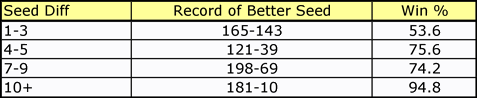
So if Sagarin calculates that the teams are within two points, and there are no geographical considerations, then the next thing I look at is seed. If the differential is four or more, I am going with the better-seeded team barring some overriding factor. In 2008, this methodology was 2-1, winning the Oklahoma/St. Joseph and Purdue/Baylor matchups, while losing the USC/Kansas St. matchup. (Interestingly, all three winners had a slight advantage according to Sagarin, even #11-seed KSU.) Had I gone with KSU’s location advantage, this part of the system would have gone 2-0.

POMEROY RATINGS

Last season, I used Points Per Shot (PPS) to pick seven games and went 3-4. I still believe that PPS is a vital stat, but it doesn’t take into account turnovers, which is key when trying to determine just how good a team is. Ken Pomeroy has offensive and defensive efficiency stats that take into account pace and strength of schedule, and those are compiled to calculate his Pythagorean Winning Percentage.

Here’s how the last few winners were ranked at the end of the tournament in this statistic: Kansas (1), Florida (2), Florida (1), North Carolina (1) and Connecticut (2). Clearly, when picking the overall winner, we don’t want to stray too far from this ranking.

Let’s take a look at the Final Four participants for the last five years and see how they finished, keeping in mind that their final ranking does take into account how they performed during the tournament.

2008: Kansas (1), Memphis (2), UCLA (3), North Carolina (4)
2007: Florida (2), Ohio St. (4), Georgetown (5), UCLA (6)
2006: Florida (1), UCLA (3), LSU (10), George Mason (23)
2005: North Carolina (1), Illinois (2), Louisville (5), Michigan State (7)
2004: UConn (2), Georgia Tech (7), Duke (1), Oklahoma St. (3)

So, excluding the outlier (George Mason), the average Pythagorean ranking for Final Four teams over the last five years has been 3.6. I wish the site showed the pre-tourney rankings, because it would be helpful to know where these teams were ranked when they started the tournament. Since all we have to go by is where they stand now, it would seem unwise to pick a team outside of the top 10 to reach the Final Four.

I used the Pythagorean method back in 2007, and through the second round of the tournament, it had picked 37 of 48 winners. I stopped using it at that point, and I’m not sure why. This year, I’ll keep track of its accuracy throughout the end of the tourney, though I think it’s important to use the static, pre-tourney rankings because that’s all we have to go by when we fill out our bracket.

We’ll see how much I use this statistic as we dig into the bracket.

So, without further ado…

Continue reading »

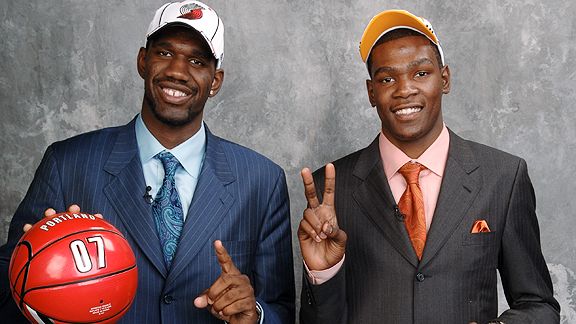
How much better off would the Blazers be had they drafted Durant instead of Oden?

No one can fault the job that Portland GM Kevin Pritchard has done so far. In 2005, when he was the Blazers’ interim coach, he reportedly advised then-GM John Nash and Steve Patterson to draft Chris Paul at #3, but the duo instead decided to trade the pick and ended up with Martell Webster at #6. He was promoted to assistant GM in 2006, and was involved in a series of deals that resulted in the acquisition of the draft rights of Brandon Roy and LaMarcus Aldridge. In 2007, he was promoted to general manager. That summer, in addition to drafting Greg Oden, he turned Zach Randolph into a trade exception that he used to steal Rudy Fernandez from the Phoenix Suns.

Other than an ill-advised threat to sue anyone that tried to sign Darius Miles, it’s tough to second-guess anything that Pritchard has done in Portland.

But what if he had drafted Kevin Durant instead of Greg Oden? How much better off would the franchise be with Durant on the roster?

Continue reading »

« Older posts Newer posts »