Tag: Heisman Trophy (Page 3 of 3)

Athlete Profile: Tim Tebow

Heisman Trophy winner Tim Tebow loves the attention he receives once he makes his way out of a tunnel and onto an opponent’s field, he wants to draw all of the ire from the opposing fans, and let his teammates concentrate on winning the football game.

So go ahead yell, scream obscenities, or make imaginative signs about his homeschooled education. It’s all been done before and none of it bothers Florida’s star quarterback.

Tebow credits his religious upbringing as being the base to give him the inner strength needed to lead on the football field. His parents wanted to instill deep Christian beliefs into the lives of their children, and decided a homeschooled education was their only option.

Bob and Pam Tebow met at a Christian student group meeting on the University of Florida campus in the 1960’s. Together, they wanted to spread the message of their faith as far as humanely possible, and after graduation, the Tebows established a Christian organization to fulfill their passion.

One of their many endeavors throughout the world was creating an orphanage in the Philippines. Last spring, Tebow traveled there with his parents to spend time with the orphans, speak about his faith, and assist the medical staff with certain procedures. The family motto is simple: The Lord has everything under control, and he will take care of the Tebows.

Before 1996, no attendance in either public or private school meant no participation in athletic events or being a member of a sports team sponsored by the school. But all that would change.

Legislation was passed in Florida allowing homeschooled students to participate in local high school sporting events. The law specifies a student is eligible only for teams in their residential school district.

The Tebows lived in the Jacksonville area of Florida, and Tim began his football career as a linebacker/tight end for a local Christian Academy in town. After the season, Tebow let his parents know that he preferred to play at the quarterback position.

His parents decided to assist their son in fulfilling his goal of becoming a high school quarterback. Tebow’s mother packed their belongings and moved them to an apartment complex closer to Nease High School, which was known for their passing game.

All it took was spring practice for Tebow to begin turning the heads of the Nease coaching staff. And before he was done with high school, Tebow would lead Nease to a state title, be named Florida’s “Mr. Football,” and a Parade All-American. His high school career numbers are staggering, as Tebow threw for 9,810 yards, 95 passing touchdowns and rushed for an additional 3,186 yards with 62 rushing touchdowns.

He wanted to remain open-minded in the college recruiting process, despite his family ties to the University of Florida. Tebow enjoyed his meeting with then-Alabama head coach Mike Shula, as they discussed how his talents would be used in the Crimson Tide offense. But in the end, he chose the Gators because of Urban Meyer’s spread offense, an offense perfectly designed to exploit Tebow’s talent at the quarterback position.

The Gator coaching staff wanted to utilize Tebow as a dual threat from the quarterback position, and he did not disappoint them in his collegiate debut as he scored a rushing touchdown. Tebow’s biggest game of his freshman season would come against SEC rival LSU Tigers, as he accounted for all three Gator touchdowns. Tebow also debut his patented, jump in the air and double-pump his throwing arm before releasing the ball pass in this game. His contributions as a key reserve seemed to be the spark plug needed to elevate Florida to a national championship, the Gators first since 1996.

Meyer named Tebow to the starting quarterback position prior to the start of spring practice for the 2007 season. But questions lingered around the program if he was ready to take on the position full-time or was Tebow simply a gimmick item from the Gator playbook. He silenced his critics immediately in his first game as Florida’s quarterback by throwing for over 300 yards and three touchdown passes. By season’s end, he became the first sophomore ever to be named a Heisman Trophy winner.

How did he do it? Simply put, his first campaign as a full-time quarterback was record-breaking. Tebow finished the season by throwing for 3132 yards with 29 touchdown passes, while running for 838 yards and scoring 22 rushing touchdowns. He is the first collegiate football player to rush and pass for 20 touchdowns in a season; and his combined 51 touchdowns were more than 87 D-1-A teams total touchdowns scored in the season. He became the third Gator in history to win the Heisman (Steve Spurrier and Danny Wueffel).

Coming into this season, Tebow understands he has a target on his back, and to keep his edge, he will have to put the time and effort on and off the practice field to be ready for game day.

Tebow on the Web

Tim Tebow Wikipedia Page

Wikipedia page; contains short bio, career stats, and external links

Tim Tebow Fan Club Page
Fan club official page; contains short bio, stats, and link to recent video highlights

Tebow’s News and Commentary

Tim Tebow says ‘sorry’ after Ole Miss stuns Gators
Tebow apologizes to the Gator faithful on his poor performance against Ole Miss

Tim Tebow Heisman Watch
See how Tebow is fairing in a weekly mock Heisman Trophy poll

Tebow Says

Tebow discusses his inner feelings following a tough defeat in SEC conference game:

”Good will come out of this,” Tebow said. “You have never seen any player in the entire country play as hard as I will play the rest of the season, and you will never see someone push the rest of the team as hard as I will push everybody.”

Tebow after winning the Heisman Trophy last season:

“I am fortunate, fortunate for a lot of things,” Tebow said. “God truly blessed me and this just adds on. It’s an honor. I’m so happy to be here.”

Why isn’t MSU’s Javon Ringer getting more Heisman love?

Javon RingerRunning back Javon Ringer carried Michigan State to a 23-7 victory over Notre Dame in East Lansing on Saturday. And he did it almost single-handedly, rushing for 201 yards on a whopping 39 carries and also scored two touchdowns.

Ringer’s 200-yard day was his second in as many weeks after rushing for 282 yards in a 17-0 win over Florida Atlantic last Saturday. So far on the season, he has totaled 699 yards on 143 carries and 11 touchdowns.

So why aren’t we hearing his name mentioned more for the Heisman? Entering this week (as in, before his 201-yard effort against Notre Dame) only Navy’s Shun White and Connecticut’s Donald Brown had more rushing yards than Ringer. And no back had as many touchdowns. Yet oddsmakers currently have Ringer has a 20/1 long shot to win college football’s most prestigious award.

Playing for Michigan State doesn’t help, but Ringer deserves more attention than he’s getting. And as previously noted, he has been the backbone of the Spartans’ offense and often carries them to victories. While he doesn’t have the size of OSU’s Beanie Wells, Ringer has a thick lower half and runs hard between the tackles. And anyone who has watched him over the past couple weeks and throughout his career knows how explosive he can be. He also benefits from his small stature, because defenders lose him behind MSU’s big offensive line.

It’ll be interesting to see how Ringer fares later in the season against better Big Ten defenses like Ohio State, Michigan, Wisconsin and Penn State. If he can continue to turn out 150-plus yard games, he’ll definitely turn some voters’ heads. (If he hasn’t already.)

Athlete Profile: Chris “Beanie” Wells

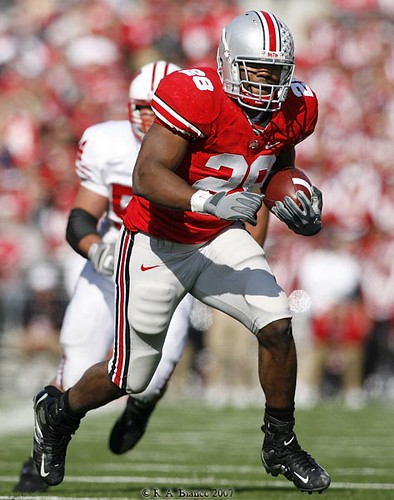
Chris For someone who stands 6’1” and 235 lbs., Chris “Beanie” Wells rushes with the speed of a 100-meter sprinter and the finesse of a rhythm gymnast. He’s able to see the tiniest of pockets in a defensive line, or seems to have a sixth sense for where they’ll open up. After using this intuition to map his route, he exploits his opposition’s vulnerability like no other. He spins out of tackles using his craftiness, burrows through them with his strength, and gathers extra yardage with his exceptional speed.

Wells once told his father that he wanted to be the first freshman to win the Heisman Trophy. Though this did not come true, Wells was a true freshman in his first year at Ohio State, playing in all 13 games. Even though he was just one player on a talented offense, Wells still finished second on the team in rushing with 576 yards on 104 carries.

By his second year, the spotlight was officially on Wells, and he was voted Most Valuable Player by his teammates. Wells rushed for 1,609 yards and 15 touchdowns, which ranked him fourth among all-time OSU single-season running backs and first among sophomore rushers.

But a memorable 38-24 loss to LSU in the 2008 BCS title game still haunts Wells and the Ohio State campus. In his third (and likely final) college season, Wells is projected by many to win the Heisman. Along with quarterback Todd Boeckman and an outstanding defense, Wells is expected to lead the Buckeyes to yet another BCS national championship.

An Ohio boy through and through, Wells was raised by his parents in Akron, Ohio along with his ten siblings. Ohio State was always the first choice for Wells, who was scouted by many prestigious schools after his time at Akron Garfield High School. It’s only been two years at OSU, but former Buckeye and two-time Heisman Trophy Winner Archie Griffin is already comparing “Beanie” to Jim Brown.

Obviously, this young man has boundless potential. If he can get over his nagging ankle and wrist injuries, he’ll likely fulfill it.

Wells on the Web

Ohio State Buckeyes: Official player page for Wells
Find career stats, highlights and a bio on Wells at OSU’s official player page.

ESPN.com player profile page for Wells
Find game by game stats, scores and a small bio on Wells at ESPN.com.

Rotoworld player page for Wells
Check out all the latest player news on Wells at Rotoworld.com.

The best Chris Wells fansite
A fansite dedicated to Chris “Beanie” Wells.

Latest on Wells

Wells will return for his junior year at Ohio State. Based off his phenomenal sophomore year— rushing for 1,609 yards and 15 touchdowns—he is a likely candidate to win this year’s Heisman Trophy.

News and Commentary


Sports Illustrated.com: 2008 Heisman candidate breakdown

SI.com expects Wells to be among one of the leading vote-getters for the Heisman in 2008.

Is Wells the next Jim Brown?
The Cleveland Plain-Dealer discusses whether or not Wells is the next Jim Brown, a legendary runner for the Browns.

Beanie says ankle injury nothing to worry about

Even though Wells is expected to compete for the Heisman Trophy in 2008, he does have a history of injuries.

Wells Says

On his nickname

“I got the nickname because when I was a baby, I came out and my big brother said I had a bean head.”

On Americans being fed up with Ohio State

“We don’t have to prove ourselves to anyone. We just go out there, play our game, and move on.”

On Archie Griffin comparing him to Jim Brown

“It’s just incredible to even be mentioned in the same sentence as Jim Brown, let alone have Archie Griffin, a two-time Heisman Trophy winner, say it.”

On how often he thinks about winning the Heisman

“All the time.”

NFL Player Profile: Eli Manning

Eli ManningGrowing up in the shadow of a famous father can be overwhelming for a child, and the challenge of following the footsteps of an older sibling can also be harmful for a kid’s ego. Then, there is Eli Manning’s childhood; his father (Archie Manning) was a football hero in the Deep South and his brother (Peyton Manning) is the advertising face of the NFL with countless commercials. And all he does is become the MVP of Super Bowl XLII, in which he led the New York Giants to an upset victory over the previous undefeated New England Patriots.

While having a successful senior year as a high school football player, Manning was still undecided on which university to attend in the fall. That changed after receiving a call from David Cutcliffe. The Manning family was familiar with him, as Cutcliffe was offensive coordinator at the University of Tennessee, and helped older brother Peyton elevate his overall game. He was named Head Coach of the University of Mississippi football team, and was hoping Eli Manning would become his first prize recruit in rebuilding the Rebel program. Upon hearing Cutcliffe’s recruiting pitch; Manning followed his father’s footstep, and became starting QB at Ole Miss.

Manning’s collegiate career was a lot like his personality: quiet but successful. He set or tied 45 single-game, season, and career records at Ole Miss. In his senior year, Manning won the Maxwell Award as the nation’s best all-around collegiate player, the Johnny Unitas Golden Arm Award, and finished in third-place for the 2003 Heisman Trophy Award behind eventual winner Jason White, quarterback of Oklahoma, and University of Pittsburgh wide receiver Larry Fitzgerald.

All the draft experts projected him to be the first overall pick of the 2004 NFL Draft but there was one hitch – Manning did not want to play football in San Diego, and formally sent a letter to the Chargers requesting them not to choose him in the draft. Despite his request, the Chargers drafted Manning with the first overall selection. Subsequently, he was traded on draft-day to the Giants in return for fourth overall pick quarterback Philip Rivers, a third-round selection (kicker Nate Kaeding) in the 2004 Draft, as well as the Giants’ first (linebacker Shawne Merriman) and fifth-round choices in the 2005 NFL Draft.

Manning sat for the first half of his rookie season, as veteran quarterback Kurt Warner tutored him. Then, Head Coach Tom Coughlin decided to start Manning for the second half of the season, as he wanted him to gain NFL experience. Manning’s lone bright spot in his rookie season was a last-minute touchdown drive to defeat arch-rival Dallas Cowboys, which ended the Giants’ eight-game losing streak.

He started off the 2005 season undefeated, but Manning’s big test would come in Week 3 – a road date with San Diego. Charger fans did not forget the snub from Manning, and they repeatedly booed him throughout the contest. The Chargers won the game, 45-23, but Manning played his most impressive game to that point of his career, going 24 of 41 for 352 yards and two touchdown passes. He went on to lead an offense that ranked third in the NFL in scoring with a total of 442 points (the most points scored by a Giant team since 1963). But passing efficiency was Manning’s lone drawback, as he completed only 53 percent of his passes and his QB efficiency rating suffered as well, with an unimpressive 75.9 rating that ranked 23rd in the league. Manning also seemed to wear down as the season progressed, culminating with a poor post-season performance against the Carolina Panthers.

His second full season as a starting quarterback was reminiscent of his prior campaign, starting off strong but declining in production toward the end of the season. His overall numbers were an improvement, as Manning had a five point improvement in his completion rate, but still ranked 18th in the league in QB efficiency. Many perceived him to be a solid QB, but not in the class of other young quarterbacks from his draft class like Rivers and Ben Roethlisberger of the Pittsburgh Steelers.

Determined to rebound in 2007, Manning trained in the off-season to perfect his timing and chemistry with the Giants’ leading receivers, wide receiver Plaxico Burress and tight end Jeremy Shockey. He opened the season with an outstanding performance against the Cowboys, throwing for over 300 yards and two touchdown passes in the game. But once again his production diminished toward the end of the regular season. Giants’ co-owner John Mara challenged him to rebound and lead the team on a successful playoff run, which he did, bouncing back with an exceptional performance in a lost to the Patriots in the final regular season game.

Then came a playoff run to dwarf all other playoff runs in modern sports history. It began with a convincing victory over the Tampa Bay Buccaneers, followed by an upset victory over the heavily-favored Cowboys, and a Super Bowl berth was secured by an improberable overtime victory in Green Bay.

Then in front of a record-setting television audience, Manning directed a late fourth quarter touchdown drive to defeat the Patriots. He became the second QB to throw two go-ahead TD passes in the fourth quarter of a Super Bowl (Joe Montana being the first). The Giants became the first team in league history to win eleven road games in one season. And the Manning’s became the first set of brothers to win successive post-season MVP honors in all of professional sports.

Manning on the Web

New York Giants Player Bio: Eli Manning
Team’s official page; contains short bio, stats, and link to recent video highlights

Eli Manning Wikipedia Page
Wikipedia page; contains short bio, career stats, and external links

Manning’s News and Commentary

Unflappable Manning lets instincts take over
Complete overview of Manning’s Super Bowl performance

Book by News writer looks at Eli Manning & David Tyree’s Super play
Manning gives his view on the 2007 season

Manning Says

Manning reacts to his part of “the Catch” to WR David Tyree:

“Just trying to avoid the sack,” Manning explained. “I felt people grabbing me. You try to get small sometimes and keep the play alive.”

Manning discusses his philosophy on playing in the third pre-season game on the schedule:

“This is the one that is most game-like,” Manning said. “You’re going to play a whole half and you usually come out in the second half and play that first series, where you really try to go out there and be sharp and make sure everybody’s on the same page. You’re making plays. You’re not having the mental mistakes. And you’ve put all that behind you and you’re out there executing the game plan well.”

Newer posts »