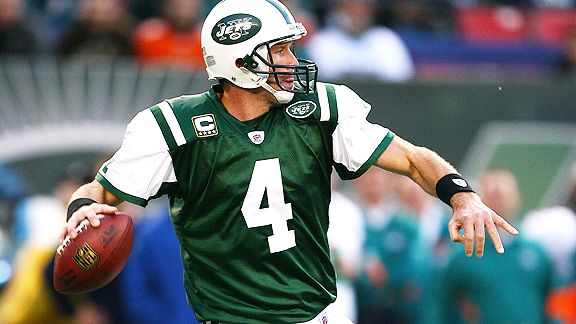
Tag: Brett Favre (Page 44 of 64)

New Bang! Cartoon: Offseason TV Guide

If you’ve never seen Al Davis rap, you’re going to want to check out the latest ‘toon by the guys at Bang! Cartoon because it might be their best to date. Aside from handing Al the mic, Bang! also checks in with the Bengals as they prepare for HBO’s latest edition of “Hard Knocks” and have an update on Brett Favre and “Retirement III.”

ESPN disputes Favre surgery story

On Monday, the St. Paul Pioneer Press reported that Brett Favre would have surgery at the end of the week to repair a tear in his right biceps so that he could eventually sign with the Vikings. But ESPN.com’s Ed Werder is disputing that claim and says that Favre doesn’t want to have surgery.

Favre, however, remains focused on non-surgical options, including cortisone injections and natural movements like light throwing and bicep curls that might cause the tendon to release naturally, the source told ESPN. If the tendon releases and the pain subsides, Favre is virtually certain to play again. If he has surgery and his arm strength diminishes or the pain remains, he will remain retired, the source said.

At 39, Favre believes the less he has to do to correct the problem the better as he believes he still possesses the arm strength he had 10 years ago. The difference now is the injury is causing pain. According to the source, Favre will return to the NFL to play for the Minnesota Vikings if the tendon ruptures and it makes him pain-free. If he submits to arthroscopic surgery and it fails to resolve the problem, then Favre intends to remain retired.

Either way, Favre is losing patience, causing the source to say the shoulder problem must be overcome soon or Favre is likely to abandon his effort to play a 19th NFL season.

It’s past the point where we should question anything the St. Paul Pioneer Press reports about Favre. It’s almost becoming second hat that when they report something, it’s going to be disputed the next day by a major media outlet, although ESPN did take the bait yesterday in regards to this story, because they linked to the St. Paul Pioneer Press’ Favre-surgery report themselves.

It’s getting harder and harder to decipher whether or not Favre will play next year. One moment it looks like he’s doing everything he can to return, and the next it looks like he’ll stay retired. The key hurdle seems to be his health and whether or not he can play without having surgery. In the end, maybe he’ll throw his hands up to the situation and stay retired after all.

Report: Favre to have surgery on biceps

According to a report by the St. Paul Pioneer Press, Brett Favre is scheduled to meet with Dr. James Andrews to discuss having a procedure done to repair his torn right biceps tendon.

Surgery to release the tendon is considered routine and is expected to be performed by Andrews later this week. Rehabilitation for Favre would be six to eight weeks.
If it goes well, Farve, who will turn 40 in October, is expected to sign with the Minnesota Vikings.
Favre missed a scheduled appointment with Andrews last week.

The torn biceps tendon is one of several sources of pain in Favre’s shoulder, but could be the most correctable. If cutting the biceps tendon doesn’t eliminate the pain, Favre would have to consider whether other more complex surgical procedures are worth undergoing. That could hinder chances of him signing with the Vikings.

The St. Pioneer Press has been hit and miss with its Favre coverage so far, but ESPN.com cited the same story so there might be some truth to this.

What’ll be interesting to see is if Favre does have the surgery, will the Vikings sign him before they see him throw? That would be a ridiculous notion, but maybe they already have an agreement in place that if he has successful surgery, they’ll sign him no matter what. I would have to imagine that the Vikings would want their doctors to check him out before they sign him, but who knows. Favre seems hell bent on playing and if the Vikings are hell bent on signing him, then there might be nothing stopping him from donning purple and white next season.

The current (sad) state of card collecting

Thanks to Big League Stew, I stumbled upon this little eight-minute documentary about modern-day card collecting. Anthony Stalter watched it as well, so we’re going to discuss how card collecting has changed throughout the years.

John Paulsen: For me, card collecting started with basketball. I was never really into baseball as a kid (mostly because my dad preferred basketball and football, which he played in college), so my focus was on other sports. I had some old Topps football and basketball cards from the late ‘60s and ’70s, but I don’t really remember how I acquired them. Basketball cards were defunct for a while — Michael Jordan’s “real” rookie card could only be found in a regional set produced by Star — and once the mid-90’s hit, the NBA’s popularity blew up, so did the prices of those Star sets from the ’80s. I got into collecting for two reasons: 1) because I liked basketball (and to a lesser extent, football) and 2) I thought it was an investment that I could someday pass onto my son to teach him about the history of the sport (and about investing). Unfortunately, by the time I had some real money to spend on cards (when I was in college), the basketball card industry was so saturated with all the different brands and sets. Instead of going out and buying one or two rookie cards of your favorite player, now there’s 10 or 15 or more amongst all these different brands. The old rookie cards are iconic. I can still picture the first cards for Magic Johnson and Larry Bird, as well as Jordan’s Star rookie and his Fleer rookie, which came a few years later. With so many different brands/lines floating around, rookie cards have lost their appeal. The whole industry has lost its appeal for me, which is depressing because I probably have a few thousand cards stored under my bed that are worth a fraction of what they were 15-20 years ago. I was more of an individual card buyer than a pack or a box buyer. I bought a few packs and boxes in my day, but all those “commons” seemed like a waste. Anthony — how did you get into collecting and what do you think of the industry today?

Continue reading »

« Older posts Newer posts »