Tag: Barry Bonds steroids (Page 5 of 6)

Strawberry has a book coming out…this should be good.

Instead of being a public advocate of the dangers of drugs and alcohol, former baseball star Darryl Strawberry has decided to write a book to gloat about how much cocaine and sex he had when he was a player.

Darryl StrawberryStrawberry has a new book coming out in April, and something tells me his ex-teammates aren’t going to appreciate the contents much. Strawberry’s claims about all the cocaine they did and the women they had sex with — sometimes during games — probably won’t sit well.

“We were the boys of summer. The drunk, speed-freak, sneaking-a-smoke boys of summer,” writes onetime home-run legend Darryl Strawberry in “Straw: Finding My Way,” out in April from Ecco. “[An] infamous rolling frat party . . . drinking, drugs, fights, gambling, groupies.”

Beer “was the foundation of our alcoholic lifestyle,” he writes. “We hauled around more Bud than the Clydesdales. The beer was just to get the party started and maybe take the edge off the speed and coke.”

The team’s mantra on the road, he writes, was to “tear up your best bars and nightclubs and take your finest women . . . The only hard part for us was choosing which hottie to take back to your hotel room. Lots of times you . . . picked two or three.”

Then there are these little tidbits about how the Mets would kill time between innings.

Although he doesn’t name names, Strawberry relates how team members picked out girls from the stands for quickies. He once watched a pitcher march a frisky fan to a private room for oral sex: “I was jealous. When I saw her heading back to her seat, I gave her a sign. She smiled, turned right back around, and met me in that same little room . . . I had to be quick and run back out on the field.”

Another time, “I was in the clubhouse, having one last quickie with this cute little Florida girl. Charlie Samuels, the equipment manager, came in and caught us. He just stood there shaking his head while I finished up.”

But, hey, at least they weren’t taking steroids right? That might give them a competitive advantage. All cocaine does is give you superhuman strength and help you ignore any pain you might be feeling. Steroids don’t do any of that.

Great point. So what’s worse, players that are all roided up or the ones who were all hopped up on cocaine and doing unpaid whores in between innings?

The majority of fans just shake their heads and move on when it comes to guys like Strawberry and Dwight Gooden doing cocaine. But Alex Rodriguez, Barry Bonds and Mark McGwire are “ruining the game we love” and should be despised. To me, whether morons like Strawberry and Gooden are doing cocaine or cheaters like A-Rod and Bonds are doing steroids, it’s all the same – they should be lumped up in the same category of players that have helped ruin baseball. (And no, I’m not naive to think that some players today aren’t doing hard drugs or the same things Strawberry was doing back in the day.)

If parents needed any more reason not to allow their kids to worship athletes, idiots like Strawberry should do the trick. Outside of guys like Kurt Warner, Warrick Dunn, Derek Jeter and a few others, I would highly stress parents to point their kids in another direction when it comes time for them to start having role models.

Is A-Rod pulling a fast one on everybody?

Let’s take a moment and reflect on this Alex Rodriguez-steroid situation for a moment, shall we? Let’s take a step back and really examine what has transpired over the past couple days.

On Saturday, SI.com ran a report that A-Rod tested positive for steroids when he was a member of the Rangers in 2003. The only response Rodriguez gave to the report was, “You’ll have to talk to the union” and “I’m not saying anything.”

That was smart – he might as well give himself some time to plan his next move before he started digging a deeper hole for himself.

So on Monday, A-Rod phones ESPN.com’s Peter Gammons and admit he did in fact use steroids and that SI.com’s report is true. (By the way, I find it kind of humorous that instead of going to SI.com, he went to ESPN since the former was the one that had a hand in outing him.)

“When I arrived in Texas in 2001, I felt an enormous amount of pressure, felt all the weight of the world on top of me to perform, and perform at a high level every day,” Rodriguez told ESPN’s Peter Gammons in an interview in Miami Beach, Fla. “Back then, [baseball] was a different culture. It was very loose. I was young, I was stupid, I was naïve. I wanted to prove to everyone that I was worth being one of the greatest players of all time.

“I did take a banned substance. For that, I am very sorry and deeply regretful.”

“To be quite honest, I don’t know exactly what substance I was guilty of using,” Rodriguez said.

“Overall, I felt a tremendous pressure to play, and play really well” in Texas, the New York Yankees third baseman said. “I had just signed this enormous contract I felt like I needed something, a push, without over-investigating what I was taking, to get me to the next level.”

“It’s been a rough 15 months here for me,” Rodriguez said. “I was stupid for three years. I was very, very stupid.”

He also said: “The more honest we can all be, the quicker we can get baseball [back] to where it needs to be.”

There are a couple of things we can take from A-Rod’s discussion with Gammons and ESPN. One, regardless of what you think of him, Rodriguez has more balls than Barry Bonds, Roger Clemens, Mark McGwire, Sammy Sosa, Rafael Palmeiro and every other player that knowingly took steroids and either denied it or tap danced around the subject in order to save face. He got caught red-handed and decided to fess up. If nothing else, I give him credit for stepping up and being a man about being caught.

But his argument that he didn’t know what substance he was guilty of using is complete bull.

Why do athletes continue to treat fans like brainless idiots? Some athletes hire professional chefs to cook their meals every day. Some athletes have professional trainers to construct detailed workout regimens for them every day. And some athletes have professional dieticians so they know what foods and supplements would be best for their bodies.

So we’re supposed to believe that athletes like A-Rod would spend money to hire all these people to help them live healthier lives, yet they don’t know what’s going into their bodies? Come on. I read the bottle of aspirin twice just to make sure I take the correct dosage when I have a headache. And these athletes are saying that they don’t what kind of steroid they were about to take and what kind of side effects could come with it? Not a chance.

Alex RodriguezPerhaps the bigger issue in A-Rod’s apology is what he used as an excuse. He talked about being “young”, “naïve” and “stupid” when he took steroids. He was 26 in 2003 – not 16. Anyone who has gone through their teenage years and their early twenties probably did some stupid shit for a variety of reasons, none of which were probably given much thought. But by your mid-20’s, you’re fully aware of every decision you make and you have come up with justification for doing it.

Rodriguez didn’t take steroids because he was young and naïve – he took steroids to gain an edge. He took steroids to make his game better, which is ridiculous when you think about it because he was already better than anyone in the league at the time. He knew exactly why he took what he took, and probably came to a rational decision as to why to do it. (Therefore the young and naïve bit doesn’t fly.)

One can’t help but wonder if this is all part of A-Rod’s plan to weasel out of this situation with minimal damage. He’s already not well liked around the league, but many of us were hoping that he would legitimize the home run record by breaking the mark after Barry Bonds stole it from Hank Aaron. We thought, “Well, A-Rod’s an ass but at least when he breaks the record that cheater Bonds won’t have it.”

So what does A-Rod do when he gets caught? Admit to it, knowing that he might save a little face and not have to endure the same public scrutiny that Bonds, McGwire, Sosa, Palmero and Clemens did. After all, his own teammate Andy Pettitte came clean about using steroids and now you barely hear his name associated with those athletes that were caught using performance-enhancers.

A-Rod confessing that he did use steroids in 2003 is all well and good. But he also claims he hasn’t used steroids since then, yet if you look at pictures from 2003 until now, his body has changed all that much. The question now becomes: Did he just fess up to being caught so it would divert everyone’s attention away from the fact that he’s still on riods? If he did, he just hung himself in the court of public opinion. The American public loves to forgive and forget, but they won’t stand for being lied to twice.

Then again, maybe this is a pessimistic way of looking at this situation. Maybe Rodriguez truly did only take steroids for one year and has been clean ever since. Maybe his reasoning that he was young and naïve is a viable excuse. And maybe everyone should focus on the fact that he stepped forwarded and admitted his wrong doing instead of dragging the situation out further. When you look at how Bonds, McGwire, Clemens, Sosa and Palmeiro handled their respective situations, A-Rod looks like the poster child of for what to do when an athlete makes a mistake.

Either way, A-Rod better hope he knows what he’s doing because every step he makes from now until the end of his career will be reported and talked about in length. He’s not in Texas or Seattle anymore – he’s in New York. And that media has only begun to take aim on his situation.

Alex Rodriguez admits to using steroids

In the wake of this weekend’s SI.com report that claimed he tested positive for performance-enhancing drugs in 2003, Yankees’ third baseman Alex Rodriguez admitted to ESPN.com’s Peter Gammons that the report is in fact true.

His voice shaking at times, Alex Rodriguez met head-on allegations that he tested positive for steroids six years ago, telling ESPN on Monday that he did take performance-enhancing drugs while playing for the Texas Rangers during a three-year period beginning in 2001.

“When I arrived in Texas in 2001, I felt an enormous amount of pressure. I needed to perform, and perform at a high level every day,” Rodriguez told ESPN’s Peter Gammons in an interview in Miami Beach, Fla. “Back then, [baseball] was a different culture. It was very loose. I was young, I was stupid, I was naïve. I wanted to prove to everyone I was worth being one of the greatest players of all time.

“I did take a banned substance. For that, I’m very sorry and deeply regretful.”

Sources who know about the testing results told SI that Rodriguez tested positive for testosterone and Primobolan, an anabolic steroid. In his ESPN interview, Rodriguez said he did not know exactly which substance or substances he had taken. In 2003, there were no penalties for a positive result.
“I am sorry for my Texas years,” the New York Yankees third baseman said. “I apologize to the fans of Texas.”

“The more honest we can all be, the quicker we can get baseball [back] to where it needs to be,” he said.

Rodriguez said he stopped taking substances after injuring himself at spring training in 2003 with the Rangers.

“It wasn’t a real dramatic day. I started experimenting with things that, today, are not legal,” he said, “that today are not accepted … ever since that incident happened, I realized that I don’t need any of it.”

Whether you like him or not, you have to admit Alex Rodriguez has more balls than Barry Bonds, Mark McGwire, Roger Clemens, Sammy Sosa and all of the other players that took performance-enhancing drugs and lied about it or danced around the topic. He got caught and fessed up and at the very least, we should be satisfied that he didn’t drag this situation out. Any player that knowingly took steroids and were caught should follow A-Rod’s lead because if there is one thing we’re know for in America, it’s forgiving and moving on.

That said, A-Rod better be telling the truth that his Yankee years have be clean. There’s nothing worse than admitting your mistake only to lie again. And one can’t help but wonder if he’s just using the “I was naive” excuse to dodge more bullets. He was 26 in 2001, it’s not like he was a 20-year-old kid who was pressured into taking steroids.

Let the A-Rod bashing begin

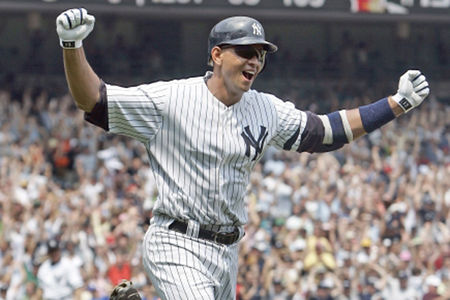
Alex RodriguezNational sports writers rejoice to hammer A-Rod in the wake of SI.com’s report that he tested positive for steroids in 2003:

Jayson Stark says that Rodriguez has destroyed the game’s history. (ESPN.com)

Bruce Jenkins writes that even tarnished stars like A-Rod will shine in the Hall of Fame. (San Francisco Chronicle)

Bill Madden says the Yankees should cut Rodriguez loose no matter the cost. (New York Daily News)

Tom Verducci breaks down how the steroid report will affect A-Rod, the Yankees and Major League Baseball. (Sports Illustrated.com)

Todd Jones plays devil’s advocate in this situation and tells fans to think about some things before condemning Rodriguez into steroid/baseball hell. (Sporting News)

So much for Rodriguez legitimizing the home run record writes Tim Cowlishaw. (Dallas Morning News)

Bob Klapisch writes that Derek Jeter better not fail us, too. (The Record)

Drew Sharp goes as far as to say that we can’t even call baseball a sport anymore. (Detroit Free Press)

Tim Marchman notes that nobody like A-Rod before the report and nobody likes him now. (Slate)

SI.com: Alex Rodriguez tested positive for steroids 2003

According to Sports Illustrated.com, Yankees’ third baseman Alex Rodriguez tested positive for two anabolic steroids when he was a member of the Rangers in 2003.

Rodriguez’s name appears on a list of 104 players who tested positive for performance-enhancing drugs in Major League Baseball’s ’03 survey testing, SI’s sources say. As part of a joint agreement with the MLB Players Association, the testing was conducted to determine if it was necessary to impose mandatory random drug testing across the major leagues in 2004.

When approached by an SI reporter on Thursday at a gym in Miami, Rodriguez declined to discuss his 2003 test results. “You’ll have to talk to the union,” said Rodriguez, the Yankees’ third baseman since his trade to New York in February 2004. When asked if there was an explanation for his positive test, he said, “I’m not saying anything.”

Though MLB’s drug policy has expressly prohibited the use of steroids without a valid prescription since 1991, there were no penalties for a positive test in 2003. The results of that year’s survey testing of 1,198 players were meant to be anonymous under the agreement between the commissioner’s office and the players association. Rodriguez’s testing information was found, however, after federal agents, armed with search warrants, seized the ’03 test results from Comprehensive Drug Testing, Inc., of Long Beach, Calif., one of two labs used by MLB in connection with that year’s survey testing. The seizure took place in April 2004 as part of the government’s investigation into 10 major league players linked to the BALCO scandal — though Rodriguez himself has never been connected to BALCO.

Does this news seriously surprise anyone? It’s come to the point now where fans should just assume that most players either are or were on some type of performance-enhancing drug from the mid 90s on.

As the SI article notes, Major League Baseball did not have a penalty for anyone who tested positive for steroids up until 2004 when it began its random testing program. It was simply frowned upon and now there’s nothing that the league or anyone else can do about it in order to punish those players who tested positive before ’04. The league is at fault for A-Rod, Roger Clemens, Mark McGwire and Barry Bonds because it allowed these players to gain an edge off the field and pollute the game without the threat of consequence.

Did these players make a conscious choice to gain an edge using performance-enhancing drugs? Yes – and they are just as much at fault as MLB is. But it all starts with the league. Bud Selig and all of these players soiled a great game and now we all can’t look at a player after he hits a home run without thinking, “I wonder if he’s on steroids.”

It’s sad.

« Older posts Newer posts »