Tag: 2010 NBA Playoffs (Page 7 of 32)

How a simple box out can win a game

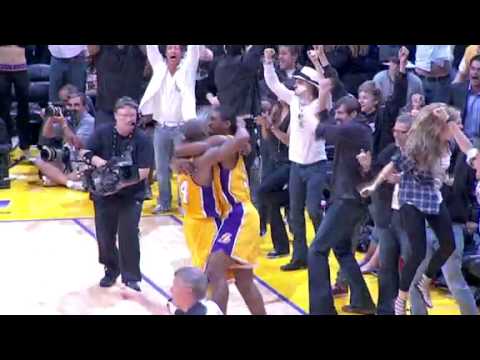
By now, you’ve probably heard about Ron Artest’s game-winner last night in pivotal Game 5 against the Suns, but what you might not know is exactly how it happened.

In the video below, you’ll see Kobe catch the ball on the sideline and chuck up a horrible shot. But what you need to pay attention to is Ron Artest and Jason Richardson on the other side of the court. Watch as Richardson turns, stands and watches Kobe’s shot. He’s supposed to be boxing out Artest, but instead, he’s about as useless as you or I am sitting at home.

Did this play look familiar? Watch Pau Gasol’s easy route to the bucket to score his game-winner against the Thunder in the first round.

This happens time and time again. It even happened to Hakeem Olajuwon in the 1983 NCAA title game when Lorenzo Charles snuck in behind “The Dream” and dunked home the game-winner…

Once a last-second shot goes up, the tendency is for players to stop and watch, especially when they think the game is over. But with 3.5 seconds to play, there is plenty of time for a shot to go up and for a tip in on the miss. That’s what Jason Richardson, Jeff Green and Hakeem Olajuwon failed to realize in these clips.

It does no good to stop and watch. After Kobe’s desperation shot attempt, the only way the game doesn’t go to overtime is if Richardson or one of his teammates fails to box out his man. In that situation, he should be seeing both Artest and Kobe (in his peripheral vision), and when the shot goes up, he needs to make contact with Artest and do whatever it takes to keep him away from the rim. If he had even slowed Artest by a half second, the game would have gone into overtime.

And that’s how a simple box out can win a game.

WCF Game 5: Ron Artest goes from goat to hero

After Ron Artest almost blew the game with an ill-advised shot, he ended up winning it for the Lakers. With 1:01 remaining and the Lakers up three, Ron Artest bricked a 20-foot jumper. Pau Gasol cleared the offensive rebound and passed it out to Artest, who (ponderously) took a three with 0:56 remaining. Phil Jackson gave him an earful during the timeout, and after Jason Richardson banked home the game-tying three with 0:03 to play, it looked like the game was heading to overtime, barring a Kobe Bryant miracle shot, of course.

Bryant got his shot, but it was a terrible look, and there was enough time left on the clock for Artest to collect the rebound and put it back in. It sure seems like there is so much attention paid to Kobe that everyone’s watching him shoot instead of getting into position for the defensive rebound. It was Richardson who failed to box out Artest.

Has Artest finally validated the Lakers’ decision to sign him instead of re-signing Trevor Ariza?


Photo from fOTOGLIF

Were the Celtics’ technicals justified?

There has been much discussion about the three technicals called on Kendrick Perkins (2) and Rajon Rondo (1) in Game 5 of the Magic/Celtics series. Here are my thoughts on each one:

1. Perkins elbows Gortat.
It looked to me like Gortat was checking on Pierce who took a hard fall and Perkins felt the need to throw a little elbow into Gortat’s chest. Gortat also deserved a technical for knocking the ball out of Perkins’ hand after the elbow. There’s no need for any after-the-whistle shenanigans, and Perkins lost some credibility with the officials when he said that he “didn’t do anything.” Yeah, right. Verdict: Justified

2. Perkins upset after a foul call. (1:10 mark)
I thought the foul call was iffy, and Eddie Rush compounded the problem by overreacting to Perkins’ overreaction. I think officials should give a little more leeway to a player after a close call like the one in question. That said, Perkins wouldn’t have been called for a “T” had he handled the call better. Verdict: Unjustified

3. Rondo called for a technical. (3:00 mark)
First of all, Rondo was dead wrong on the call. Jameer Nelson’s feet were outside of the restricted area, though the video doesn’t show it. He continued to complain through the timeout and tried to get the attention of the official who made the call. An always emotional Joey Crawford stepped in and told Rondo to go to his bench and gave him a warning. Rondo said something — we don’t know what — and that’s what led to the technical. Since we don’t know what he said, we don’t know for sure if the technical was justified, but Rondo needs to understand his audience. Joey Crawford once tossed Tim Duncan out for laughing on the sidelines, so everyone knows he has a short fuse. Don’t mess with him by continuing to talk to him after he’s already given you a warning to go to your bench. If Rondo hadn’t said anything over his shoulder, he wouldn’t have gotten the technical. Verdict: Justified

Note: I don’t really care who wins this series, so I consider myself an objective observer. I do feel that there is too much complaining to officials during NBA games and it needs to be curtailed. As for Crawford and Rush “having it in” for the Celtics, I don’t buy it. Two technicals were called on Orlando as well (Gortat, Matt Barnes).

Kendrick Perkins will play in Game 6

The Boston Celtics are no doubt breathing a sigh of relief, as Kendrick Perkins will be eligible to play in Game 6. One of the two technicals he received in Game 5 was rescinded, so the seventh-year center will be in the C’s starting lineup as usual. NBC Sports comments:

We have no idea how the league decided which technical to rescind, as both appeared to be pretty bad calls. This is obviously great news for the Celtics, who are still going to have to deal with injuries to Rasheed Wallace and Glen Davis, as well as worry about Perkins picking up another tech or two in Game 6.

If Perkins does pick up another technical and it’s not rescinded, then he will be suspended for the following game, so he has to be careful.

This is a symptom of a bigger problem in the NBA — the constant complaining. Some players spend more time barking at the refs than they do focusing on the game, and every time a call doesn’t go their way, they react like a petulant two-year old.

Getting all pissed off and complaining about a call doesn’t do anyone any good. The official isn’t going to change his call and an emotional response is only going to end badly. Basketball is an emotional game and the amount of pressure is immense, but players have to learn to keep their composure. If they have a problem with a call, they need to go over to the ref in a calm manner (after he’s spoken with the scorer’s table) and ask him what he saw. Most officials will explain the call when addressed in this way.

Officials are human too, and they don’t need their calls constantly questioned. And they certainly don’t need to be shown up by grown men throwing temper tantrums every time a call doesn’t go their way.

That said, Perkins did walk away on his second technical, and he should be allowed to vent some frustration as long as it’s not directed at the official in question.

From a series standpoint, this news is big for the Celtics, who desperately need Perkins to defend Dwight Howard down low. He’s strong enough to keep Howard out of the lane and often forces Orlando’s superstar into long, contested shots from the post.


Photo from fOTOGLIF

« Older posts Newer posts »