Tag: 2010-11 NBA season (Page 23 of 52)

Was McDyess’s tip-in goaltending?

Check out Antonio McDyess’s tip-in at the buzzer to beat the Lakers last night at Staples Center.

Was it goaltending? Lakers fans think so, but a quick read of the NBA’s goaltending rules leads me to believe that it wasn’t:

Section I-A Player Shall Not:
a. Touch the ball or the basket ring when the ball is using the basket ring as its lower base.
EXCEPTION: If a player near his own basket has his hand legally in contact with the ball, it is not a violation if his contact with the ball continues after the ball enters the cylinder, or if, in such action, he touches the basket.
b. Touch the ball when it is above the basket ring and within the imaginary cylinder.
c. For goaltending to occur, the ball, in the judgment of the official, must have a chance to score.

The view from the side shows that the ball was coming off, but I think it was still in the imaginary cylinder when McDyess’s hand touched it. However, as part “c.” states, if the official did not think it had a chance to score (which it didn’t), then it cannot be goaltending. This appears to supersede the fact that the ball may have been in the cylinder.

Spurs win.
Using efficiency and win % to determine the 2011 All-Stars

Blake Griffin of the Los Angeles Clippers (R) prepares to shoot as Kevin Love (L) of the Minnesota Timberwolves defends in first half action at the Staples Center in Los Angeles, California USA 19 January 2011. EPA/MIKE NELSON CORBIS OUT fotoglif919014

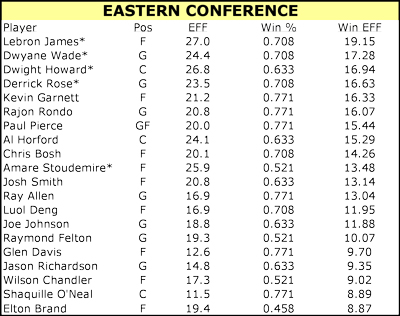
Since the All-Star reserves will be announced tonight on TNT, I thought I’d try to come up with some sort of formula to calculate who should make the All-Star Game.

What’s important in an All-Star? Well, to me, it comes down to two things: stats and wins. So I took my favorite (and flawed) all-encompassing stat, efficiency, and calculated it on a per-game basis for each player. Then, I multiplied each player’s efficiency with his teams win percentage to come up with a new stat: Win Efficiency. (Please note that rebounds are easier to come by than assists, so big men tend to do better in overall efficiency than guards do.)

From there, picking the All-Stars would be simple. Take out the five starters for each conference, and fill out the roster with three guards, three forwards and a center. Surprisingly, the results came out pretty well. (By the way, I put an arbitrary minimum of 35 games played.)

Here’s a look at the top 20 players from the Eastern Conference:

Continue reading »

Why baseball stats matter so much more than basketball stats

In his latest column, which is mostly about how certain NBA players are defying the aging process, Bill Simmons theorizes why stats are so much more important to baseball fans than they are to basketball fans.

For whatever reason, basketball fans don’t care about career NBA numbers like baseball fans care about baseball numbers. I see four reasons for this: (1) baseball has been around almost twice as long as basketball; (2) baseball’s signature threshold numbers are famously identifiable (500, 3,000 and 300), as are the players who broke its major records, whereas your average sports fan would struggle to answer questions like “Who leads the NBA in career scoring?”; (3) statistics matter more in baseball because it’s an individual sport; and (4) we need to throw ourselves into baseball statistics because the sport itself is so f—— boring. If we were eating lunch and I told you, “Johnny Damon has 2,571 hits right now,” that would mean something to you. If you’re a true baseball fan, you would process that information in 0.008 seconds and think, “He needs 429 for 3,000, that’s doable!” But if I told you “Dirk Nowitzki has 21,925 points right now,” you wouldn’t think anything other than, “That’s a lot.”

I agree with all four points. The only basketball stats I really care about are per game or season stats and that’s because I play fantasy hoops. It doesn’t really matter who is the league’s all-time leading scorer or who has dished out the most assists. The number of championships (Kobe potentially passing Michael Jordan in rings) is one that is important to a lot of NBA fans.

Ron Artest is a master of the third person

On the heels of Marc Stein’s report that Ron Artest would like to be traded, FanHouse posted an interview with Ron Artest where Ron Artest talks about Ron Artest quite a bit. Here’s an excerpt:

FH: Break down last season compared to this one for me. What are the main differences for you?

RA: Last year I didn’t really know the offense that much. I realized this is (Bryant’s) team, so he really dominates the game a lot and I had to adjust my way of thinking. My whole summer before my first year as a Laker, I practiced spotting up. Even if I played with regular players in the street, I’d be a spot-up player because I knew Kobe was going to dominate the ball and I wanted to perfect my role. But then during the playoffs, I’d see how these teams be playing off me … and I’d mess up. I’m like, ‘A couple years ago, y’all were double-teaming me, and triple-teaming me,’ so I had to readjust.

The whole year I was going through a transition of getting comfortable, and then the playoffs came and, bam, the old Ron Artest came, the best one — where he locks up his player, where he locks up a former Finals MVP (in) Paul Pierce, he gets five steals, a couple rebounds and scores buckets. So this summer, it was different. I didn’t prepare to play a role. I prepared to play like Ron Artest played. And that’s to help my team.

So sometimes it’s uncomfortable a little bit because I can’t play how Ron Artest plays all the time, but I don’t quit. I don’t quit on my team. I still do what it takes to win. So even if I have two points, I’m so arrogant with my defense — because I already know my defense can change a game. So when people are saying, ‘Ron Artest is playing bad,’ I’m like, ‘No, I’m playing great. Just give me a chance and I’ll show you.’ That’s the difference. The difference this year is I’m definitely playing how Ron Artest is going to play.

His numbers may not be there this season, but Ron Artest is certainly working the third person for all it’s worth.

Ron Artest wants out?

Denver Nuggets guard J.R. Smith (C) tries to draw a foul from Los Angeles Lakers forward Ron Artest at the Pepsi Center in Denver on January 21, 2011. The Lakers beat the Nuggets 107-97. UPI/Gary C. Caskey

Marc Stein has a source that says that Ron Artest wants out of L.A.

Artest’s two main beefs?

1. He’s weary of being scapegoated for the team’s struggles and feels that he’s destined to always absorb the bulk of the blame no matter what happens because Jackson and Bryant are so dependent on the more glamorous contributions of Pau Gasol and Lamar Odom and will never publicly go after regal Laker lifer Derek Fisher.

2. As we heard at various points during his stops in Indiana, Sacramento and Houston, Artest is eventually going to squawk if he’s being marginalized in the offense, which inevitably disengages him from his defensive responsibilities.

After a so-so regular season, Artest justified his signing by coming up big in the playoffs. He followed up Kobe Bryant’s airball with a game-winning layup against the Suns in Game 5 and then hit a HUGE three-pointer against the Celtics in Game 7.

But he’s averaging just 8.1 points and 2.9 rebounds this season, which are easily career lows. The problem here is not that Artest wants out, it’s that nobody is going to trade for him. He’s 31, and his game has (seemingly) fallen off a cliff. The Lakers aren’t happy with the way he’s defending, and that might be a result of how he’s been marginalized offensively. He has three years and almost $22 million remaining on his deal, and he has a reputation for being a malcontent — who is going to want to take that contract on?

No, the Lakers are stuck with Ron Artest and Ron Artest is stuck with the Lakers.

Trevor Ariza is starting to look pretty good, isn’t he?

« Older posts Newer posts »