Page 2291 of 2957

How to charm a snake (draft)

Most fantasy football drafts utilize a “snake” draft where teams pick 1-12 in odd rounds and 12-1 in even rounds. Crafty owners can take advantage of the characteristics of such a draft if their draft position is one, two or three spots from either end. So those owners with the #2, #3, #4, #9, #10 or #11 picks (in a 12-team draft) should pay attention.

Here’s the situation: you have the #3 pick in the draft and the two owners ahead of you select LaDainian Tomlinson and Adrian Peterson in the first round. You take a running back – let’s say Brian Westbrook – and the draft proceeds. Now you’re up again with the 2.10 (#22) pick and you’ve narrowed your pick to the following list:

T.J. Houshmandzadeh, Willis McGahee, Jamal Lewis, Ryan Grant and Steve Smith

Let’s say that you like Smith, but now that he’s going to miss the first two games due to suspension, you’re a little down on him. You like Housh more; he’s a consistent WR in a terrific offense. However, you know that RBs are important and you want to select one of the three to round out your backfield, but you can’t decide which one since they’re all about the same. What do you do?

Take Housh.

Why?

The two owners picking #1 and #2 each have two picks before your next pick. Both have already taken a RB, so it isn’t likely that either owner is going to select two RBs with the next two picks because they’ll probably want to start filling out the rest of their roster. That leaves you with at least one of the three RBs to pick at 3.03. By selecting Housh (whom you value more than the next WR, Smith) you get the best WR on the board, and since McGahee, Lewis or Grant is likely to be there at 3.03, you’ll probably get a solid #2 RB in the next round. Since it didn’t matter to you which RB of the three you got, you let the other two owners make the tough decision, while you laugh all the way to the playoffs.

Now let’s say you’re in the same draft slot and your pick is up at 6.10. So far you’ve selected the following players:

Westbrook (RB), Houshmandzadeh (WR), Grant (RB), Santonio Holmes (WR), Tony Gonzalez (TE)

That’s a nice squad, but you have no QB. At 6.10, you’re selecting from the following group:

Matt Hasselbeck, Donovan McNabb, Marc Bulger and Jay Cutler

You notice that the team selecting #2 doesn’t yet have a QB while the team selecting #1 has Tony Romo. You can safely assume that team #1 won’t select another QB so soon, but team #2 might select their first QB before you pick at 7.03. You like both Hasselbeck and McNabb, but you really like Jerricho Cotchery over the other available WRs. So whom do you take?

Grab Cotchery.

In this case, you take Cotch and pass on Hasselbeck and McNabb, as one (or both) of them will probably be available for you to pick at 7.03.

This principle is applicable to all positions. Whether it’s a TE in the middle rounds or a kicker or a defense in the late rounds, being able to predict your opponents’ actions gives you an advantage during the draft. The key to this strategy is to know what players the #1 and #2 teams have already drafted so you can use that information to your advantage. In live drafts, it is often difficult to draft your own team as well as keep track of the other teams, but if you only pay attention to the important teams – in this case the teams picking #1 and #2 – it shouldn’t be much of a burden.
Independent blogs like Sports by Brooks getting noticed nationally

Unless you’ve been living under a rock the past year and a half, you’re well aware of how sports blogs have taken over the online world. Blogs have become the “new media,” as newspapers continue to die out. This revelation hasn’t been lost on more nationally known sports sites like NBC Sports, who gave major recognition to edgier blogs like SR friends SportsbyBrooks.com in a recent article.

Such is the difference between the staid old sports media and the edgier new sports media — the latter being led by non-affiliated blogs that sensationally sell sex, sports and celebrity. Those blogs are forcing many athletes, who would rather not appear in such a context, to watch their public behavior. And they are forcing old-media outlets to reconsider how they cover those athletes in a hipper way in order to reach a younger demographic.

“I was in the main media for many years, and got bored with it,” said Brooks Melchior, who founded Sports By Brooks in 2001 and calls his site the progenitor of the format. “I enjoyed the off-the-beaten path stuff, and the merging of sports and celebrity. Now you see what’s happened since then. It’s exploding.”

Melchior, 40, has a diverse journalistic background. He worked on the night editing desk at the Kansas City Star, was a hockey and baseball play-by-play broadcaster, co-hosted a radio show in Columbus, Ohio, and served as a radio station program director. He said that his history leads him to be a little more cautious than some of his contemporaries.

“If I was writing something libelous or defamatory, I would have been sued by now, and put out of business,” said Melchior, who has received cease-and-desist orders but said the pursuit has never gone further.

He doesn’t claim to serve as a substitute for mainstream outlets such as newspapers. Rather, Melchior calls his site a “clipping service. But instead of just clipping the article, we repackage it with a more provocative approach in most cases, and put it up there.” Once the story is on the site, it acts as a major distribution point to recirculate back into the mainstream media, since writers from around the country begrudgingly admit to reading such sites.

The concern that blogs aren’t “real journalism” has merit. But times have changed. Good or bad, people don’t want to read full articles anymore. They want their information concise and entertaining. Blogs like SbB are entertaining and although older generations hate the fact that newspapers are dying, there’s a large group of online readers who enjoy more spiffy (or slick or edgy) content.

Blogs aren’t for everyone. And with the way newspapers outlets have made their content available online, readers have the opportunity to stick with something they’re more comfortable with. But the fact of the matter is that whether they’re accepted or not, it appears that blogs are here to stay.

Worst athlete bobbleheads

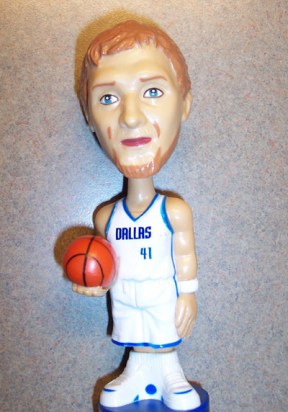
EPIC CARNIVAL compiled a small group of the worst athlete bobbleheads (i.e. bobbleheads that don’t actually resemble the athlete).

Take a look at the Dirk Nowitzki bobblehead:

What the hell is that on his face? I’m sure The Diggler was absolutely thrilled to see a bobblehead that depicted him as a rent-for-kids-birthdays circus clown. If it wasn’t for the #41 on his jersey, I would truly have to guess “Shawn Bradley” before I’d say Dirk’s name.

Oh…that’s right. The knee-high shoes should have been the dead giveaway. And again with the lipstick. What’s with that?

Jesus, that’s one freaky bobblehead.

Michael Phelps’ quest for history

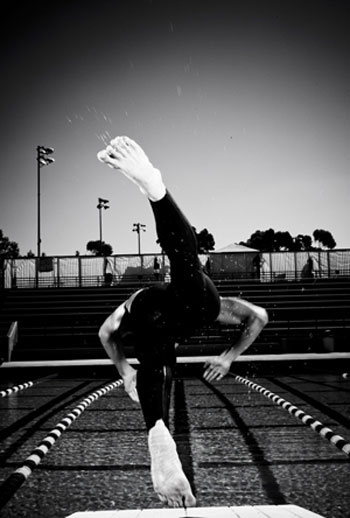
Michael Phelps is trying to do something no one else has ever done – win eight gold medals at the Olympics. The latest issue of ESPN The Magazine has a great article outlining the challenges standing in his way (and how Phelps plans to overcome them).

Threats will come from all sides. Some will grab him, strangle him while he swims. Some will wait until the lights have dimmed and the fans have left. Every threat will eat at his energy and strength, until he comes up for air after his final race and realizes that his threats—or his dreams—are gone.

Swimming might never be wildly popular in America. But for those who consider sports a test of human limits, there may be no more impressive feat than what Michael Phelps will do over nine days in August. He will swim eight finals (five individual, three relays) and 17 races overall, including prelims and semis, in a quest to become the only Olympic athlete to win eight gold medals at a single Games. Football, basketball, hockey and baseball players rest not only after games, but during games. Tennis and soccer players get days off between matches. Boxers get months. But Phelps? Phelps will burn a marathon’s worth of calories in the pool every day for nine days, on his way to swimming more than 30 miles. He will weaken with every minute, stroke and breath. The threats will not.

THREAT 1: PAIN
Phelps begins with the most difficult event: swimming’s decathlon, the 400 individual medley. The race begins with 100 meters of butterfly, in which he must propel his body out of the pool, over and over, until he feels as if he’s doing squat jumps with two kids on his back. The fly requires an edge, almost an anger. “You have to be tougher, meaner,” says 1992 gold medalist Mel Stewart. “If you don’t have a base of strength and stamina, you fade. You die.”

If you’re interested in Phelps’ quest, it’s a great read.

(Read the rest after the jump.)

Mark Cuban wants to own the Cubs

It died down for a while, but the Mark-Cuban-wants-to-own-the-Chicago-Cubs chatter has resurfaced. But once again, the talk has mostly centered on whether or not MLB wants to let Cuban into their owners’ fraternity.

Cuban is loud, passionate and opinionated. He’s a media creature comfortable on multiple platforms, and he turned the once-comatose Mavericks into a perennial winner (though they have not won it all, just like the Cubbies, at least not since 1908). He has amassed nearly $1.7 million in fines, mostly for criticizing N.B.A. referees. As penance for insulting the chief of referees as incapable of managing a Dairy Queen, he spent a day at the chain serving up a promotional bonanza.

Colangelo, who also owned the Arizona Diamondbacks, said baseball and basketball owners were different breeds. “Basketball is a little more cutting edge, and baseball has been stodgier,” he said. “Some people say it’s difficult to see him as a baseball owner, but times change, circumstances change and he’s done an incredible job in basketball.”

The Cubs have always been owned by a company that cares more about putting fans in the seats than a winning team on the field. And the only reason they’ve won of late is because the Tribune Company wants to sell the club, so they’ve been willing to spend more to dress up their product.

Cuban would be great for both the Cubs and baseball because he’s a passionate owner who wants to win. If baseball were lucky enough to have 30 owners who are as passionate about winning as they are turning a profit, than MLB would be a league to be admired. (Instead of being viewed as a “how to” on how not to run a league into the ground.)

« Older posts Newer posts »