So I was sitting at my favorite sports bar (Rudy’s in Newport Beach), knocking down a pitcher or two with some teammates after a big rec league basketball win, and the subject of home court advantage came up. Each guy had his own take on what sport gave the home team the biggest advantage, and like most of these “sports bar” conversations, an idea for a column popped into my head. Why not take a look at each of the four “major” sports (NFL, NBA, MLB and the NHL) and see which one has the biggest home field/court/ice advantage?
I wanted a decent sample size, but I also wanted the data to be relatively current, so I compiled the home wins and losses over the last three regular seasons for each league. (By the way, on the whole, Yahoo! Sports seems to have the best home/away “split” data, though for some reason its NHL data is incomplete. Luckily, NHL.com had what I needed.)
Here’s a summary of the W/L data:

The NFL, NHL and MLB are all very close (within a 1.7% range), while the NBA has by far the biggest home court win percentage with a stellar 59.8%. Why is this?
The first thing that jumps to mind is the proximity of the fans. NFL, NHL and MLB are separated from the action by one thing or another, whether it’s distance in football and baseball or the protective glass in hockey. NBA fans are basically right on the court and are therefore more able (though not always willing) to change the course of a game. They can do it three different ways:
 1. NBA officials sometimes get caught up in the emotion of a lively home crowd.
Due to the high number of possessions in basketball, officials are forced to make more decisions than any other sport, and are therefore more able to change the game’s outcome. (Just ask Tim Donaghy.) So NBA crowds can directly impact the outcome of a game.
2. The proximity of the fans makes their reaction to non-calls more immediate.
It seems like there are more “late whistles” during the course of a NBA game than there are “late flags” in the NFL. Since the fans are sitting closer, their negative reaction to a no-call gets to the official more quickly, which makes it more likely that the official will reconsider and blow his whistle.
3. The proximity of the fans can affect the opposing players.
As a former collegiate basketball player myself, most guys do a pretty good job of blocking that stuff out. Still, when you’re talking about taking a game-winning shot, there is probably more in-your-face noise and distraction for a basketball player than there is for any other sport.
Travel also has a big impact on the NBA. In baseball, teams generally stay in a city for a two- to four-game series, while NBA teams are hitting a different city every (or every other) night. This doesn’t explain the difference between the NHL and NBA; both leagues play 82 games and have somewhat similar travel schedules.
Monotony may also play a factor. While the NBA and NHL regular seasons are kind of a drag, every game in the NFL season holds significant importance. In football, the season is shorter, so there is more riding on each game, especially because the playoffs are less inclusive (than the NBA and NHL).
The baseball season is certainly monotonous, so why don’t road teams lose focus? Well, the baseball season can certainly be a drag, but it’s more about the length and the sheer number of games. The stakes are raised over the second half of the season as there are only eight playoff spots up for grabs. Plus, much of the competitiveness of baseball rides on the pitchers, who usually get several days between starts and are therefore focused when they do pitch. Throw in the lack of parity in baseball and you have a lot of good clubs that can go win some games on the road.
 Also, there just aren’t as many “key moments” in baseball. In football or basketball, the crowd is going to get loud for each third down, free throw or when the home team goes on a scoring run. Other than the occasional big at-bat, baseball crowds are usually pretty quiet. The more laid back the crowd, the less impact it’s going to have on the game.
All right, enough about win percentage. The other factor I wanted to look at was point differential. Here’s the breakdown:
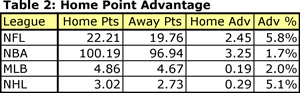
From a points per game perspective, NFL home teams have the biggest advantage. It works out to almost a 6% increase for the home team in terms of advantage in relation to total points per game. It’s unclear why this doesn’t translate to a bigger home win percentage, but the NFL is second in that category, so maybe it has more to do with the characteristics of the NBA than it does with the NFL.
Regarding the NBA’s last place finish in this category, it sort of goes with the league’s reputation. They say that you don’t have to watch the first three quarters of a NBA game, because it will probably be close at some point in the fourth quarter. Momentum swings wildly in basketball, more wildly than in any other sport, and if a team gets complacent, its opponent will probably go on a run. So while a 3.25-point advantage is significant, it doesn’t seem like a lot given the total number of points scored per game. But it is.
The more I dig into this, the more I want to see how home field/court/ice advantage translates to the playoffs. It seems like focus and travel issues would be eliminated, and we might get a clearer picture of which sport has the biggest home field advantage.
But that’s another column for another time.


