Page 1888 of 2957

Curt Schilling weighs in on A-Fraud mess

Curt Schilling has been an outspoken critic of players who used steroids and HGH, and he doesn’t hold back on the revelation that A-Rod tested positive for steroids, which contradicts A-Rod’s past statements on the matter.

Schilling wants Major Leaugue Baseball to release all information on all the positive tests.

I’d be all for the 104 positives being named, and the game moving on if that is at all possible. In my opinion, if you don’t do that, then the other 600-700 players are going to be guilty by association, forever.

It’s not about good and bad people, because Mark McGwire and Jason Giambi are two of the kindest human beings ever. Andy Pettite is a fantastic person. That’s seemingly got nothing to do with anything. One hundred and four players made the wrong decision, and it appears that not only was it 104, but three of the greatest of our, or any, generation appear to be on top of this list.

And before anyone asks, I’ll make it clear: My name will not appear on any lists of positive tests. I’ve never tested positive for steroids or HGH, and I’ve never taken steroids or HGH in my life, ever. You don’t need to call the union, or an agent to verify that.

Baseball needs to address this. The story will never end, and we’re seeing more and more players whose Hall-of-Fame careers are tainted by the use of these drugs.

It’s stunning to see practically all of Jose Canseco’s allegtions turn out to be true. I heard him recently on Howard Stern, and he regrets exposing other players. He’s been reduced to boxing Danny Bonaduce, and he realizes that his vendetta against Major League Baseball has not made his life any better, despite being vindicated as the facts about steroid and HGH usage by the game’s stars have been exposed. Regardless of his motivations, Canseco has been much more honest than those he accused. Some of the most respected players in the game have been exposed as liars and cheaters, proving once again that this is a business, and money and fame can distort the ethics of many players, even those blessed with the most talent.
Jamal Anderson busted on drug charges

This is a surprise.

Former Atlanta Falcons running back Jamal Anderson was arrested and booked into an Atlanta-area jail late Saturday night on a felony possession-of-cocaine charge and possession-of-marijuana charge, a misdemeanor.

Anderson, an NFL analyst for ESPN’s First Take this past season, was booked into the Fulton County jail in Georgia and denied bond.

His first hearing was set for Monday morning, the Fulton County sheriff’s office said Sunday.

Anderson, 36, was arrested at the Peachtree Tavern in the community of Buckhead after an off-duty officer working security at the club alerted police, according to The Associated Press, citing a police spokesman.

Police found a suspected marijuana cigarette in Anderson’s pocket, local reports said. Another man with Anderson was also arrested. Police said both men were in possession of cocaine, according to the reports.

Anderson never struck me as someone who would get into this kind of trouble, but who knows these days. The marijuana is not the big deal here. The hysteria surrounding the Michael Phelps story is absurd, but cocaine is another matter.

Racism persists in European soccer

This story is very disheartening.

Ghanaian soccer player Solomon Opoku heard the Serbian fans screaming racist insults and turned around as they set upon him, hurling punches and abuse.

The attackers were supporters of Opoku’s team, determined that a black player shouldn’t take the field for their club.

Two days later, Olympique Marseille President Pape Diouf got a firsthand look at what his black players endure when he traveled to the team’s UEFA Cup match at Zenit St. Petersburg in northern Russia.

“What we went through was hideous,” Diouf, who is black, said in an interview with the Associated Press. “It was the classic stuff, the bananas thrown at black players warming up, the monkey chants, obscene gestures. Not only does Zenit not hide the fact that no black player could play for this club, the fans say so themselves.”

Racism has become the scourge of European soccer stadiums. Whether the supporters are watching a minor league in Serbia or a major European competition such as the Champions League, matches are stubbornly plagued by prejudice from the Mediterranean Sea to the Ural Mountains.

Anti-racism campaigns aimed at fans have met with limited success at best, leaving the problem to FIFA, the sport’s governing body, and the Union of European Football Associations to clean up.

Soccer officials have condemned fan racism and issued fines. But penalizing clubs or nations in ways that would hurt both them and their fans — such as disqualification from tournaments, forfeiting points or stopping a match — is something they have been reluctant to do.

“You have countries, [like] Russia today, where racism is a quasi-official doctrine,” said Pascal Mignon, a French sociology researcher at the INSEP sporting institute. “In Russia, xenophobia is quite strong. So you will see it in a more powerful way, like you will in southern European countries like Spain or Italy.”

FIFA needs to take tougher action.

Cards could face major changes next season

The Arizona Cardinals aren’t even a week removed from losing Super Bowl XLIII and already they need to fill both coordinator positions, convince starting quarterback Kurt Warner to return next season and deal with wide receiver Anquan Boldin’s continued unhappiness. Oh yeah, and linebacker Karlos Dansby is also set to become a free agent.

On Friday, the Chiefs hired Todd Haley – the mastermind behind the Cardinals’ dynamic offense in 2008 – to become their next head coach. Not 24 hours later, Arizona fired coordinator Clancy Pendergast, despite his success coming up with defensive schemes to thwart top NFC runners Michael Turner, DeAngelo Williams, Brian Westbrook and Willie Parker in the playoffs.

The loss of Haley is significant because he developed all the game plans and called the plays for the Cards’ biggest strength: their offense. It’s unsure at this point why the team fired Pendergast, but the franchise must have someone waiting in the wings because you don’t make a dramatic move like that without having a game plan in place.

If Arizona can’t re-sign Warner and Dansby, then has to part with Boldin because they can’t appease his contract demands, then we could be looking at a very different Cardinals team than the one that took the field last Sunday in the Super Bowl. By all accounts, the team shouldn’t have much of a problem convincing Warner to return, but Dansby will be a highly sought-after free agent who is only 27 and in the prime of his career.

Boldin’s situation is a different animal. He requested that the team trade him last preseason due to a lack of contract respect, and then threw a tantrum on the sidelines during the NFC Championship Game because Haley replaced him during a pivotal offensive series. Just recently, Boldin said that his relationship with the Cardinals was irreparable. At the end of the day, the team might not have a choice but to cut ties with the underrated receiver and trade him so his situation doesn’t continue to be a distraction.

In order for the Cards not take a major step back, the two coordinators that the team chooses will need to be sound hires. It would be wise for Arizona to then make re-signing Warner and Dansby their next priority, and then deal with Boldin since he’s already under contract and can’t bolt on his own accord. Nevertheless, this will be an interesting offseason in Arizona.

SI.com: Alex Rodriguez tested positive for steroids 2003

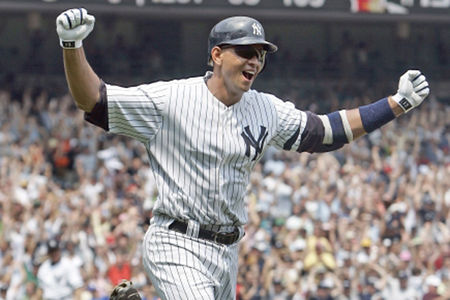
According to Sports Illustrated.com, Yankees’ third baseman Alex Rodriguez tested positive for two anabolic steroids when he was a member of the Rangers in 2003.

Rodriguez’s name appears on a list of 104 players who tested positive for performance-enhancing drugs in Major League Baseball’s ’03 survey testing, SI’s sources say. As part of a joint agreement with the MLB Players Association, the testing was conducted to determine if it was necessary to impose mandatory random drug testing across the major leagues in 2004.

When approached by an SI reporter on Thursday at a gym in Miami, Rodriguez declined to discuss his 2003 test results. “You’ll have to talk to the union,” said Rodriguez, the Yankees’ third baseman since his trade to New York in February 2004. When asked if there was an explanation for his positive test, he said, “I’m not saying anything.”

Though MLB’s drug policy has expressly prohibited the use of steroids without a valid prescription since 1991, there were no penalties for a positive test in 2003. The results of that year’s survey testing of 1,198 players were meant to be anonymous under the agreement between the commissioner’s office and the players association. Rodriguez’s testing information was found, however, after federal agents, armed with search warrants, seized the ’03 test results from Comprehensive Drug Testing, Inc., of Long Beach, Calif., one of two labs used by MLB in connection with that year’s survey testing. The seizure took place in April 2004 as part of the government’s investigation into 10 major league players linked to the BALCO scandal — though Rodriguez himself has never been connected to BALCO.

Does this news seriously surprise anyone? It’s come to the point now where fans should just assume that most players either are or were on some type of performance-enhancing drug from the mid 90s on.

As the SI article notes, Major League Baseball did not have a penalty for anyone who tested positive for steroids up until 2004 when it began its random testing program. It was simply frowned upon and now there’s nothing that the league or anyone else can do about it in order to punish those players who tested positive before ’04. The league is at fault for A-Rod, Roger Clemens, Mark McGwire and Barry Bonds because it allowed these players to gain an edge off the field and pollute the game without the threat of consequence.

Did these players make a conscious choice to gain an edge using performance-enhancing drugs? Yes – and they are just as much at fault as MLB is. But it all starts with the league. Bud Selig and all of these players soiled a great game and now we all can’t look at a player after he hits a home run without thinking, “I wonder if he’s on steroids.”

It’s sad.

« Older posts Newer posts »