Page 1540 of 2956

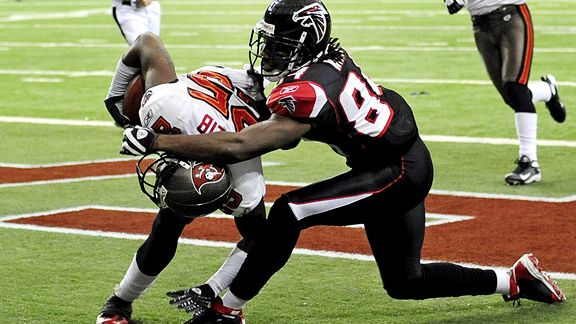
White’s contract fair for both him, Falcons

A couple days ago, the Falcons’ receiving corps was essentially on life support.

How bad were things? No. 1 wideout Roddy White was in the midst of a contract holdout that wasn’t going well, promising slot receiver Harry Douglas torn his ACL in practice and will miss the entire season, and the team had to scrap near the bottom of the free agent barrel by signing veterans Robert Ferguson and Marty Booker.

But over the weekend, things went from ugly to hopeful again as White ended his holdout by signing a six-year, $50 million contract extension with $18 million in guarantees. The deal was less than Larry Fitzgerald’s four-year, $40 million deal, but more guaranteed money than Greg Jennings’ three-year, $26.35 million (with incentives) extension.

Last week it was reported that White was seeking a deal similar to Fitzgerald, which would have been ridiculous if the report were true. White has been excellent the past two seasons, emerging as Atlanta’s best receiver and top playmaker. But he didn’t deserve Fitzgerald-type money, not with his lackluster first two seasons in the pros, where he didn’t even combine for 1,000 receiving yards and amassed just three touchdowns.

When you compare the two player’s numbers from a year ago, White (88 rec., 1,382 yards, 7 TDs) and Jennings (80 rec., 1,292 yards, 9 TDs) had comparable numbers. Given White’s solid 2007 season (83 rec., 1,202 yards, 6 TDs), it makes sense that he was given more guaranteed money than Jennings, but in no way should he make what Fitz does.

The Falcons did a nice job not panicking during White’s holdout, and not feeling the need to overpay when Douglas went down for the season. GM Thomas Dimitroff played it cool and got a deal worked out before White’s holdout became too much of a distraction. Plus, Dimitroff proved that the Falcons will take care of veterans like White when they play out their contracts.

Overall, this was a solid deal for both sides.

Team Terrorism Aces Team England

http://www4.pictures.gi.zimbio.com/Olympics+Day+6+Badminton+4Ytn0yTcVEnl.jpg

Before we delve into this, let me just say: granted badminton is not exactly popular in America, nor is it even considered much of a sport by many. However, while the sport itself may not be too important here, the implications and precedent delivered by the event occurring within it very well could be. Anyway the story: The Team England has pulled out of the World Badminton Championships in Hyderabad, India after receiving terrorist threats. I found this story off the BBC News page:

Performance director Ian Moss said: “It is a disappointing outcome, especially after we had enjoyed a very good preparation at our holding camp in Doha, Qatar, last week.

“Our athletes were extremely well prepared for these championships but, at the end of the day, personal safety must take priority over performance.

“This was a unanimous squad decision and is not reflective of the efforts made by the organising committee to create the safest environment possible for all athletes.”

Is not reflective of the organizing committee? Well, it seems to me that if a team containing last year’s Olympic silver medalist (Nathan Robertson, he’s in the picture) cancels their trip to your tournament because of terrorist threats, it might mean you need to get your security a bit more in order.

That aside, it’s not often, if I may use a cliche here, that “The terrorists truly win.” I mean, Team England bowed out and down on this one (BTW Team Scotland and Team Wales plan to represent at the tournament). They have most definitely given into terrorist demands here. Hell, they even got someone in a market with basically no interest in the sport to write a story about it. I certainly am not helping their cause either, though you’ll need to go to the link above to find out who the group was.

But let’s not be too harsh here, would you feel like hitting a shuttlecock if you thought you might be bombed out of your hotel room that night? Wait a second, have I made a new double entendre? Anyway, one’s personal safety should be their biggest concern.

Getting the gold is one thing, but returning home to your family is another. I’m not bashing them for their decision, but I’m still not happy with the situation. In the end, of course the terrorists are to blame, but the organizers of the event need to be able to supply the competitors with a safe arena of play.

2009 Fantasy Football Preview: RBs

All 2009 Fantasy Articles | 2009 Position Rankings

Ah, the good ol’ running back…they’re the backbone of every good fantasy football squad…most of the time.

Over the past few years, many leagues have tried to diminish the importance of the running back position. If your league only requires one starting RB (and makes the other a flex position), then RBs aren’t quite as important as they are in leagues that require two starting backs. If your league awards a point per reception, the importance of wide receivers and tight ends is increased, while the talent pool at RB is expanded to include players that catch a lot of passes out of the backfield. For example, in a non-PPR league, Reggie Bush is just a mediocre starting back. In a PPR league, he is fantasy gold. (Assuming he’s healthy, of course.)

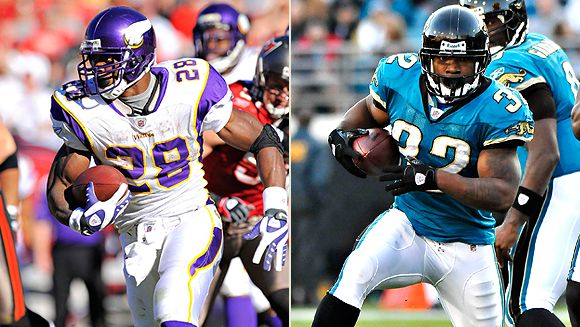
A typical first round will include 10 or 11 running backs with a quarterback or a wide receiver sneaking in late to break up the streak. With the trend of taking the onus away from the RB position, there has been a small, but growing movement towards drafting a WR late in the first round. The theory goes that the RBs available that late (and early in the second round) aren’t all that much better that those that are available in the late third or early fourth. So instead of following the herd, why not draft a WR like Larry Fitzgerald or Andre Johnson that will give you an advantage at another position? After all, in PPR leagues, Fitz and AJ might very well be expected to score more points than Adrian Peterson.

This year, for owners stuck with a late pick in the first round, this strategy looks solid, but it should (probably) only be utilized in those leagues that have a flex position instead of a RB2 or those leagues that award one point per reception. Instead of drafting Steve Slaton or Chris Johnson, go with Fitz or AJ. Guys like Ronnie Brown, Darren McFadden, Kevin Smith, Pierre Thomas, Ryan Grant, Derrick Ward, Knowshon Moreno and Marshawn Lynch may be available at the 3/4 turn – would anyone be shocked if one or more of these players outperformed Slaton or Johnson? And if you’re in a league that features both a flex position and one point per reception, don’t be afraid to go WR/WR with your first two picks. Yes, you’ll really be zagging when everyone else is zigging, but you really only need to find one good running back to start with your next several picks and you’ll already have a huge advantage at WR1 and WR2.

But if you’re in a non-PPR league with two starting RBs, then it’s usually wise to go RB/RB with your first two picks. Fitz or AJ would be tempting early in the second round, along with Reggie Wayne, Randy Moss, Steve Smith and Calvin Johnson a little later on, but by the time the 3/4 turn rolls around, there isn’t going to be much left at RB.

Still, with all of those aforementioned backs, a few are bound to be available. So let’s focus on a few players that should be available in rounds 3-7 and try to identify the best values of the early-middle rounds. We’ll also provide rankings for the entire RB position, broken into tiers.

Continue reading »
Ozzie Guillen warns opposing pitchers

Guillen

White Sox manager Ozzie Guillen is sick and tired of his batters getting beaned, intentional or not.

Guillen was upset Sunday after Paul Konerko, Scott Podsednik and Gordon Beckham got hit by pitches by the Cleveland staff a night earlier in Chicago’s 8-5 win. Guillen acknowledged he didn’t think the Indians were throwing at them, but he’s had enough of watching his players get hit.

“Yesterday I get upset, they hit one guy and they throw in into another guy. I got upset. I know for a fact they’re not throwing at nobody, but enough is enough,” Guillen said. “I have Konerko bruised all over the place. Around the league, be careful because we’re going to hit people. I don’t care if I get suspended because I need to protect my players.”

The White Sox have been hit by pitches 45 times this season, fifth in the majors. The Indians have been hit 65 times, most in the majors.

I feel like this “retaliation” is happening a lot this season. When players get hit, the other team later throws at their star player. This seems to be happening even in games where the outcome is a forgone conclusion and I’m not sure why. The issue is only getting worse. When Prince Fielder was hit by Guillermo Mota, he tried to confront Mota in the locker room after the game. Of course, Mota only threw at Fielder because the Brewers hit Manny Ramirez.

I know Ozzie Guillen is trying to protect his batters by issuing this warning, but he should care about being suspended. Teams need their managers and Guillen knows this. White Sox owner Jerry Reinsdorf can’t be too pleased. He’s paying Guillen to manage games, not get thrown out of them.

If a player is crowding the plate then fine, brush them back. Guillen’s right in that if the pitcher is unable to do that without hitting the batter, then he shouldn’t even attempt it. It just makes for messy baseball and umpires need to wise up. They’re beginning to crack down on pitchers, but they’re going to need to be even stricter if this continues.

Ortiz represents our immunity towards steroids

Steve Buckley of The Boston Herald thinks that fans will just have to deal with the fact that some of these players may not have known what substances they were actually taking in the past. Since the players might have been in the dark, the fans will never get answers.

In what continues to be a complicated issue in which facts and innuendo collide, creating an awkward, interpretative truth, it comes down to this: Anybody with an interest in baseball, from fans and media to industry employees and the players themselves, is forced, in the end, to make a judgment call about all this.

It’s a little like viewing an abstract painting: What you see, what you feel, may be far different from what the person standing next to you is seeing, feeling.

And so it is with David Ortiz.

But perhaps some Yankees – and some of Big Papi’s teammates – viewed the entire scene from afar, wondering if their name will be the next released.

It’s the world in which the players now live.

It’s the world in which anyone who follows baseball now lives.

I hate all this pussyfooting. If a player took a supplement that “may or may not have contained steroids,” I view the issue in the same light as just doing the real drugs. It’s like finding a paper bag full of money hidden in a bush. You know that money is there under shaky circumstances, but you might take it anyway and walk away with an unexpected payday. Still, it’s not kosher. These players knew they were getting into some risky business when they walked into these “stores” or “doctor’s offices” and are willing to feign ignorance.

Find a picture of David Ortiz from the height of his career. Now look at Mark McGwire, Barry Bonds, and Alex Rodriguez from theirs. Now go find a photo of Hank Aaron from any point of his career. Case closed.

If guys like David Ortiz really cared about “keeping it clean,” they would have made sure the substance didn’t contain a steroid. Whatever he was taking, it allowed him to put up bloated numbers that he’ll never again be able to replicate. To me, that’s evidence enough. I hope I’m proven wrong. Then again, like most real baseball fans, I take the last 15 years of the game with a grain of salt.

Hank Aaron never hit over 50 home runs in a season. However, he did hit 755 in his career, but none of them went over 500 ft. into impossible territory. I don’t think too much about the suspicion surrounding Ortiz because I already know the answer. None of those guys were for real.

« Older posts Newer posts »