Category: MLB (Page 307 of 448)

Media Reactions: Phillies heading to World Series

The Philadelphia Inquirer writes about the thirstiest sports town in the universe finally draws closer to title drink.

– Bill Plaschke of The L.A. Times writes about Dodgers’ fans booing their club into the offseason after their terrible performance in Game 5.

– T.J. Simers writes that even though the Dodgers fell short, Manny Ramirez made them important again.

– Rich Hofmann writes that the Fightin’ Phils get to write a new chapter in their history.

– Bill Shaikin writes that Dodger veterans Jeff Kent, Greg Maddux and Nomar Garciaparra deserved a better ending.

– Bob Ford reminds Phillie fans to savor this victory.

The Numerology of the Cy Young Award

Calling all stat-heads! Fire Ned Colletti Now has just done an in-depth piece on the 2008 NL Cy Young Award. They detail who should win the honor using statistical analysis, but they justify their reasoning along the way. If you’ve every been confused by how terms such as WHIP, VORP, and FIP actually factor into this type of decision making, give it a read.

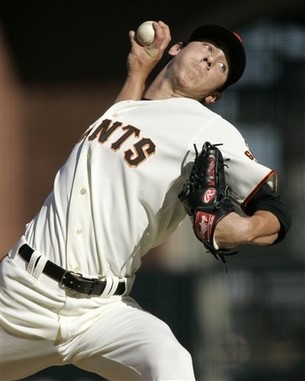
Tim LincecumAs far as what I will measure the pitchers by, I feel that the most important statistics are ERA, WHIP, and VORP. ERA’s importance is even recognized by the most staunch traditionalists. It measures the pitcher’s primary reason for being out there: to prevent runs from scoring. WHIP is a “new” statistic by mainstream standards, but when explained, I think traditionalists would agree it makes sense as well. It’s a statistic that revolves around a pitcher’s control and ability to limit hits. Less baserunners is obviously a good thing for the pitcher. VORP is where things get cloudy for a lot of baseball writers. It’s one of those magical and mystical statistics that seems to daze and confuse them. I think it’s valuable because it shows, in the scope of total contribution, how effective a pitcher has been at preventing runs from scoring. If you don’t already understand, you’ll see what I mean later on.

One thing you’ll notice is that I don’t mention wins anywhere. Yes, I am one of those guys who thinks that it is a worthless statistic as far as measuring the worth of a pitcher’s performance. If you disagree, feel free to tell me about it. However, please do so by explaining why Livan Hernandez (13-11, 6.05 ERA) is a better pitcher than Jake Peavy (10-11, 2.85 ERA) in 2008. Thanks. I await your input, John Kruk.

All year, my gut instinct has been that Tim Lincecum should win the NL Cy Young. However, history has shown that players on struggling teams usually don’t win either the Cy Young or MVP. These are the same statistics used by the Baseball Writer’s Association of America, so it’s interesting to see someone break down why Lincecum is the best pitcher in the league. At 23 years-old, this kid is going to be in high demand after his five years with the Giants.

Chiefs’ president Carl Peterson is unreasonable

Tony Gonzalez is in the twilight of his career but he is still one of the top three or four pass-catching tight ends in the game. The Chiefs are surely in the midst (or at the beginning?) of a rebuilding effort, so why would they hold onto Gonzo when there was a third round pick on the table? The Chiefs’ president, Carl Peterson, apparently was holding out for a second round pick. The Packers, Eagles, Giants and Bills all showed interest, but that offer never came, so Gonzalez is still a Chief.

Barring a few slight differences, this scenario is pretty similar to the Brett Favre situation this summer. Both players are All-Pro caliber and both are going to probably play one or two more seasons. The Packers traded Favre for a conditional fourth round pick that will turn into a third round pick if Favre plays at least 50% of the Jets’ snaps. It could turn into a second round pick if Favre plays 70% of his team’s snaps and the Jets make the playoffs.

So the market value for an aging, still productive Pro-Bowler is a second or a third round pick. It’s fine to hold out for a second rounder, but if your team is rebuilding and no one is willing to offer that up, take the third round pick! What good does it do you to have a grumpy Tony Gonzalez on your roster?

Not only that, but it’s a slap in the face of Gonzalez. Peterson deems that extra round more important than allowing the face of your franchise to go somewhere else and have a chance at a title. Everyone in Kansas City realizes that they aren’t going to be making a Super Bowl run in the next two years, so why not let Gonzo have a shot elsewhere?

Torre remains confident after terrible decisions

TorreFor the majority of the season, Joe Torre faced criticism for failing to move the Dodgers to the top of their division. His talents as a World Series-caliber manager were questioned: Was it Torre that got the Yankees into the playoffs, or the players alone? As he always does usual, Torre remained calm and optimistic. Then, Manny Ramirez came around and the Dodgers found themselves sweeping the Cubs in the NLDS. The negative remarks quickly quelled, and Torre was once again hailed as a genius. But after his decisions in Game 4 of the NLCS on Monday, that harsh criticism has resurfaced.

In street clothes and a blue cap bearing the name of the Safe At Home Foundation he created, Torre took the podium for a noon news conference and answered questions about the widely scrutinized decisions he made in Game 4 — from his call to pull Derek Lowe in the sixth inning to his choices about which relievers he used and when.

Torre said he didn’t second-guess any of his decisions.

“You wish the result was different,” he said. “If we all know the results, we certainly say, ‘Yeah, maybe I should have done that and done this.’ But with what I had at hand and knowing what I wanted to do, the only thing I’d like to change is the result.

“I have a two-run lead in the seventh inning, the game’s in my court and then the winning home run is hit off my closer.

“I don’t know what I could say to myself that would change what I would do, to be honest with you.”

The only change Torre said he envisioned making today would be to re-insert Matt Kemp into the lineup. Kemp, who has hit .208 in his six postseason starts, had his place in center field taken by Juan Pierre in Game 4.

I’ve always been a fan of Joe Torre. When he arrived in Los Angeles, he did the best he could with what Dodgers GM Ned Colletti had given him. Without a big bat in the top of the order, he still remained neck and neck with Arizona. Manny was only the missing link, and he certainly proved it.

Still, even with Ramirez in the lineup, Torre has made some confusing decisions. Monday against the Phillies, he pulled Lowe in the top of the sixth, after only throwing 70 plus pitches and giving up two runs. Granted, he was only on three days rest, but he has just pitched his only one-two-three inning of the game. Then, he pulls Hong Chi Kuo—a pitcher the Phillies have been awful against—after giving up one single to Jimmy Rollins. These two decisions probably cost the Dodgers the series. Torre brought in all the wrong pitchers at all the wrong times. A string of bad decision killed Dodgers chances of tying this series: a twenty-year old Clayton Kershaw, a struggling Chan Ho Park, an inconsistent Joe Beimel, and a tired Cory Wade. With nowhere to go, in the top of the eighth inning Torre brought in their young, overworked closer, Jonathan Broxton. After elder statesman Matt Stairs hit a monster homerun into the right field pavilion, the Dodgers fans fell silent. Joe Torre’s critics, however, erupted.

Torre needs Chad Billinglsey to give him at least six good innings in the game tonight. If this doesn’t happen, the Dodgers are finished. However, with a lead going into the seventh, the Dodgers have two strong relievers in Kuo and James McDonald, who shut down the Phillies in Game 2. Then, it will come down to Big John Broxton, who’s hopefully learned a thing or two from Matt Stairs.
« Older posts Newer posts »