Category: Fantasy Football (Page 7 of 324)

Jemele Hill and Skip Bayless react to Jenn Sterger interview [video]

I broke down the first part of her interview yesterday, and generally speaking, I think Hill is missing the point. Sterger wants to answer charges that she’s a gold-digger, and apparently she’s not. She hasn’t profited from this situation at all. Good for her. But she also wants to answer charges that she’s a home-wrecker, and those accusations are not so easily dismissed since she did engage in some sort of interaction through text message with Favre for a period of time.

If she wasn’t interested in what he had to say, then she never should have responded to him. Ignore his texts and voicemails and he’ll eventually go away. But she didn’t do that. She admitted to texting him but couldn’t recall what her texts were about, claiming that she was just trying to figure out who it was. So something doesn’t add up.

Regardless, I think we’re all ready for this story to finally go away. But let’s not leave this thinking that Sterger is some sort of victim. Had she not interacted with Favre via text or shared those texts/voicemails with friends, this story never would have seen the light of day. Favre is mostly responsible for the interaction/incident, but she was complicit by responding to those texts. And due to her poor choice in confidants, she was mostly responsible for this story becoming public.

Here’s the problem with Pro Football Talk

Arizona Cardinals receiver Larry Fitzgerald runs to score a touchdown on a pass from quarterback Kurt Warner during play against the Green Bay Packers in their NFL playoff game in Glendale, Arizona January 10, 2010. REUTERS/Rick Scuteri (UNITED STATES – Tags: SPORT FOOTBALL)

Pro Football Talk is associated with NBC and is a juggernaut in the industry (82K Twitter followers and counting), and while I appreciate the work that guys like Gregg Rosenthal and Evan Silva do in fantasy circles, some of PFT’s practices bother me.

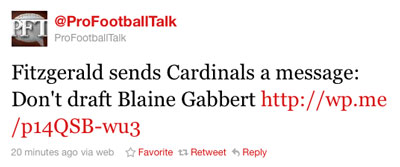
For example, I just saw this headline on Twitter:

Reading that, I’m thinking, “Wow, Fitzy must have said something pointed about Gabbert.”

Clicking through to the article, I see Fitzgerald’s actual quote:

“I would doubt that we would draft a quarterback that high (No. 5),” Fitzgerald told FOX Sports Arizona on Tuesday. “I would doubt it. But, who am I? I’m just a player.”

The author, Silva (whose work I generally respect), concluded that Fitzgerald must be talking about Blaine Gabbert, since the Cardinals have been linked to the Missouri QB.

Only Fitzgerald never mentioned Gabbert. And he never said that the Cardinals shouldn’t draft a QB. He just said that he doubted they would. Big difference.

Headlines are meant to drive interest and traffic, I get that. But this one was simply misleading.

What is a “pegged” cap and why should you care?

DeMaurice Smith, NFL Players Association Executive Director, makes a statement after negotiations collapsed between the National Football League (NFL) and National Football League Players’ Association (NFLPA) in Washington on March 11, 2011. The last real hope for a quick end to the dispute ended when the union representing the players (NFLPA) filed a court application to dissolve itself after failing to reach an agreement with league and owners over a range of issues. REUTERS/Joshua Roberts (UNITED STATES – Tags: SPORT FOOTBALL EMPLOYMENT BUSINESS)

The latest scuttlebutt out of the NFL labor non-negotiation negotiations is the idea of a “pegged” cap, which was reportedly brought up by the players. A pegged cap is a stable salary cap that is based on revenue projections and goes up at a set amount each season. The last CBA had a salary cap based on actual annual revenue that could go up or down each year depending on which way the wind was blowing.

Why does this matter?

Pro Football Talk’s Mike Florio explains…

If the actual numbers come in lower, the players still get paid. One major area of dispute has arisen from the question of whether and to what extent the actual performance exceeds the projected revenue growth. The owners’ offer of March 11 omitted that wrinkle; the players want to share in the upside.

The players, we’re told, prefer a “pegged cap” approach to expense credits because it entails simpler auditing and fewer disputes.

I’m on the players’ side in this debate, but if they are getting guaranteed pay no matter how the league is actually doing, then they can’t really demand a substantial share of the upside. If they have no downside, why should they get considerable upside?

Of course, it all depends on the projections used to create the pegged cap. If they’re conservative, and revenue is very likely to be greater, then the players do deserve a share. If the projections are aggressive, then the players should be happy they have stable salaries with no downside and forget about trying to get a piece of the additional revenue.

Florio continues…

As of right now, the two sides are $10 million apart per team on the the “pegged cap” approach, which is driven by projected revenues. The owners have offered $141 million per team in salary and benefits, and the players have requested $151 million. If they can bridge the gap and devise a procedure for handling any excess growth, they should be able to do a deal fairly quickly.

Well, that’s awfully optimistic given the current status of the negotiations, which are at a standstill. The two sides need to get talking again, but that is unlikely since they’re waiting on the courts to decide the fate of the lockout.

Tick-tock, people! (Don’t they know I have fantasy football rankings to put together?)
Which DTs were most productive in 2010?

Other positions: QB | RB | WR | TE | DT

When doing a postmortem on any fantasy football season, I like to look at how a particular player performed on a per game basis adjusted for his strength of schedule (SOS). DTs are no different, except that they all played the same number of games. SOS will have an impact, but the per game aspect of it won’t make much of a difference.

Keep in mind that I used the following scoring system:

DT/ST TD = 6 points
Safety = 2 points
INT = 1 point
Fumble = 1 point
Sack = 1 point

Defensive Points Allowed
Shutout = 10
2 – 6 = 8
7 – 10 = 6
11 – 14 = 4
15 – 19 = 2
20+ = 0

Here’s a look at how the 32 DTs stack up against each other when SOS bias is removed:

Continue reading »

Which TEs were most productive in 2010?

Other positions: QB | RB | WR | TE | DT

Here’s a look at the Top 50 TEs of 2010 in terms of adjusted fantasy points per game, which is calculated by dividing the player’s total points by the number of games he played and then adjusting the result by the average schedule bias for his team. Keep in mind these are points scored in a standard (non-PPR) scoring system. (The PPR table is further down.)

Continue reading »

« Older posts Newer posts »