Category: Fantasy Football (Page 13 of 324)

Key factors in the NFL CBA negotiations

I’m in Las Vegas at the Fantasy Sports Trade Association conference and one of the panels yesterday featured former Packer VP Andrew Brandt (current president of the National Football Post) and sports agent Blake Baratz discussing the ongoing collective bargaining agreement negotiations between the NFL and the Players’ Association.

Here are the key points of contention:

1. Share of revenue.
The players currently get 59% of the pie and the owners would like to see that share reduced. This is obviously a contentious issue.

2. An 18-game season.
The NFL wants to expand the regular season by two games while eliminating two preseason games. This would be a boon for the owners since regular season games bring in more revenue than preseason games. For the players, this is a health and safety issue and one concession that the owners could make might be in the area of health benefits and post-career pensions.

3. Guaranteed salaries.
This is not a big deal with regard to established players like Peyton Manning, who is in the midst of negotiating a contract that would make him the highest paid player…ever. Baratz believes that the main issue is with the Top 10 players in the draft. There is a ridiculous amount of money being thrown at unproven players and everyone (outside of the ten young men who will be drafted that early) would like to see that amount of money reduced. Baratz believes that there isn’t much of a difference between an early first round player and a late first round player, yet the monetary difference is huge, and those fat contracts (think JaMarcus Russell or Ryan Leaf) can hamstring a franchise for years if that player doesn’t pan out. However, the two sides won’t necessarily agree on what to do with the money. The veteran players would like to see it spread around the rest of the league while the owners might just want to cut that cost out completely.

4. Health benefits.
This is more important to the rank and file players than the stars who make far more money, but as of March 3, NFL players will have no health benefits. Brandt mentioned a story where one player asked another if he and his wife should plan to induce labor so that the delivery is covered by insurance.

5. Salary cap.
When we headed into the 2010 season without a salary cap, many pundits were worried about how out-of-control owners would spend, spend and spend some more. Instead, we’ve seen the opposite, with teams slashing salary and going under the salary cap floor. The Players’ Association needs that salary floor to keep players’ salaries up, so they’ll no doubt agree to a similar salary cap structure that was found in the previous CBA.

Both men are optimistic about a deal getting done relatively soon, and place the chances of something getting done before training camp at around 90-95%.
To Packer fans, this is the game that matters

Chicago Bears fans cheer their team as they play the Seattle Seahawks during the fourth quarter of the NFC divisional playoff at Soldier Field in Chicago on January 16, 2011. The Bears won 35-24. UPI/Brian Kersey

As this week has progressed and it has finally hit me that my beloved Packers are really playing for a Super Bowl berth on Sunday, I’ve realized something — beating the Bears on Sunday is more important than a potential matchup with the Steelers or Jets in two weeks.

In other words, if someone guaranteed me that Green Bay would win on Sunday, but it would mean a guaranteed loss in the Super Bowl, I’d be all right with that. I’d take that guaranteed win over our arch-rival instead of letting this four-team tournament play itself out.

Why? Because if the Packers lose, Bears fans will be insufferable. Chicago will probably go on to lose to whichever AFC team wins on Sunday, but it won’t matter. Bears fans will gloat about how they knocked the Packers out, and how nobody gave them any respect, and how Jay Cutler is headed to the Hall of Fame, and how Mike Martz is a genius, and how a dynasty is forming, etc.

Continue reading »

How did the Packers get here?

With the Green Bay Packers getting ready to face the Bears in the NFC Championship Game this weekend, it’s a good time to stop and reflect on a franchise that was in a serious state of flux as recently as two-and-a-half years ago, when Aaron Rodgers took the reins from Brett Favre.

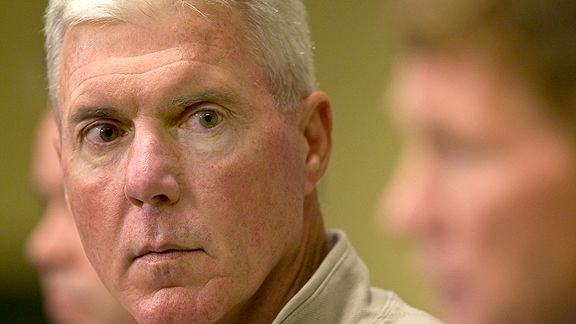
Ted Thompson is the man who made that call (and countless others) over the past six years, so he’s ultimately responsible for the Packer roster as it stands. A roster that is playing very good football and has enough depth to withstand 15 players on injured reserve, including starters Jermichael Finley, Nick Barnett, Ryan Grant, Brandon Chillar and Mark Tauscher.

Let’s go year-by-year and look at each draft, along with any major transaction that Thompson made.

2005

Thompson took over in January of 2005, with the Packers coming off a 10-6 season and a first round loss to the Vikings at Lambeau Field. Mike Sherman was stripped of his personnel duties, and Thompson was brought in to call the shots.

The 2005 season was a rough one. The Packers went 4-12. Favre tossed 29 interceptions and the Packers were 31st in turnover ratio. It was an excruciating season as Green Bay was just 1-5 in games decided by three points or less. Part of the problem was Thompson’s unwillingness to pay free agent (and Pro Bowl) guards Marco Rivera and Mike Wahle. The O-line struggled, and so did the Packers.

Here’s a look at that Thompson’s ’05 draft: (1) Aaron Rodgers, (2) Nick Collins, (2) Terrence Murphy, (4) Marviel Underwood, (4) Brady Poppinga, (5) Junius Coston, (5) Mike Hawkins, (6) Michael Montgomery, (6) Craig Bragg, (7) Kurt Campbell, (7) Will Whitticker

Note: Players in bold are starters. Players no longer with the team are in italics.

Of the 11 players selected in that draft, just three remain. But they’re three good ones. Collins was named to his third consecutive Pro Bowl this season and if Rodgers isn’t a top 5 QB, he will be soon. He also landed a starter-caliber LB (Poppinga) in the fourth. Thompson knew that he had to be patient with Rodgers, especially with Favre still on the roster and capable of MVP-type numbers. He passed on a player that could help immediately in order to draft the QB of the future, and he took some grief for it.

Obviously it worked out for the best.

Continue reading »

« Older posts Newer posts »