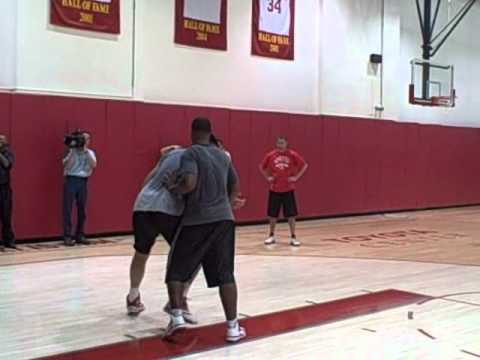
The big fella is moving around well in this recent workout:
Category: Fantasy Basketball (Page 51 of 274)

Grizzlies owner Michael Heisley is a character. He appeared on the Chris Vernon Show recently and got into a…um…spirited debate over whether or not the Grizzlies should exercise a little-known clause in the collective bargaining agreement that allows for teams to negotiate a performance incentive into rookie contracts.
Xavier Henry is still unsigned due to Heisley’s insistence on this performance incentive. Rookie contracts are generally ‘rubber stamp’ type deals where the player gets the max (120% of the rookie scale) and he signs immediately. Heisley claims that the Grizzlies are not the only team to use this strategy, but he was unwilling to name any names and I certainly haven’t heard of any other teams doing so.
On the show, Heisley is passive-aggressive, condescending and entertaining, and in addition to the Henry negotiations, he defends the Pau Gasol trade, the Zach Randolph acquisition, and his decision to draft Hasheem Thabeet over Ricky Rubio.
Matt Moore of CBSSports called the interview an ‘abject trainwreck,‘ while Chris Harrington of the Memphis Flyer called it ‘borderline-embarrassing.’

Bill Simmons’ latest column delves into ‘chewed-on theories’ and one question he tries to answer is why Shaq would sign with the C’s for the league minimum. He believes it goes back to Kobe’ response after Game 7 of the Finals when he was asked what this title meant to him.
His response?
“I got one more than Shaq! You can take that to the bank.”
O’Neal signed with Boston because “when I close my book at the end of the day, it’s all about winning and nothing else.” This was someone who told a teammate before the final game of his 2009 Suns season — when they had just been eliminated from playoff contention — that he “needed to start getting in shape for my reality show.” Game 82 and you need to get in shape? Huh? Now you suddenly care about winning titles again? Now you’re fine with swallowing your dignity to be a spare part, a minimum guy, an afterthought, someone with no security at all? Just to chase a ring? When you already have four?
My theory: I think Kobe’s postgame routine got back to Shaq. I think it pissed him off. I think it got his competitive juices flowing for the first time in years. I think he realized Boston was his best chance to tie Kobe at five. I think he wants this more than anything. I think he shows up next month in surprisingly good shape, and I think we’ll be saying in November, “Wow, that Shaq signing may have been a great move by Boston!” And I think this will happen for only one reason: because Shaq hates Kobe and Kobe hates Shaq. Just a theory.
It certainly seems reasonable. My sense is that Shaq is not happy with the way things went in Phoenix or Cleveland and is hoping to make him relevant again for one more playoff run. Of course, he’d love to beat the Heat and the Lakers along the way.

Chris Dempsey of the Denver Post thinks so:
Meanwhile, if the Nuggets cannot convince Carmelo Anthony to sign an extension with the team and they decide to trade him at some point, could it be to the Los Angeles Clippers? I’m hearing it could be a possibility. It would get both he and his wife, La La, out to where entertainment opportunities are plentiful, which is key factor in their decision to want to move on. The Nuggets might be able to get a good young player or two or draft picks, and Anthony would be able to play on a team with some good up-and-coming talent.
“I’m hearing it could be a possibility.”
I love statements like that. He’s not saying that it’s a possibility, he’s saying that it could be possible. In other words, it’s possible that it’s possible.
Great.
Clipper fans are a loyal, downtrodden bunch. Let them be. They just missed out on LeBron James even though they were never really in the running. Owner Donald Sterling vastly underestimates how bad his image is around the league, and the Clippers aren’t likely to have sustained success until he sells the team.

Longtime coach Don Casey has a few ideas, specifically the matchup zone…
The matchup zone will accomplish the following against Miami:
1. It will neutralize the Heat’s athleticism.
2. It will disrupt Miami’s offensive rhythm.
3. It will impede the pick-and-roll drastically.
4. It will contain or push out or down Miami’s drive and kick plays.
5. It will force the Heat’s offense to take time. The matchup makes the shot clock your ally.
6. It will make the Heat a “catch and shoot” team. How many of those players does Miami have? I’m not talking about spot-up shooters; I’m talking about guys who can catch and shoot. I see maybe one, Mike Miller.
7. It will make Miami’s offense more routine, and the more routine an offense, the easier it is for a defense to groove into its schemes.
8. It can make Miami think “zone” even if the other team is back in man-to-man defense.
This is a tall order, for sure. If executed correctly, a good matchup zone can even the playing field. But most teams aren’t used to playing zone, while the Heat will see it quite often. This could be a bad combination.
Pick and rolls don’t work very well against zones, so the Heat will have to have a game plan that involves cutting and passing. A great spot to attack the zone is the short corner (along the baseline, just outside the paint). When a team runs a player along the baseline, he can pick and choose the open spots in the zone, catch a pass and possibly score or hit an open man for a bucket or a wide open jumper.
Players can’t just stand on one side or another against a zone, because it’s too easy for the defense to keep track of them. They need to move from side to side, along the baseline, up through the paint…whatever it takes to make the defense adjust.
FOLLOW US!

CATEGORIES
© 2026 The Scores Report – The National Sports Blog
Theme by Anders Noren — Up ↑