Category: Fantasy Basketball (Page 4 of 274)

Who is the best overall big man in the NBA?

Orlando Magic’s Dwight Howard (R) drives on Los Angeles Lakers’ Andrew Bynum during the first half of their NBA basketball game in Los Angeles, California March 14, 2011. REUTERS/Lucy Nicholson (UNITED STATES – Tags: SPORT BASKETBALL)

For an explanation of my methodology, check out my point guard post from a few days ago. Marcin Gortat was the only big man in the study that was traded and since he was traded early and played much bigger minutes in Phoenix, I just ignored his Orlando numbers.

Below is a chart of 51 big men. Why 51? Because it’s my study, that’s why. Round numbers are overrated anyway.

Continue reading »

Who is the best overall wing in the NBA?

Miami Heat’s Dwyane Wade (R) steals a rebound from Los Angeles Lakers Kobe Bryant during third quarter NBA basketball action in Miami, Florida March 10, 2011. REUTERS/Hans Deryk (UNITED STATES – Tags: SPORT BASKETBALL)

Follow John on Twitter.

For an explanation of my methodology, check out my point guard post from yesterday. The only difference with the wings is that I found a way to account for a full season of Opponent PER and Net Defense stats for those players that were traded, so we won’t see the outliers that we saw in the point guard study.

Below is a chart of the Top 52 wings in the NBA. I took the Top 48 in terms of Efficiency Per Game and then added four players (Marcus Thornton, Tony Allen, Ron Artest and Ben Gordon) that I was interested in studying. As always, click on the chart to see a bigger version.

Continue reading »

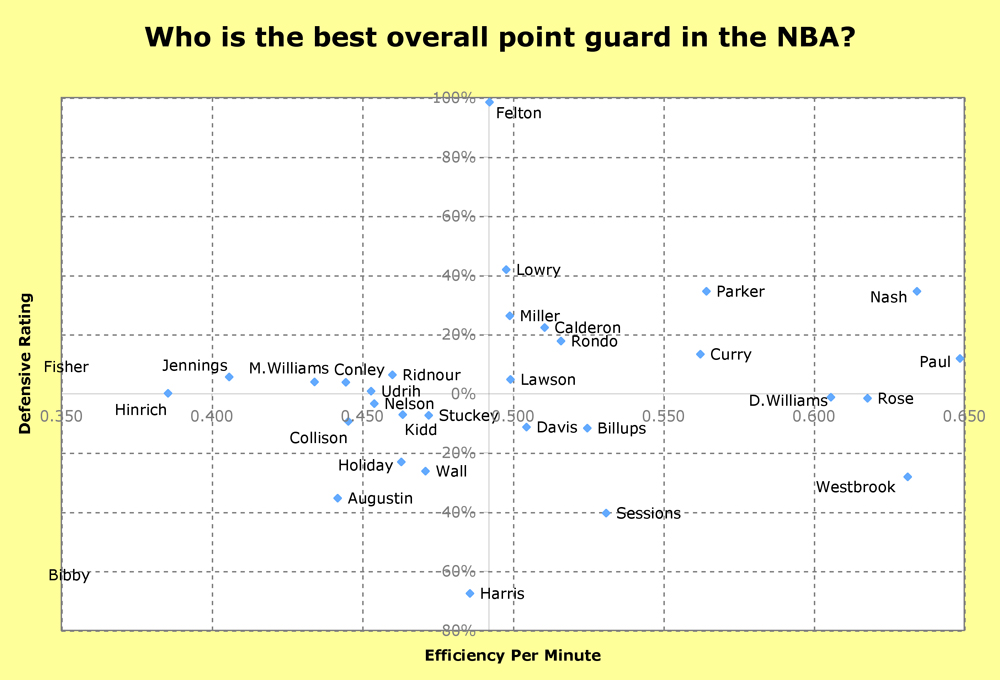
Who is the best overall point guard in the NBA?

Phoenix Suns guard Steve Nash celebrates after his teammate Hakim Warrick scored to put the New York Knicks down nine points very late in the fourth quarter of their NBA basketball game at Madison Square Garden in New York January 17, 2011. REUTERS/Ray Stubblebine (UNITED STATES)

Follow John on Twitter.

Who is the best overall point guard in the NBA? The answer to this question depends on your criteria. Are you using the eye test or are you more interested in basic stats like points, assists and turnovers. Or do you want to use advanced statistics like Player Efficiency Rating (PER) or plus/minus numbers?

I am a stathead, but numbers only go so far. A point guard’s leadership, presence, poise, vision and defense is just as important as his shooting percentage or his assist to turnover ratio. As a former college player I think I know the game pretty well and I understand that numbers only go so far.

That said, let’s look at some numbers!

I like to use Efficiency Per Minute as a good overall gauge of a player’s production when he’s on the court. For this study, I took the top 30 players in Efficiency Per Game and then added a few players so that every team would be represented at least once.

EPM doesn’t take into account defense (except for steals, blocks and defensive rebounds), so for that side of things, I am putting together a custom statistic that uses both Opponent PER and on/off defensive stats from 82games.com. So, for Tony Parker, I’ll use his 48-minute opponent PER (15.1) and his Net Defense per 100 Possessions (-3.8). Both of these stats are flawed. Opponent PER doesn’t take into account what kind of team defender Parker is while his net defense could be impacted positively (or negatively) if his backup is really poor (or really great) defensively. There may also be bias of strength of schedule (i.e. there are better point guards in the West). But this is what we have to work with.

Using both Opponent PER and Net Defense, I came up with a Defensive Rating that weights each number equally versus others in this study. If the Defensive Rating is positive, he’s a better than average defender. If it’s negative, he’s below average.

Keep in mind that the EPM numbers are for an entire season while the 82games stats are only for a player’s current team, so the defensive rating for players who were traded midseason — Ray Felton, Chauncey Billups, Mike Bibby, Deron Williams, Mo Williams, Baron Davis, Devin Harris and Kirk Hinrich — will only factor in games after they were traded.

Here’s a look at the resulting chart. As always, click on the chart for a bigger version.

Continue reading »

Who is the best rebounder in the NBA?

Minnesota Timberwolves forward Kevin Love (42) holds back Dallas Mavericks forward Brian Cardinal (C) in front of Timberwolves’ Michael Beasley (R) during the first half of their NBA basketball game in the Target Center in Minneapolis, March 7, 2011. REUTERS/Eric Miller (UNITED STATES – Tags: SPORT BASKETBALL)

Over the past few weeks, I’ve tackled the MVP race, triple-dozens, point guard characteristics and three-point shooters, and now it’s time to take a look at rebounding.

To be eligible, a player has to meet the following criteria:

1. He must appear in at least 50 games.
2. He must play in at least 24.0 minutes a game.

I took the top 30 players in terms of Total Rebounding Rate (the number of rebounds a player gets as a percentage of total available rebounds available while he’s on the floor) and plotted Offensive Rebounding Rate (ORR%) against Defensive Rebounding Rate (DRR%).

Here is the list of eligible players (in alphabetical order): Andrew Bogut, Carlos Boozer, Kwame Brown (yes, Kwame Brown), Marcus Camby, Tyson Chandler, DeMarcus Cousins, Tim Duncan, Kevin Garnett, Pau Gasol, Marcin Gortat, Blake Griffin, Chuck Hayes, Roy Hibbert, J.J. Hickson, Nene Hilario, Al Horford, Dwight Howard, Kris Humphries, Serge Ibaka, Josh Smith, Al Jefferson, Amir Johnson, DeAndre Jordan, David Lee, Kevin Love, JaVale McGee, Greg Monroe, Lamar Odom, Emeka Okafor and Zach Randolph.

Below is the chart. As always, click on it to see a bigger version.

Continue reading »
« Older posts Newer posts »