Category: External Sports (Page 291 of 821)

Pujols disappointed with slow pace of negotiations with Cardinals

St. Louis Cardinals Albert Pujols sits in the dugout watching the scoreboard in the bottom of the ninth inning against the Cincinnati Reds at Busch Stadium in St. Louis on September 4, 2010. Cincinnati won the game 6-1. UPI/Bill Greenblatt

Albert Pujols began negotiations with the Cardinals for a long-term contract over a month ago, yet the two sides appear no closer to agreeing to a deal today as they were back then. And according to Joe Strauss of the St. Louis Post-Dispatch, this has left Pujols feeling disappointed with the process.

DeWitt has maintained that he believes the window for negotiations could remain open through spring training. However, implementation of the deadline in the first place probably reflected growing frustration by Lozano and his client about the virtual absence of negotiations last spring training and earlier this winter.

At his client’s urging, Lozano has offered little public comment during the last 11 months about the process. However, that hasn’t prevented sources close to Team Pujols from noting the first baseman’s disappointment over a process that has never reached high gear.

As an outsider, it feels like the Cardinals are dragging their feet. Maybe they’re hoping that the longer they wait, Pujols will eventually accept a “discount” to stay in St. Louis. But as it stands right now, Pujols’ camp has stayed steadfast in saying they want a deal similar to A-Rod’s 10-year, $275 million contract or the best player in baseball will test the free agency market in 2012.

This situation is complicated but the decision is rather clear-cut. Either the Cardinals pony up and pay Pujols one of the richest contracts in baseball history or they allow him to walk and face intense public scrutiny. There aren’t any other options as the situation current stands, because Pujols has already put the kibosh on any potential trade.
Super Bowl XLV Prediction: Steelers vs. Packers

Green Bay Packers quarterback Aaron Rodgers throws a pass against the New York Jets in the second quarter in week 8 of the NFL season at New Meadowlands Stadium in East Rutherford, New Jersey on October 31, 2010. The Packers defeated the Jets 9-0. UPI /John Angelillo

When I saw that oddsmakers had made the Packers 2.5-point favorites for Super Bowl XLV, my immediate reaction was: “Pittsburgh’s an underdog? Ha! Give me the Steelers…you’re welcome.”

Why wouldn’t you take the Steelers on Sunday? They’ve played in two Super Bowls the past six years and won them both. They have a more experienced head coach who oversees a more experienced quarterback. Ben Roethlisberger is 2-0 in the “big one” and thanks to Dick LeBeau’s guidance, Pittsburgh’s defense often resembles an immovable force.

But then I got to thinking: Tom Brady lost in the Super Bowl, as did Peyton Manning and Brett Favre. Bill Belichick has lost in the championship, as has Mike Holmgren, Bill Cowher and even Tom Landry.

Experience flies out the window once that ball has been kicked off the tee at the start of the game. What football essentially comes down to is execution, avoiding mistakes and beating the guy across from you.

Both of these teams can execute. Both of these teams can limit mistakes and both of these teams have the players on each side of the ball that can win individual battles. Which team will accomplish those three feats on Sunday is anyone’s guess, and that’s the great thing about this particular matchup – it’s so even.

But when you get down to the brass tacks, the Steelers have a big problem along their offensive line. Losing Maurkice Pouncey hurts, but having two offensive tackles that are below average pass-blockers is a bigger problem when you consider the Packers finished second in the league in sacks. Granted, Pittsburgh finished first in that category but I have more faith in Green Bay’s O-line protecting Aaron Rodgers than I do the Steelers’ front five protecting Big Ben.

Continue reading »

Five ways the Steelers beat the Packers in Super Bowl XLV

Pittsburgh Steelers’ quarterback Ben Roethlisberger is seen on the field after the Steelers defeated the Baltimore Ravens 13-10 at M & T Bank Stadium in Baltimore on December 5, 2010. UPI/Kevin Dietsch

I’m not a NFL coordinator and therefore won’t act like I hold the secrets on how either team can win Super Bowl XLV. (Wait a minute – I don’t hold any secrets? What the fu…)

When it comes down to it, putting together a solid game plan is only half the battle. The players still have to execute and avoid mistakes and a great scheme won’t save a team that turns the ball over and commits penalties. But here are five ways the Steelers can get the upper hand on the Packers and take home the Lombardi Trophy on Sunday.

1. Run the ball right down Green Bay’s throat.
You have to look hard, but the Packers’ defense does have a weakness. Green Bay allowed 107.7 yards per game on the ground this season to finish a respectable 11th in that category, but they also allowed rushers to average 4.5 yards per carry. Only six teams (Indy, Washington, Denver, Jacksonville, Tampa Bay and Buffalo) gave up more yards per carry than the Packers, who struggled mostly against teams with power running games. The Dolphins, Vikings, Lions and Falcons (during the regular season – not the postseason) all had success running against Green Bay’s front seven. The Packers went a combined 3-3 against those teams, so running the ball at GB doesn’t necessary mean victory but it’ll certainly help the Steelers’ cause. The Steelers were 6-1 when Rashard Mendenhall rushed for over 80 yards this season. Feeding him the ball can help slow Green Bay’s pass rush, keep Aaron Rodgers off the field and help Pittsburgh control the tempo of the game.

2. Disrupt Rodgers’ rhythm by being physical with his receivers.
What the Eagles, Bears (in the first quarter) and especially, the Falcons, did in trying to defense Green Bay’s passing game was an absolute sin. Aaron Rodgers has outstanding vision, accuracy and makes wise decisions. He can read blitzes as well as any quarterback in the league and he gets the ball out of his hand in a timely manner. That’s why playing his receivers seven yards off the ball is a travesty. Midway through the second quarter the Bears realized they had to roll the dice with their corners and start being more aggressive in coverage. That’s part of the reason the Packers struggled to move the ball as well as they did after the first quarter. Ike Taylor is a fine corner and can certainly hold his own. But the Packers will look to exploit Bryant McFadden and William Gay, so both defensive backs must be physical at the line of scrimmage in order to disrupt Rodgers’ timing. LaMarr Woodley and James Harrison are two of the finest pass-rushers in the league. But instead of solely relying on the pressure that their front seven can produce, Pittsburgh also needs to be aggressive in its secondary or else Rodgers will continue his assault on opposing backfields.

Continue reading »

Using efficiency and win % to determine the 2011 All-Stars

Blake Griffin of the Los Angeles Clippers (R) prepares to shoot as Kevin Love (L) of the Minnesota Timberwolves defends in first half action at the Staples Center in Los Angeles, California USA 19 January 2011. EPA/MIKE NELSON CORBIS OUT fotoglif919014

Since the All-Star reserves will be announced tonight on TNT, I thought I’d try to come up with some sort of formula to calculate who should make the All-Star Game.

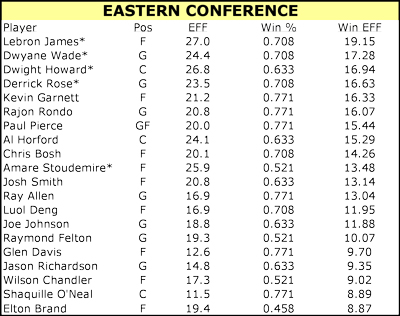
What’s important in an All-Star? Well, to me, it comes down to two things: stats and wins. So I took my favorite (and flawed) all-encompassing stat, efficiency, and calculated it on a per-game basis for each player. Then, I multiplied each player’s efficiency with his teams win percentage to come up with a new stat: Win Efficiency. (Please note that rebounds are easier to come by than assists, so big men tend to do better in overall efficiency than guards do.)

From there, picking the All-Stars would be simple. Take out the five starters for each conference, and fill out the roster with three guards, three forwards and a center. Surprisingly, the results came out pretty well. (By the way, I put an arbitrary minimum of 35 games played.)

Here’s a look at the top 20 players from the Eastern Conference:

Continue reading »

« Older posts Newer posts »