Author: Jeff Dooley (Page 2 of 4)

Curry, Lawson and Ellington enter loaded pool of guard talent in NBA Draft

Stephen Curry

As all eyes turn to today’s NFL Draft, why not take a moment for a little speculating about June’s NBA Draft.

Three significant underclassmen guards announced their entry into the NBA Draft this week – Davidson’s Stephen Curry and North Carolina’s Wayne Ellington and Ty Lawson – joining a talent pool already loaded with guards.

Here are list of a few more who figure to be in the running to be top 20 picks in this year’s draft:

Ricky Rubio, Spain

James Harden, Arizona State

Tyreke Evans, Memphis

Brandon Jennings, Italy

DeMar DeRozan, USC

Eric Maynor, VCU

Gerald Henderson, Duke

Jrue Holliday, UCLA

Terrence Williams, Louisville

Jonny Flynn, Syracuse

Jeff Teague, Wake Forest

Patrick Mills, St. Mary’s

The question is, where are these three newcomers going to go? ESPN’s Chad Ford doesn’t even have Ellington in his top 30 available prospects, and while he did come up big in the Tar Heels’ championship run this season, he had to withdraw from the draft last year because of a lack of interest from NBA teams.

Lawson’s stock is up this year, and he has the reputation of being one of the fastest end-to-end point guard prospects in the draft. But will NBA GMs side with him over the just-as-quick and better-shooting Jonny Flynn, Eric Maynor or Jeff Teague?

Same goes for Curry. From a production standpoint, he’s light years ahead of everybody on this list except perhaps Lawson or James Harden. But he would likely enter the NBA as the league’s skinniest player, and given teams’ tendencies to let workouts and physical potential rule the day, it may be tough for them to take Curry over say, a DeMar DeRozan, Tyreke Evans or even a Jrue Holliday – all players with NBA-ready bodies and major upside.
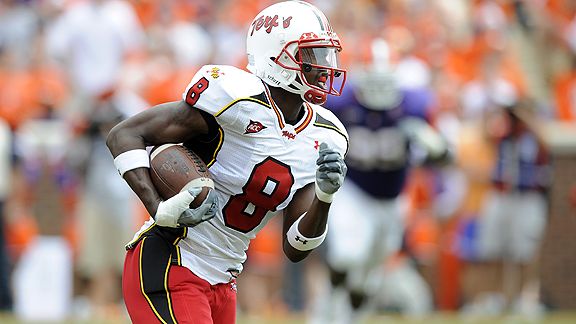
Athlete Profile: Darrius Heyward-Bey

Take one look at Darrius Heyward-Bey and it’s not hard to see why the University of Maryland prospect turns so many NFL scouts’ heads.

A muscular 6’3”, 206 pounds, Heyward-Bey has blazing speed. He ran the fastest 40-yard dash of any player at this year’s NFL combine. Had he wanted to, coming out of high school he would have had a good chance at winning an NCAA championship and possibly even qualifying for the Olympics in track. Instead, Heyward-Bey turned his attention to burning rubber on the field.

Despite having to play in the Terrapins’ struggling offense for three seasons, Heyward-Bey didn’t take long to establish himself as one of college football’s elite playmakers. Throughout his career, he turned out eight plays of 50 yards or more, scored 15 touchdowns (13 receiving, 2 rushing), and consistently averaged 15 yards per catch. He was able to do so all while being the only real offensive threat on a team that failed throughout his career to consistently move the ball.

The NFL is a league that values its playmakers. “Scoreboard changers,” as analysts dub them, are always one play away from ripping off a big play for their team. Players like Reggie Bush, Devin Hester, Chris Johnson and Steve Smith are valued greatly for their game-breaking abilities with the football in their hands. Heyward-Bey is cut from the same cloth, with his eye-popping athleticism, and it’s for this reason that NFL teams have stopped to take notice.

They’ve also noticed a few of his flaws, however. Heyward-Bey is not considered a consistent route runner at this point in his career, and he has frequently gone through slumps where he’s had trouble catching the ball consistently. These are two very undesirable qualities for an NFL receiver, where speed and playmaking ability alone do not guarantee success (see: Peter Warrick).

Continue reading »

Athlete Profile: Andre Smith

2009 has not been kind to Andre Smith.

His year got off to a rotten start, as he was suspended from the University of Alabama’s embarrassing Sugar Bowl loss to Utah. This incident caused questions about his character to surface, and the offensive tackle who had at one point been thought of as a potential no. 1 overall pick was suddenly on the defensive.

He didn’t help his cause any by showing up to the NFL scouting combine out of shape, then refusing to take part in drills before leaving the combine altogether without informing anyone. In just two months, Smith had gone from the draft’s hottest prospect to its most dangerous, as projections began to put Smith somewhere late in the first round.

Since then, however, teams appear to be warming back up to the mercurial lineman. They are remembering how dominant Smith was on the field last season, playing a huge role in the Crimson Tide’s surprise run to the top of the polls. They are remembering his unreal size-quickness combination, that the 6’4”, 332-pounder mauled defenders in the running game and was an impenetrable wall in keeping quarterback John Parker Wilson upright in the passing game.

Continue reading »

Athlete Profile: Brian Cushing

mill

For this season at least, the University of Southern California should be known as Linebacker U.

That title has traditionally been worn by Penn State University, but given that the Trojans will most likely have all three of their starting ’backers taken in the first round of this year’s NFL draft, it’s clear that an exception needs to be made.

Perhaps the least heralded of the trio is Brian Cushing, a 6-3, 250-pounder who has stayed somewhat in the shadow of the better-known Clay Matthews and Rey Maualuga. Cushing is no secret to NFL scouts, however. In fact, there is a school of thought among draft experts that it is Cushing who, of the three, may end up having the most successful NFL career.

The reasoning behind this thinking is due to a few things. For one, Cushing’s intensity level is unmatched. He was called a bulldog by both USC Head Coach Pete Carroll and linebackers coach Ken Norton, Jr. He plays the entire game at one speed – full speed – and can wreak absolute havoc on offenses due to his relentless motor and game-changing playmaking ability.

Another reason for the scouts’ love affair with Cushing is the New Jersey native’s versatility. He is capable of playing any linebacker position, both on the inside and on the outside – an asset that makes him capable of fitting in with any defensive scheme.

Lastly, teams can’t get enough of Cushing’s athleticism. He was actually recruited out of high school as a strong safety, but his work in the weight room led to such a dramatic weight gain that he grew into the linebacker position. Despite packing on the extra muscle, Cushing has managed to maintain the quickness and speed he displayed as a defensive back prospect.

As with every potential draftee, Cushing has a few question marks surrounding him. One is that he and the rest of his USC teammates look better on tape because they all have played with such a strong supporting cast. Critics claim that if they did not have each other, they would be less impressive individually as prospects. A more serious concern is one that has dogged him since high school, and that is the issue of steroids. Despite never having failed a single drug test, Cushing has had to consistently endure claims that he uses steroids, including a recently surfaced report that was categorically denied by Cushing’s handlers and coaches.

Continue reading »

Athlete Profile: Vontae Davis

Vontae Davis

Vontae Davis wants to be known as more than just Vernon Davis’ little brother.

And understandably so. After all, Vernon’s most noteworthy action of the 2008 NFL season was when the San Francisco 49ers tight end was banished to the locker room in the middle of a game by Head Coach Mike Singletary for demonstrating less than team-oriented behavior.

But when it comes to some comparisons, he’ll gladly take them. Like when his physical skills are compared to Vernon’s eye-popping athleticism and top-flight talent. Vontae says he owes a lot to Vernon, that his big brother helped him out in developing into the football player he has become – a football player poised to become a first-round pick in the 2009 NFL Draft.

Davis, an early-entry prospect out of the University of Illinois, is considered one of the top cornerbacks in the draft. The 6-0, 200-pounder possesses incredible athleticism, capable of both running with the league’s fastest receivers and coming up to the line of scrimmage both in run support and on corner blitzes. In three years with the Illini, Davis earned the reputation of one of the nation’s hardest-hitting defensive backs.

Continue reading »

« Older posts Newer posts »