Author: Christopher Glotfelty (Page 60 of 67)

Francisco Rodriguez signs with the only team that really wanted him: The New York Mets

K-RodAfter a record-setting 62-save season in 2008 with the Angels, Francisco Rodriguez has signed a three-year deal with the New York Mets. The $45 million contract, which includes an option for a fourth year, was reportedly the only offer from an organization other than the Angels.

Owner Arte Moreno said the Angels made as many as six contract offers to Rodriguez over the years, the last one for three years and $34 million in November 2007.

Rodriguez, believing his value was more in line with the three-year, $45-million deal Yankees closer Mariano Rivera signed that month, rejected the offer.

Rodriguez was hoping to parlay his record-setting season into a five-year, $75-million deal, but with a glut of closers available and only one big-market team in the hunt for one, Rodriguez’s market was severely depressed this winter.

Scioscia said the Angels wouldn’t necessarily enter 2009 with a set closer. Veteran setup man Scot Shields probably will be given the first crack at the job, and right-hander Jose Arredondo, coming off an impressive rookie season, will be considered.

Veteran left-hander Darren Oliver could pitch later in games, and hard-throwing youngster Kevin Jepsen will probably play a more prominent role. The Angels are also talking to the agent for free-agent left-hander Brian Fuentes, who could close.

Too bad K-Rod couldn’t just swallow his pride and stay with Angels, a team that will consistently have a shot at making the World Series. It seems like in the days of the modern bulky pitching contract (a la CC Sabathia), Rodriguez felt it with was about time he was given some monetary respect.

The Angels still made the right move. Scot Shields is an effective set-up man and if they can land Brian Fuentes as a closer, they should be in good shape. But pitching was never the Angels’ problem. As seen in the last fall’s ALDS, the only person who drove some runs in was Mark Texiera, and it appears that he’s who they’re going after.

And they should. Aside from Albert Pujols, Texiera is the best all-around first baseman in the game. He has a good attitude, a solid bat, and is a wall at first base. If I were Arte Moreno, the owner of the Angels, I’d sign this guy before Brian Cashman of the Yankees looks under his chair and finds $200 million that he had forgotten about after closing in on Sabathia earlier this morning.

Country clubs in peril?

country clubThe Wall Street Journal has been covering the ways in which our country’s struggling economy is affecting sports culture. The paper is reporting that many country clubs are on the brink of closing as members fail to renew their membership due to financial concerns.

For instance, you hear a lot of talk about the “walkaway” risk. This is a calculation of the leverage that clubs have or don’t have over members to keep them from leaving. At most clubs at least one newcomer has to join before a current member can cash in his bond, deposit or other type of equity stake and quit. If the annual dues are $7,500 and the equity stake is $20,000, most members will be inclined to stay put until a new member signs up. But if annual dues are high — say, $12,000 or $15,000 — and the projected clearing time on the resignation list is four years (not uncommon in this economy), some financially strapped members will choose to bail immediately.

Clubs don’t like that because dues and the additional spending of an active member are more important than $20,000 in the bank. That is particularly true for the many clubs these days that are servicing big debt loads piled up in better times for multimillion-dollar course renovations or clubhouse expansions, and for new clubs, some in stalled real-estate developments, that haven’t yet reached their full quota of members.

For clubs unable to adapt in their current form, the next step is often allowing paid play by outsiders at off-hours — that is, becoming semipublic — and after that full conversion to a public facility. At that point clubs often look for ways to sell off the property to housing developers or for other uses, giving equity members a windfall, but zoning laws make this impossible in all but about one in 10 cases, according to the National Golf Foundation study. Each conversion of a private club to a daily-fee course, usually a high-end one, gives would-be club members in that area one fewer reason to make the expensive, long-term commitment to join a club, and the cycle propagates itself.

There’s a country club where I live in southern California. However, there are also three public courses. The game has never particularly appealed to me; I can count the number of times I’ve played on one hand. Though the sport’s television ratings haven’t dwindled, its ability to entice kids to pick up the game has. The same has happened with tennis, as American youngsters typically opt to play football, basketball, baseball, and soccer. I had always been under the impression that country clubs would become obsolete because my generation would find better ways to invest their time and money. Turns out, the current economy is accelerating the process as would-be members can’t afford the fees. Instead, they’re playing the public courses like every Tom, Dick, and Harry.

Who will sign Rafael Furcal and Garrett Anderson?

FurcalThe Los Angeles Angels have passed on offering arbitration to veteran left-fielder Garret Anderson. This comes as no surprise since the organization previously spent $3 million to buy out Anderson’s $14 million contract. The Los Angeles Dodgers have also refused arbitration to a former All-Star, shortstop Rafael Furcal.

The Angels spent $3 million to buy out the $14-million option on Anderson’s contract, but Monday’s decision doesn’t necessarily mean Anderson’s 15-season career with the Angels is over. The team can still negotiate with the outfielder, who has hired Scott Boras as his agent.

Dodgers General Manager Ned Colletti said Furcal’s days with the team aren’t necessarily over.

“We obviously have interest in the player and the player has interest in being here,” said Colletti, adding that he spoke over the weekend to Arn Tellem of Wasserman Media Group, which represents Furcal.

But the Dodgers’ refusal to offer him arbitration is further evidence that Furcal’s demand for a four-year deal isn’t the only point of contention in their negotiations. The Dodgers are also reluctant to re-sign him at the average annual salary of $13 million he made over the three years of the contract he completed this year, and an arbitration hearing might have resulted in a raise.

The Angeles will be fine in the outfield, whether they decide to re-sign Anderson or not. They have Torii Hunter, Gary Matthews Jr., Juan Rivera, Vladimir Guerrero, and Chone Figgins, all who can play the outfield positions. Hopefully, the Angels are doing a salary dump with Anderson’s contract so they can secure Mark Texiera to at least a three-year deal. Texiera was the only Angel who could swing a bat in the ALDS against the Red Sox. If they lose him, they’ll be without a gold-glove first baseman and have to rely on Guerrero as their only source of power. Anderson still has one or two productive years left in him. He’s mediocre at best in left field, but can still hit around .300 and give you 17 home runs. He’s also a California loyalist and could find a perfect fit with…

The Los Angeles Dodgers seem to be setting themselves up for failure. It’s true that Manny Ramirez propelled the team into the NLCS with his bat, but he was able to do it with the exceptional pitching of Derek Lowe, Chad Billingsley, and Hiroki Kuroda. Lowe will likely return to Boston next year, so the Dodgers will be without an ace in their rotation. Now, they’re going to let Rafael Furcal go, either to Oakland, San Francisco, or Atlanta. If the Dodgers are dumping contracts in order to sign Ramirez, the future Hall of Famer will garner a contract so large that they team will be unable to fill the holes left by Lowe and Furcal.

Why not just let Ramirez go back to the American League where he can’t harm their already pathetic division? The Dodgers could then make an attempt to sign CC Sabathia, and bolster their already strong rotation. Re-sign Furcal and then go after Adrian Beltre and Garret Anderson to fill the position at third base and left field, respectively. I know Sabathia will land a gigantic contract, but it won’t be nearly as disgusting as Ramirez’s. If Dodgers GM Ned Colletti plays it wisely this off season, he can definitely put together a team that reaches the playoffs once again.

Oakland A’s owner has an idea

SeligLew Wolff, owner of the Oakland Athletics, has recently suggested making the first round of the MLB playoffs a best-of-one competition.

“I’d make it one-game-and-you’re-out for the first series,” the Oakland Athletics owner said Wednesday. “It would be exciting. It would be great.”

Begun in 1995, the division series has been a best-of-five competition. Some people have advocated it be expanded to best-of-seven, matching the league championship series and the World Series. Baseball commissioner Bud Selig has repeatedly said he favors the current format.
Wolff said he hasn’t brought up his concept with Selig.

“No, I’m afraid to do that,” he said.

Under the current format, Game 7 of the World Series wouldn’t be until Nov. 5 next year. Selig said during this year’s World Series that the postseason has too many off days, but shortening it appears to be impossible if Major League Baseball sticks to having the World Series start on a Wednesday, a schedule that began in 2007.

While I don’t think Wolff’s idea is a particularly good one, I am in favor of more owners speaking up about Major League Baseball’s current playoff system. I was probably one of the few people who enjoyed the Phillies/Rays series, for the simple fact that it turned two teams into powerful organizations. Gone are the days when the Red Sox and Yankees were the only teams guaranteed to make the playoffs. A closer look at the NL Central and AL East divisions reveals that teams are becoming more evenly matched. This competitive play can only help the business side of the game, as more fans believe their team has a chance of making the playoffs. However, it’s no secret that this past World Series had low television ratings.

It’s true that the Phillies and Rays don’t have the same national popularity as the Dodgers, Red Sox, and Yankees, and that this deficiency generated fewer viewers. Still, you have to place a considerable amount of blame on Bud Selig and his scheduling of the games. Those games should not have taken place that far into October, sometimes beginning so late in the evening that they extended after midnight. There are ways of remedying this, of course. The season needs to start earlier and/or there should be a few scheduled double-headers for each team during the regular season.

However, Wolff’s suggestion that the first round of the playoffs be a best-of-one competition is impractical. When considering a regular season that lasts 162 games, it would be unfair to have the first place team eliminated by the wild card entry after only one game. Baseball is a game that proves any team can be better than the other on any given day. Only after a series of five or more games can one club emerge as undeniably more dominant. If the first round were to be best-of-one, the remaining two series would have to switch to this format as well. Of course, this would never slide with Selig.

The commissioner is trying, though. The winner of the All-Star Game now determines the home field advantage in the World Series. Regardless, after attempting to keep up with the World Series after that awful rain delay, I’m ready for some changes.

In the 22nd century, a lock of Manny Ramirez’s hair will be priceless

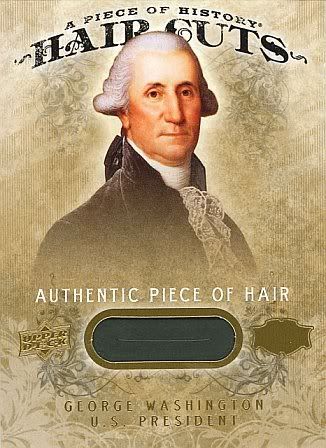
The Wall Street Journal has continued their coverage on the struggling world of card collecting. In a recent attempt to lure collectors, Topps and Upper Deck have begun inserting “DNA cards,” which contain strands of hair from such historical figures as Abraham Lincoln and Marilyn Monroe.

Hair CardThis year, closely held trading card giant Upper Deck Co. LLC, based in Carlsbad, Calif., launched chase cards containing the hair of people ranging from King George III to Marilyn Monroe. The company began tentatively last June, with just 10 hair cards of historical figures — from George Washington to Ronald Reagan — inserted into certain packs of baseball cards.

Upper Deck noticed hair on a list of items for sale from a collector it does business with, and thought it compelling, though it gave pause to some. “It was a little awkward initially, like, ‘Is it a little morbid?'” says Joe Fallon, director of innovation for Upper Deck. “But when we saw it, we knew we had a good idea.” Plus, it fit easily on a trading card.

The buzz that generated — Ms. Artusa posted her Lincoln card on eBay for $30,000 — prompted the company to launch a second series of hair cards a couple of months later. The company says that group of 140 includes strands from figures including John F. and Jackie Kennedy.

The industry is betting that emphasizing historical figures may lure new buyers. “Baseball is pop culture, Americana, and there’s a lot of natural synergy when you do things outside of baseball in the cards,” says Clay Luraschi, spokesman for New York-based Topps Co., another major card company.

The only sports figure included in either company’s hair collection is Babe Ruth.

Read the rest of the article to find out what other desperate attempts these companies have tried in the past (Topps has even offered bits of the Berlin Wall). I didn’t think sports card companies would ever get to the point where their primary marketing ploy didn’t involve sports. Apparently, sales for these packs have been doing very well, so I’m glad the strategy is helping the industry. But how is Babe Ruth the only sports figure in either series? Seems to me like inserting hair strands of other legendary, deceased athletes would entice their core market—sports fans. I guess having a piece of Geronimo or Jackie Kennedy’s hair would be fun, but this will only briefly draw in aficionados from all realms of collecting. While true card collectors will remain after they run out of hair, the Antiques Roadshow-types will be long gone.

Also, it’s obvious that the major card companies have given up on pursuing the young collector. “Dad, can we go the card shop? I really think I can get a piece of Andrew Jackson’s hair this time.” I remember trying to put together a complete 150-card set when I was younger. As the market bottomed out, I knew people that would buy packs just because they wanted the “insert” cards—they likely threw away the “commons.” Now people are buying packs not for the cards, but for a piece of hair which belonged to a figure that had nothing to do with sports. Where will they go from here?

“Dad, look what was attached to my Evan Longoria rookie card—it’s Eddie Van Halen’s guitar pick!”

« Older posts Newer posts »