Author: Christopher Glotfelty (Page 61 of 67)

Sports Agent Arn Tellem’s Economic Look at Baseball

TellemThe Wall Street Journal recently had a chance to sit down with a high-profile sports agent not named Scott Boras. Arn Tellem currently represents Francisco Rodriguez, Rafael Furcal, Mike Mussina, and Jason Giambi, all who are entering contract negotiations during this offseason. In this interview, Tellem discusses how the current economy will affect the big contracts his clients are pursuing.

WSJ: Let’s consider the Passover question — what makes this year different from all other years?

Mr. Tellem: It’s probably unprecedented in recent times that there is the cloud of what is happening in the global economy. In 1987 there was a huge drop in the stock market, which also occurred on the eve of free agency, though as I remember that was right in the middle of the period of collusion among the owners.

WSJ: Have owners been spreading the word that with the economy in trouble agents better understand this isn’t the year for the big-money, multi-year deal?

Mr. Tellem: Free-agent signings will not be impacted by what has happened. Baseball has had a run of record attendance and revenue. Major League Baseball and the teams have done an incredible job of marketing the sport here and abroad. You look at Philadelphia and you see the impact that winning can have on an organization and a city.
Owners are passionate about trying to win and fielding the most competitive team. Those that miss the playoffs and the World Series want to get there. I believe the owners all recognize that being successful means to prudently risk and manage a company’s assets for a successful future. When you quit taking calculated risks, failure is inevitable. There are a number of players who can make a difference, and I expect the market to be robust.

WSJ: Do you adjust your advice to consider the times and the economy, perhaps telling a client to take an offer more quickly than in another offseason?
Mr. Tellem: Unlike any other business, sports is a true meritocracy. Players get paid on prior performance and on what people expect them to do in the future. No business is more predictable. The irony is if the same scrutiny that applies to pro sports were applied to executives of public companies, we’d be better off as a nation. The statistics are part of the public domain, we all know the ups and downs, and players are accountable to the sports media each day about their performance. If we had an equivalent level of scrutiny and accountability in the business world, I guarantee we would not have the same levels of compensation given to executives of public companies that are now being bailed out by the government.

WSJ: Does a team like Tampa Bay making the World Series with a $44 million payroll hurt your efforts to get your clients the money you feel they deserve?

Mr. Tellem: In baseball success is achieved in a variety of ways. Tampa went through tough years. They marshaled high picks and drafted wisely and now they are seeing the fruits of their labor. Every team has a different strategy. There is no one way, and that’s a reason why baseball has had so many different winners recently.

I really appreciate Tellem’s point about success in baseball being achieved in different ways. While a team like the Yankees constantly adopts a “win-now” mentality by signing marquee players to big contracts, the Tampa Bay Rays made strategic moves over the years that ultimately paid off in the end. It’s as if the Rays were willing to take years of losing because they knew they would ultimately achieve their ideal roster. This type of waiting game really makes you wonder what teams like Pirates and Reds are doing.

Tellem’s also correct in that Furcal, K-Rod, and Giambi will still command high-paying contracts despite the economy. Major League Baseball had a very successful year. All-Star Weekend sales and viewership can support this claim. “Baseball has had so many different winners recently” and this is wonderful. The sport is becoming more competitive as teams like the Rays, Phillies, Brewers, and Dodgers are now formidable organizations. Thus, as more teams become competitive and have the ability to make the playoffs, the fans will come out to support their team, as witnessed in Tampa Bay.

Many organizations still have deep pockets and we’ll see them on display over the next few months. Guys like Manny Ramirez, CC Sabathia, and Francisco Rodriguez will still get the same type of big money that was being dolled out from 2000-05. From the Yankees to the Nationals, teams want to win, and they’d be dropping millions even if the next Black Friday were right around the corner.
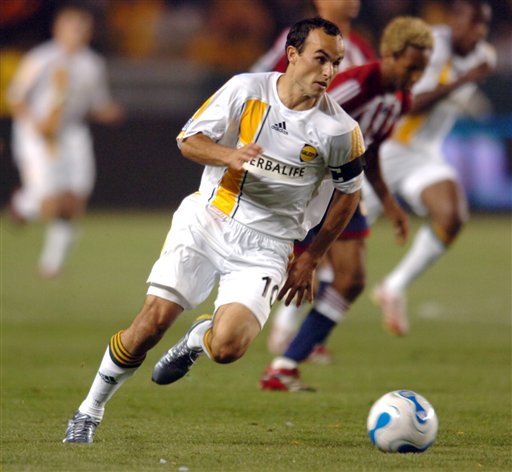
Landon Donovan to Germany? Another blow for the MLS

DonovanAs we are all well unaware of, Major League Soccer is in the midst of their conference championships, and millions of fans around the world are counting the days till the MLS Cup on November 23rd. Sarcasm aside, the league has had yet another disappointing season in terms of attendance and viewership. To make matters worse, its 2008 Player of the Year, Landon Donovan, is considering leaving the league to play in Germany.

Galaxy forward Landon Donovan should have been in Los Angeles on Tuesday, picking up his fifth Honda Player of the Year award for being the best player on the U.S. national soccer team.

Instead, the poster boy of American soccer was 5,964 miles away, trying to show Bayern Munich that he now has what he didn’t have before — the fortitude that it takes to survive in the rough and tumble of the Bundesliga.

Donovan is essentially trying out for a spot on the four-time European and 21-time German champion.

In his corner is Juergen Klinsmann, the former German national team coach and Newport Beach resident who is Bayern’s coach.

Klinsmann knows Donovan’s ability as a player, including his blistering pace and his deadly finishing. What he needs to see are the intangibles — the willingness to rebound after being knocked silly by a defender, the ability to fit into a constellation of stars rather than being the lone star orbiting David Beckham.
For its part, the Galaxy said simply that Donovan “will train . . . for the next 10 days . . . and is expected to return to Los Angeles later this month.”

Like the NHL, the MLS is riddled with the same problems in trying to increase its popularity. Both sports are a struggle to watch at times. The “dump and chase” style of NHL play lacks the creativity exhibited in the ’80s, while the MLS skill level simply doesn’t meet the exciting standards of the better European leagues. Unfortunately, both leagues suffer from a lack of intrigue, as their players don’t have the celebrity status or appeal as those from the MLB, NBA, or NFL.

David Beckham’s celebrity was supposed to bring in new fans. It didn’t, and no one can blame him. A league cannot have one representative, albeit from another country. In fact, Landon Donovan should have been the poster boy for the league. Due to the joke of the department that is the MLS Public Relations, most Americans are still unfamiliar with this exceptional athlete. For him, jumping ship to Germany isn’t just deserved, but also necessary. Why stay in a league to refuses to challenge your ability? Sadly, the MLS is becoming a farm system for European clubs and it will continue to be one until it gets its act together.

Henry Paulson: “Your old card collection is not a suitable bailout plan.”

The Wall Street Journal has confirmed what we all pretty much suspected: any sports cards bought over the past 30 years are virtually worthless.

MantleIn 2000, Mr. Christensen died suddenly at age 28. Today, the cards sit in a storage unit and his mother must decide their fate. She has no idea how many cards are in the collection or whose faces appear on them. Maybe they’re worth a lot of money. Maybe not.

“I don’t know what they’re worth, so I don’t want to start giving them away,” says his mother, Carol White. “I don’t want them to sit in storage,” which she notes is not climate controlled. “I don’t have any grandchildren. He didn’t have a family, so I might as well sell them.”

It’s not uncommon for sports collectibles to fall into the hands of a non-collector through death, divorce or debt. Then what?

“What people need to understand is that the price guides list the retail price, and the amount a dealer would pay would be much smaller,” Mr. O’Connell says. For vintage cards — those from before 1980 — a dealer might pay between 50% to 60% of the retail value. Newer cards may only command 5% of the retail price. That’s not necessarily because the dealers are dishonest, Mr. O’Connell notes, it’s just how they make a profit.

With only vague descriptions and few details, Mr. O’Connell could not even guess whether Mr. Christensen’s collection carries much value. But 1972, his birth year, suggests that many of the cards are relatively new. “So the values for cards that you saw in the ’50s, ’60s and ’70s you won’t get here,” Mr. O’Connell says.

Case in point, when I was twelve years old, I pulled a Cal Ripken Jr. insert card worth $1,000 at the time. When I checked the Beckett price guide two years ago—$150! I’ve foolishly kept the card in a safety deposit box over ten years on the advice from the shop owner that the list price would only continue to rise. Well, that’s an 85% loss in value and this decrease is represented in most of my collection, which spans the years 1990-2002.

I specifically remember realizing when sports cards were on their way out. The industry had been suffering for years and companies like Topps, Pinnacle, and Upper Deck were beefing up their packs to try and increase demand. These tactics included more insert cards, pieces of athletes’ uniforms, autographs—I even own a series that includes nothing but coins. Then came Pokemon and Magic, whose cards also doubled as components of a complicated game. This new and very young demographic of nerds and elementary school kids clobbered the sports card industry. While fathers continued to collect, their children were drawn to the allure of fantasy cards.

I always kid with my dad about how his card collection will bail me out of hard times in the future. In a way, it’s no joke. His collection runs from 1950-1980 and includes such prizes as a complete 1956 Milwaukee Braves Topps set. I have an absurd amount of cards which at one point probably valued about $10,000. Now, the collection probably isn’t worth the cases it’s stored in.

Obviously, collections are only worth the value collectors are willing to place on them. As the number of card aficionados has dwindled over the years, the industry is barley hanging on. However, those cards produced before 1980 are still highly sought out by the old school of collectors. Thus, guys like my dad are sitting on a cardboard gold mine.

Tis the Season for Scott Boras

BorasWith clients Mark Texiera, Manny Ramirez, and Derek Lowe entering contract renegotiations during the offseason, agent Scott Boras is busier now than ever. The Los Angeles Times recently interviewed Boras about his humble beginnings and his 70-plus employee company, Boras Corp.:

Boras said his company has negotiated about $4 billion in contracts. He represents more than 70 major league players and another 70 minor leaguers, who are well taken care of. The Boras Corp. employs two psychologists and a conditioning coach who runs the Boras Sports Fitness Institute. The company has a marketing and personal management division.

Boras said his company has never had outside investors.

“You can’t have bills because your interest has to solely be on the athlete,” he said. “In the corporate world, a lot of agents have demands on them from the board. They have to make revenue. My attitude is that whatever you do in this business, whatever you own, whatever you have has to be paid for. That way when you’re negotiating, you’re negotiating strictly for the client, not for the need for money.”

But it also meant, Boras said, that he lost money in his first 10 years in the business.

Boras was the second-oldest of four children who grew up in a modest household in Elk Grove, south of Sacramento.
He said he used to wake up between 4:30 and 5 a.m. every morning to work on the family farm. Until his chores were done, he said, he couldn’t play baseball.

He earned a scholarship to the University of the Pacific and was a minor league outfielder and infielder in the St. Louis Cardinals and Chicago Cubs systems.

He went to law school when his career was cut short by knee injuries and did medical malpractice work in Chicago. He started representing some of his former teammates and became a full-time agent in 1985.

Boras has been credited — and vilified — for his role in landing record contracts for major league and amateur players.

Boras has proved that being a big-name agent can be just as valuable as being a big-name athlete. And in baseball circles, Boras has become a household name. After he negotiated Alex Rodriguez’s 10-year, $252-million deal in 2000, he became the agent of choice for many blue chip ball players. Still, team owners and general managers constantly approach Boras with caution. He negotiated huge contracts for players that turned out to be huge busts (Andruw Jones, Barry Zito) and he’s convinced players to spontaneously abandon current contracts on a whim when a better opportunity presents itself (J.D. Drew).

The next few months are going to huge for the Boras Corp. Despite our decaying economy, Boras will remind us all why Manny being Manny is profitable anywhere.

All is Forgiven, Mitch Williams

WilliamsThe Wall Street Journal recently did a nice piece about Mitch Williams, the former Philadelphia Phillies closer who gave up the Game 6 homerun to Joe Carter of the Blue Jays in the 1993 World Series. The town scapegoat has since shaken off the persona in the wake of the Phillies’ current success. You can now hear “Wild Thing” on Comcast SportsNet in Philadelphia as well as buy his signature salsas and cheese dips.

Mr. Williams has fared far better than many of baseball’s other well-known goats. In 1908, New York Giant Fred Merkle neglected to advance from first base to second on an apparent game-winning hit by a teammate, and was forced out at second base as he celebrated, costing his team the pennant. He was ridiculed for decades for his blunder, and didn’t attend old-timer celebrations at the Polo Grounds until 1950.

Bill Buckner of the Red Sox let a crucial ground ball go through his legs in the 1986 World Series, leading to his team’s eventual loss. He has spent his retirement in Idaho. Only this year did the Fenway Park faithful forgive him, with a standing ovation when he threw out the first pitch at the home opener.

Sometimes, the fallout is tragic. Donnie Moore of the California Angels gave up a ninth-inning home run in 1986 when his team was one strike away from advancing to the World Series. The Red Sox won that game and two more to take the pennant. Three years later, he shot his wife and committed suicide.

Mr. Williams was not a classic closer. Most pitchers brought in late in games to shut down the other team have stellar control and allow few base runners. Mr. Williams’s pitching style didn’t inspire confidence. The rugged, 6-foot-4-inch fireballer had a mullet and a violent delivery. When he threw, the top half of his body went one way, the bottom half another. He nearly tumbled off the mound with each pitch.

I remember watching that game as a kid. It was the first time I had really seen anyone “blow it.” Event at that young an age, I could sense the doom Williams was feeling. It’s good to hear that Philadelphia, one of the toughest cities in sports, has welcomed his return to baseball.

« Older posts Newer posts »