Author: John Paulsen (Page 683 of 937)

Ryan Torain has surgery, may miss three months

Broncos rookie RB Ryan Torain was having a terrific camp before injuring his elbow. Now, he might be out for three months.

His recovery time could be as long as three months, which means the Broncos will have to make a decision by the end of training camp on whether to place him on injured reserve, which would make him ineligible to play this season.

If they think his recovery may be slightly quicker and that he may be able to get back on the field by late October, they could use a roster spot when final cuts are made to 53 players, but they would have to release a healthy player to do it.

Torain suffered a fractured bone near his left elbow Wednesday and was taken for a magnetic resonance imaging (MRI) exam as well. That test showed ligament damage that Torain needed repaired Thursday morning.

Broncos coach Mike Shanahan has called Torain “one of the most gifted running backs I’ve been around, and I’ve been around for a long time, very similar to Terrell Davis when he came in.”

That’s high praise coming from Skeletor, who has a history of jerking his running backs around. Torain was pushing Selvin Young for the starting job, but now it looks like it is Young’s job to lose. He’s a nice pick in the middle rounds when you’re trying to find a third RB. This is Mike Shanahan, so if you want to play it safe, go with someone like LenDale White or Rudi Johnson.

Grizzlies open up wallet, offer $58 million to Josh Smith?

The Memphis Edge (blog) is reporting that, according to NBA sources, the Memphis Grizzlies have sent Josh Smith an offer sheet worth $58 million.

As the only team left with significant room under the salary cap, the Griz have shifted out of a summer holding pattern and targeted the versatile 6-9, 235-pound forward.

Atlanta has seven days to match, per league rules, once Smith receives the offer sheet.

The Hawks have said they would match any contract offer to the 22-year-old Smith, but are on the hook next season with big contracts for Mike Bibby and Joe Johnson.

Should the Griz land Smith he is expected to play power forward alongside Rudy Gay at small forward, O.J. Mayo at shooting guard and Mike Conley at point guard.

The length of the contract is unkown, but that sounds like a four-year deal to me. If it were five years in length, it would average less than $12 million per season, and the Hawks are likely to match that. In a recent post, What Are These Guys Worth?, I estimated J-Smoov’s value to be $13.0-$14.0 million per season. On a four-year deal, that would total $52-$56 million.

That Conley-Mayo-Gay-Smith lineup has some serious potential, that’s for sure. The Grizzlies should be congratulated for at least making a move on Smith. It was about time that they tried to spend some of that cap space.

Team USA still has trust issues

Call me unpatriotic, but at times during the 2004 Olympics in Athens, it was tough to root for the U.S. Men’s Basketball Team. Helmed by Larry Johnson (boy was that a bad choice), Team USA was young, fragmented and couldn’t shoot. For the most part, the competition in Athens played together, proving the old adage that a sum can be greater than total of its individual parts. Teams like Greece and Argentina ran fluid, smart offense and played gritty defense – stuff that would make James Naismith proud.

Truthfully, the bronze medal finish was just what American basketball needed. It served as a wake up call that the rest of the world hadn’t just caught up to Team USA, it had passed them by.

Enter former Suns owner and four-time NBA Executive of the Year, Jerry Colangelo, who became the national director of Team USA. He immediately decided to hire legendary Duke coach Mike Krzyzewski to helm the team. Tired of the revolving door access to Team USA, in 2005 Colangelo required a three-year commitment that would take the program through the 2008 Bejing Olympics.

While the team has made progress defensively and (generally) playing together, offensively things are still a little rough. Team USA is at times sloppy, playing too fast and chucking up bad shots when an open jumper is two passes away. It’s difficult for NBA stars to check their egos at the door and pass up what they believe to be a good shot to eventually get a great one.

The team looked pretty good in a recent series of warm-up games against Turkey, Russia and Lithuania. They did not, however, look very good against Australia, even though they were playing without the Milwaukee Bucks’ Andrew Bogut.

The team added long range bomber Michael Redd (right) to shore up its shooting, but only he and Carmelo Anthony are consistent deep threats. Anyone on the team can get hot, but only the perimeter shooting of ‘Melo and Redd strikes fear in the hearts of the opposition. I’m afraid what will happen if both players have a bad game.

ESPN has been running a series called “Road to Redemption” that follows Team USA in its preparation both on and off the court. Essentially, it’s a fluff piece with all the players talking about how great everyone is and how much fun it is to play on Team USA. The footage from the meetings reveals a serious side to all of this; there is incredible pressure on the team to return with the gold medal. Failure is not an option.

Team USA opens up on Sunday at 10:15 AM ET against Yao Ming, Yi Jianlian and the rest of the Chinese team.

Here’s the complete schedule:

vs. China: Aug. 10, 10:15 a.m. ET
vs. Angola: Aug. 12, 8 a.m. ET
vs. Greece: Aug. 14, 8 a.m. ET
vs. Spain: Aug. 16, 10:15 a.m. ET
vs. Germany: Aug. 18, 8 a.m. ET
Quarterfinals: Aug. 20
Semifinals: Aug. 22
Finals: Aug. 24

How to charm a snake (draft)

Most fantasy football drafts utilize a “snake” draft where teams pick 1-12 in odd rounds and 12-1 in even rounds. Crafty owners can take advantage of the characteristics of such a draft if their draft position is one, two or three spots from either end. So those owners with the #2, #3, #4, #9, #10 or #11 picks (in a 12-team draft) should pay attention.

Here’s the situation: you have the #3 pick in the draft and the two owners ahead of you select LaDainian Tomlinson and Adrian Peterson in the first round. You take a running back – let’s say Brian Westbrook – and the draft proceeds. Now you’re up again with the 2.10 (#22) pick and you’ve narrowed your pick to the following list:

T.J. Houshmandzadeh, Willis McGahee, Jamal Lewis, Ryan Grant and Steve Smith

Let’s say that you like Smith, but now that he’s going to miss the first two games due to suspension, you’re a little down on him. You like Housh more; he’s a consistent WR in a terrific offense. However, you know that RBs are important and you want to select one of the three to round out your backfield, but you can’t decide which one since they’re all about the same. What do you do?

Take Housh.

Why?

The two owners picking #1 and #2 each have two picks before your next pick. Both have already taken a RB, so it isn’t likely that either owner is going to select two RBs with the next two picks because they’ll probably want to start filling out the rest of their roster. That leaves you with at least one of the three RBs to pick at 3.03. By selecting Housh (whom you value more than the next WR, Smith) you get the best WR on the board, and since McGahee, Lewis or Grant is likely to be there at 3.03, you’ll probably get a solid #2 RB in the next round. Since it didn’t matter to you which RB of the three you got, you let the other two owners make the tough decision, while you laugh all the way to the playoffs.

Now let’s say you’re in the same draft slot and your pick is up at 6.10. So far you’ve selected the following players:

Westbrook (RB), Houshmandzadeh (WR), Grant (RB), Santonio Holmes (WR), Tony Gonzalez (TE)

That’s a nice squad, but you have no QB. At 6.10, you’re selecting from the following group:

Matt Hasselbeck, Donovan McNabb, Marc Bulger and Jay Cutler

You notice that the team selecting #2 doesn’t yet have a QB while the team selecting #1 has Tony Romo. You can safely assume that team #1 won’t select another QB so soon, but team #2 might select their first QB before you pick at 7.03. You like both Hasselbeck and McNabb, but you really like Jerricho Cotchery over the other available WRs. So whom do you take?

Grab Cotchery.

In this case, you take Cotch and pass on Hasselbeck and McNabb, as one (or both) of them will probably be available for you to pick at 7.03.

This principle is applicable to all positions. Whether it’s a TE in the middle rounds or a kicker or a defense in the late rounds, being able to predict your opponents’ actions gives you an advantage during the draft. The key to this strategy is to know what players the #1 and #2 teams have already drafted so you can use that information to your advantage. In live drafts, it is often difficult to draft your own team as well as keep track of the other teams, but if you only pay attention to the important teams – in this case the teams picking #1 and #2 – it shouldn’t be much of a burden.

Michael Phelps’ quest for history

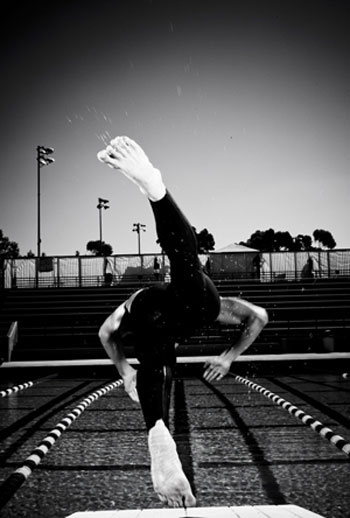
Michael Phelps is trying to do something no one else has ever done – win eight gold medals at the Olympics. The latest issue of ESPN The Magazine has a great article outlining the challenges standing in his way (and how Phelps plans to overcome them).

Threats will come from all sides. Some will grab him, strangle him while he swims. Some will wait until the lights have dimmed and the fans have left. Every threat will eat at his energy and strength, until he comes up for air after his final race and realizes that his threats—or his dreams—are gone.

Swimming might never be wildly popular in America. But for those who consider sports a test of human limits, there may be no more impressive feat than what Michael Phelps will do over nine days in August. He will swim eight finals (five individual, three relays) and 17 races overall, including prelims and semis, in a quest to become the only Olympic athlete to win eight gold medals at a single Games. Football, basketball, hockey and baseball players rest not only after games, but during games. Tennis and soccer players get days off between matches. Boxers get months. But Phelps? Phelps will burn a marathon’s worth of calories in the pool every day for nine days, on his way to swimming more than 30 miles. He will weaken with every minute, stroke and breath. The threats will not.

THREAT 1: PAIN
Phelps begins with the most difficult event: swimming’s decathlon, the 400 individual medley. The race begins with 100 meters of butterfly, in which he must propel his body out of the pool, over and over, until he feels as if he’s doing squat jumps with two kids on his back. The fly requires an edge, almost an anger. “You have to be tougher, meaner,” says 1992 gold medalist Mel Stewart. “If you don’t have a base of strength and stamina, you fade. You die.”

If you’re interested in Phelps’ quest, it’s a great read.

(Read the rest after the jump.)

« Older posts Newer posts »