Here’s a look back at the first two rounds (or three rounds if you want to buy into the NCAA’s terminology) of March Madness.
[nggallery id=33 template=carousel images=15]
Here’s a look back at the first two rounds (or three rounds if you want to buy into the NCAA’s terminology) of March Madness.
[nggallery id=33 template=carousel images=15]
It’s been a tough day to be a ref, but the officials blew another one, this time in the Syracuse/Marquette game.
The rule (4.3.8) states:
After a jump ball or during a throw-in, the player in his/her front court, who makes the initial touch on the ball while both feet are off the playing court, may be the first to secure control of the ball and land with one or both feet in the back court. It makes no difference if the first foot down was in the front court or back court.
Notice that both feet of Scoop Jardine are off the court, and as he catches the ball his foot lands on the line. This should have been a play on, but the ref called a backcourt violation.
The game was tied at 59-59 with 0:52 to play and Marquette hit a three-pointer on the next possession to take control of the game. Marquette won, 66-62.
With the Longhorns up two with under 10 seconds to play, Texas was attempting to inbound the ball. Watch as the official hands the ball to the Texas player and counts to four. He starts his five count when the Texas player indicates a timeout, but the ref instead calls a five second violation. Texas led by two at the time, but Arizona had a three-point play to take the lead and win the game.
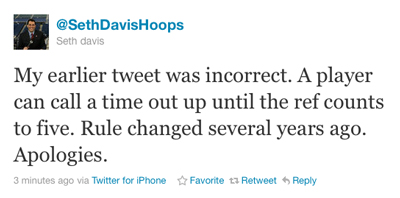
According to the CBS studio crew, the rule states that you can’t call a timeout after four seconds, but after a quick search, I couldn’t find anything regarding this situation in the NCAA rulebook. (Let me know if you can.) Here’s what I found:
Section 12. Timeouts Not Granted
Art. 1. No timeouts shall be granted:
a. To the opponents of the throw-in team after the throw-in starts.
b. During an interrupted dribble.
c. To a player or coach when an airborne player’s momentum is
carrying him/her out of bounds or into the backcourt.
d. Unless there is player control by the requesting team. Exception:
Rule 5-12.1.c.
e. Until after the jump ball that begins the game and the conditions as
described in Rule 5-10 are in effect.
Again, I can’t find anything about the four second rule.
I clocked this on my stopwatch three times and came up with 4.2-4.5 seconds each time when starting with the beginning of his first arm swing. I’m not sure why you can’t call a timeout after four seconds, but supposedly that’s the rule.
Update: Seth Davis clears it up for us…

So it’s official, Texas got jobbed.
North Carolina outlasted Washington, 86-83, in Charlotte, but most of the talk after the game was how the officials determined the amount of time remaining on the last play of the game.
Washington’s Venoy Overton heaved a half-court shot (with his off hand, no less) and the ball hit John Henson’s hand before it went out of bounds. The replay clearly showed it hit the floor out of bounds with 1.2 seconds remaining, yet when Washington’s coaching staff asked the refs to check the time, they said it was fine and play proceeded with 0.5 seconds remaining. Washington didn’t have much time to get a good look and ended up taking a contested two-pointer that wouldn’t have changed the outcome of the game even if it had gone in.
The NCAA director of men’s officials, John Adams, told CBS after the game that the officials acted correctly since there’s a lag time between when the ball hits, when the official blows his whistle and when the scorekeeper stops the clock.
Fine. But there’s an elephant in the room — why didn’t the officials bother to go to the video? They don’t have to check the video, but if the Washington coaching staff did indeed ask about the time, then the officials should have double-checked. With the Sweet Sixteen on the line, why not take a minute and make sure you got it right?
Who knows, had Washington had an extra 0.7 seconds, maybe they would have had time to get a better shot.
Obviously, Pitt losing was a tough blow for my bracket. Anytime you drop a Final Four team in the first weekend, it hurts. But in the grand scheme of things, Pitt’s loss is not a bracket killer, at least not in the two pools (~20 players each) that I’m in.
At this point, I still just need Ohio State to beat Kansas in the Final and I’ll probably finish in the money. It would help if Duke made the Final Four and if Florida didn’t — the best thing for those of us that had Pitt would be for Butler to make a repeat appearance in the Final Four, because then no one but the faithful Butler alumni would be capitalizing on Pitt’s loss.
How are Sagarin and Pomeroy’s rating systems faring so far? Pretty darn good. Teams with a three-point Sagarin advantage are 26-4 (87%) so far (with USC, Louisville, G-Town and Pitt the four losers). Teams with a two- to three-point Sagarin advantage are just 1-2, but teams with a slight (zero- to two-point) Sagarin advantage are an impressive 9-2. Usually anything under two points is a toss-up, but Sagarin’s ratings have performed well in this area over the last two years. Overall, Sagarin went 26-6 in the first round.
Pomeroy’s numbers are just as impressive. I track four different groups — 70%+ (20-4), 65%-70% (4-0), 60%-65% (2-1) and 50%-60% (9-4) — and they’ve all been pretty strong thus far. His favorites went 25-7 in the first round.
If you’re looking for updated Sagarin and Pomeroy data, click here. Keep in mind that for record-keeping purposes, I use the static data from before round one to calculate all of these won/loss records since that’s all that’s available to users to make their bracket picks.

© 2026 The Scores Report – The National Sports Blog
Theme by Anders Noren — Up ↑