Author: Anthony Stalter (Page 38 of 1503)

Super Bowl XLVI Giants vs. Patriots: Five Questions

New England Patriots quarterback Tom Brady (L) scrambles for a first down against the New York Giants in the first half of their NFL football game in Foxborough, Massachusetts November 6, 2011. REUTERS/Brian Snyder (UNITED STATES – Tags: SPORT FOOTBALL)

With kickoff of Super Bowl XLVI rapidly approaching, what are some of the bigger questions surrounding Sunday’s title game?

1. Can Brady shake out of his Giant funk?
There are just some teams that Tom Brady doesn’t play well against. Entering this year’s AFC championship game, Brady’s completion percentage in five career outings against the Ravens was 55.9, which was his lowest against any team in the league. So it wasn’t any wonder while he compiled a 57.5 QB rating in a lackluster 239-yard, two-interception performance versus Baltimore two Sundays ago. Now he faces a New York team that, again, for whatever reason, he’s had trouble beating. From a passer-rating standpoint, Brady had his worst performance of the season in a Week 9 home loss to the Giants. His quarterback rating of 75.4 in the 24-20 loss was only slightly worse than his 82.5 rating in Super Bowl XLII back in 2008. Save for his 356-yard, two-touchdown performance against the Giants in Week 17 of the ’07 regular season, Brady has struggled to beat this New York team. Following his poor performance, he reportedly told owner Robert Kraft in the locker room following the AFC title game that he would play better in Super Bowl XLVI. For a quarterback that has largely been viewed as cool, calm and collected, it’s not a stretch to think that Brady is feeling the pressure of potentially losing yet another game to the Giants.

2. Can the Patriots slow the Giants’ pass rush?
These two teams have met three times since December of 2007 and during that span the Giants have sacked Brady a total of eight times (including five times in their Super Bowl victory in February of ’08). New York uses four defensive ends in passing situations, which is something no other team can boast. Jason Pierre-Paul (16.5 sacks), Justin Tuck (5 sacks), Osi Umenyiora (9 sacks in just nine games) and Dave Tollefson (five sacks) can line up at the same time because Pierre-Paul and Tuck have the ability to play inside. The Giants also have the option of playing a combination of three of those ends with Mathias Kiwanuka (3.5 sacks), who is a highly versatile role player. It’s no coincidence that Brady struggled in New England’s 24-20 home loss to New York in Week 9 considering that was one of the games Umenyiora was healthy for. When the Giants can dress all five of their pass rushers they’re a completely different defense – a defense that the Patriots and their usually solid group of pass blockers has had trouble with in the past two meetings with New York.

3. Can the Pats’ defense slow down all of the Giants’ weapons?
The Giants’ offense doesn’t receive nearly enough attention for how explosive it is. In a lot of ways, that’s a direction reflection of how some view Eli Manning, who also doesn’t receive the recognition he deserves for being a quarterback that can put pressure on a defense with his playmaking ability. For all of the attention that the Giants’ pass rush has received lately, without Manning’s outstanding play the Giants wouldn’t have won nine games this season. They wouldn’t have made the playoffs, upset the Packers at Lambeau, or have an opportunity to make it two-for-two against the Patriots in the Super Bowl. Granted, Manning has had help. Hakeem Nicks and Victor Cruz have been outstanding for a New York passing attack that stacks up to any offense in the league outside of maybe New Orleans, New England and Green Bay. Mario Manningham is also a weapon in the vertical game because he can attack a defense along the seam, which is important seeing as how New York doesn’t have a Jimmy Graham-type at tight end. Throw in Ahmad Bradshaw and Brandon Jacobs (who both have awoken from their season-long slumber) and yes, the Giants offense is that good. That said, New England’s red-zone defense has allowed just two touchdowns in seven opportunities throughout the playoffs, as Denver went 1-of-3 inside the 20 in the Divisional round and Baltimore went 1-of-4 in the AFC title game. Statically speaking the Patriots weren’t very good defensively this season. But they’re starting to come together on that side of the ball so it’ll be interesting to see who wins the Giants’ O vs. Patriots D matchup come Sunday.

4. Will Belichick continue to make sound second-half adjustments?
Baltimore has been the only team in the past seven weeks that has matched New England after halftime. The Ravens and Patriots each scored 10 points apiece in the second half of last Sunday’s AFC championship game, but other than that New England has killed teams in the final two quarters. The Pats have allowed an average of 5.7 second-half points in their last six games, which is an indication that Bill Belichick and his coaching staff are making sound in-game and halftime adjustments. In fact, New England has outscored opponents 111-34 in the second half over their past six games so it’ll be interesting to see how Sunday’s game plays out. If the Giants build a first-half lead, can they sustain it?

5. How effective will the “Gronk” be?
At this point the question isn’t whether Rob Gronkowsi will play but rather how effective will he be. This isn’t the same situation as last year with Pittsburgh center Maurkice Pouncey, who never really had a realistic shot of playing in the Super Bowl after suffering a high ankle sprain in the AFC championship game, because Gronk is going to play. But remember two years ago when Colts’ defensive end Dwight Freeney tore a ligament in his right ankle late in the AFC title game versus the Jets, played in the Super Bowl but was largely ineffective? Will Gronk be the same player he was for the Pats during the regular season or will he serve as merely a decoy in passing situations? We already know that Gronkowski will likely need his left ankle scoped following Sunday’s game so it’s not unrealistic to believe he could be severely limited. Granted, the Pats do have Aaron Hernandez, who not unlike Gronkowski is a weapon from the slot or tight end position. But the “Gronk” was nearly unstoppable this season and is a major mismatch against defensive backs and linebackers. The Patriots need him to be as healthy as possible if their offense is going to fire on all cylinders.
Will Boise State’s Kellen Moore go undrafted?

Boise State Broncos quarterback Kellen Moore (11) follows through on a pass during the second half of a NCAA football game against the Virginia Tech Hokies in Landover, Maryland, September 6, 2010. REUTERS/Jonathan Ernst (UNITED STATES – Tags: SPORT FOOTBALL)

Sporting News draft analyst Russ Lande writes that Boise State quarterback Kellen Moore is in danger of being undrafted following a poor week in Mobile for the Senior Bowl.

Coming to Mobile, Moore needed to really step up, but things could not have gone much worse for him. Not only did he measure under 6 feet, but he showed below-average arm strength and lacked accuracy on passes longer than 10 yards. He did not show the arm strength to make all the NFL throws with good velocity and had a long delivery and release, which made it easier for defenders to break, close and make plays on his passes. Moore will have to be amazing at the Combine and his pro day if he hopes to get drafted.

This isn’t all that surprising of a report. Moore isn’t the type of quarterback who will force defenses to cover the entire field because his arm strength is limited. His lack of size also becomes a problem when a defense is able to create pressure from the interior and push the pocket into his face. He simply has a lack of physical skills that cannot be overcome, even by a great combine or Pro Day performance.

But that doesn’t mean that Moore won’t prove to be a quality backup or provide depth at the next level. He’s very accurate with the football, has good pocket awareness and he’s able to decipher information quickly. Thus, he shouldn’t be discouraged if he isn’t drafted because he does have a future in the NFL if he gets in the right system.

At this point, a separation might be good for both Manning and the Colts

Indianapolis Colts quarterback Peyton Manning (18) runs from the field against the Kansas City Chiefs at a time out during the second quarter of their NFL football game in Indianapolis October 10, 2010. REUTERS/Brent Smith (UNITED STATES – Tags: SPORT FOOTBALL)

Based on some of the comments coming out of Indianapolis these days, it would appear as though Peyton Manning’s career with the Colts is coming to an end.

Such as life. Times change, people separate, memories fade. Why should sports be any different?

According to ESPN NFL Business Analyst Andrew Brandt, it would cost the Colts $50.5 million to keep Manning and Andrew Luck on the same roster in 2012. Manning’s option is $28 million in addition to a $7.4 million salary while the No. 1 overall pick will receive approximately $15.1 million in bonus plus salary in 2012. Thus, it doesn’t make sense financially for the Colts to pay Manning and draft Luck while trying to fill holes all over a depleted roster.

It doesn’t make sense from a risk/reward standpoint either. Manning is 35 and is still trying to recover from neck surgery that he had last May. I’m not a doctor but when you listen to other athletes talk about the same nerve damage that Manning has, it’s feasible that he could have complications the rest of his career. That’s why there’s still plenty of speculation about whether or not he’ll ever play again.

I’m not trying to be cold because I’m very aware of what Manning has meant to the Colts franchise over these past 14 seasons. But former Giants GM Ernie Accorsi said it best when he stated that he would rather be accused of getting rid of a player a year too early rather than a year too late. This is a business decision and the right business decision for the Colts is to part ways with Manning and draft their future signal caller while they have that chance. There are teams like the Browns, Dolphins, Bills and Redskins who continuously fail to address their quarterback situation and the Colts have a golden opportunity to replace one franchise signal caller with another in just one fell swoop. Cold? Probably. But smart? Definitely.

Let’s not overlook the fact that this could be a good thing for Manning as well. During John Elway’s final years he essentially took a backseat to Terrell Davis because the Broncos became Davis’ team. He won two Super Bowls handing the ball off to Davis and throwing when he had to, but Manning doesn’t have that same fortune. The Colts proved last year that they’re a serious rebuilding project. At this point in his career, Manning shouldn’t be at the helm of a rebuilding team: he should be trying to take one more shot at winning a Super Bowl just like Elway did. (Assuming of course that Manning is healthy enough to ever pick up a football again.)

In a perfect world the Colts would already have Manning’s replacement on their roster. But they don’t, and now this is the situation that they find themselves in. Separations are never easy and if the Colts do decide to move on from Manning, it will be a hard decision. But it doesn’t have to be difficult.

Times change, people separate, memories fade. That’s just life.

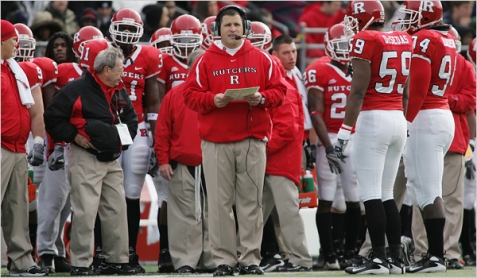
After losing out on Kelly, Bucs go back to college ranks and hire Rutgers’ Schiano

Lose out on one prominent college football head coach? No problem, just hire another.

Just days after Chip Kelly spurned them by deciding to stay at the University of Oregon, the Tampa Bay Buccaneers have hired Rutgers’ Greg Schiano to be their next head coach. He takes over for Raheem Morris, who was fired after a disastrous 2011 season in which the Bucs lost their final 10 games while stumbling to a 4-12 record.

The three finalists to take over as coach of the Bucs were apparently Panthers’ offensive coordinator Rob Chudzinski, fired Texas A&M coach Mike Sherman, and Schiano. Just 45 years old, Schiano gained the respect of his peers and media members after impressively transforming Rutgers into a Big East power. Since 2001, the Scarlet Knights have gone to six bowl games, winning their last five. Schiano led them to a win in their most recent bowl game, a 27-13 victory over Iowa State in the 2011 Pinstripe Bowl.

What’s interesting is that Kelly and Schiano couldn’t be more different in terms of offensive philosophies. Oregon has had one of the most dynamic offenses in college football under Kelly, who runs a zone-read scheme that is unlike any system currently in the NFL. Schiano, meanwhile, has always run a “smashmouth,” run-first offense that uses a heavy dose of running back committees.

The contrast in styles makes you wonder whether or not the Bucs knew what they wanted in their next head coach. Did the Glazers just want to make a splash hire following their Morris tenure? Were they focused on a disciplinarian? Did they want to use the same blueprint as the 49ers, who obviously just had a ton of success following the hiring of former Stanford head coach Jim Harbaugh last year?

Schiano is a great football coach and appears to be less of a gamble than Kelly, whose offense may not have survived in the pros. But it’s odd that in the end, the Bucs’ top two choices had such contrasting styles (at least offensively).

Tigers’ Cabrera expected to move to third base to make room for Fielder

Milwaukee Brewers batter Prince Fielder reacts after he hit a ball out of the ballpark foul against the New York Yankees before striking out in the eighth inning of their MLB interleague baseball game at Yankee Stadium in New York, June 30, 2011. REUTERS/Ray Stubblebine (UNITED STATES – Tags: SPORT BASEBALL)

Following the Detroit Tigers’ acquisition of free agent first baseman Prince Fielder on Tuesday, Miguel Cabrera is expected to move to third base.

There was some initial talk that the club would use a rotation at the corner infield spots, as Fielder and Cabrera would each play first base on some days while Cabrera moved to third base on others. But Cabrera told the Venezuelan newspaper Lider en Deportes that he would move to third base to accommodate Fielder.

“I will come back to the third base, which is my natural position,” Cabrera said via a translated version of the story. “The arrival of Fielder will benefit us.”

Cabrera played third base with the Florida Marlins before being traded to Detroit and eventually shifting over to first. At 240 pounds he’ll likely need to get into better shape this offseason in order to gain more flexibility for the position, but his willingness to move has to be comforting for the Tigers. (Especially considering the small rift that occurred in Miami earlier this offseason where Hanley Ramirez gave the Marlins some gruff by stating he would not move to third base in order to make room for free agent acquisition Jose Reyes.)

Fielder batted .299 with 38 home runs and 120 RBI in his final season with the Milwaukee Brewers last year. Since 2007, he hasn’t hit less than 30 home runs in a season and outside of 2010 (83), he has never drove in less than 100 RBI.

He and Cabrera now make a dangerous duo in the middle of Detroit’s lineup. Cabrera drove in 105 RBI last season while belting 48 home runs and hitting .344. The addition of Fielder eases a lot of doubt created by the loss of Victor Martinez, who suffered a torn ACL during winter conditioning and could miss the entire 2012 season.

« Older posts Newer posts »