
This is one way to kill time on the team plane…
Tag: Steve Nash (Page 5 of 6)
DALLAS – So there I was last Friday afternoon in Austin, Texas, a little over 48 hours before the historic 2010 NBA All-Star game would take place just 200 miles away in Dallas. Somewhere around 100,000 tickets were said to be sold, including an unquantified number of $30 Standing Room Only “party passes.” The Great Recession of 2009 had left me nearly flat broke when they went on sale last year though, so I remained ticketless and with little hope. Then I read an interview with Dallas Mavericks owner Mark Cuban, where he seemed to up the ante on what this event could be.
I don’t think Cowboys Stadium has really been leveraged as a party destination the way it can. I think people are going to be pleasantly shocked. It’s more designed to be a night club than a destination for a sporting event. And because this is really geared toward fun, I think it’s really going to shine,” Cuban told the Dallas Morning News. “You’re just there to have fun. I think that makes a big difference. No one’s betting on this game. No one’s screaming and yelling. It’s just ‘Are you having fun? Yes or no.’ That makes for better people-watching. That makes for better enjoying of libations and such. It’ll be a lot of fun.”
Cuban was probably engaging in a hype game, but all this talk of unprecedented, newly leveraged fun seemed to demand personal investigation. I hit the Dallas and Austin Craigslist ticket boards, trying to find someone who might unexpectedly have found themselves with a couple of those party passes to sell for face price. Most were asking around $60 apiece, while some pirates sought $100. Then I saw a posting that more of the party passes were now on sale at Ticketmaster.com – one click later, he shoots, he scores! I knew prospects for getting a decent view of the game were slim, but how could any serious NBA fan pass up the chance to attend this historic contest for a mere $30 and a three-hour drive? Not to mention that a California friend had just relocated to Dallas that week for a new job, providing free lodging to boot. It had clearly become a mission from God.
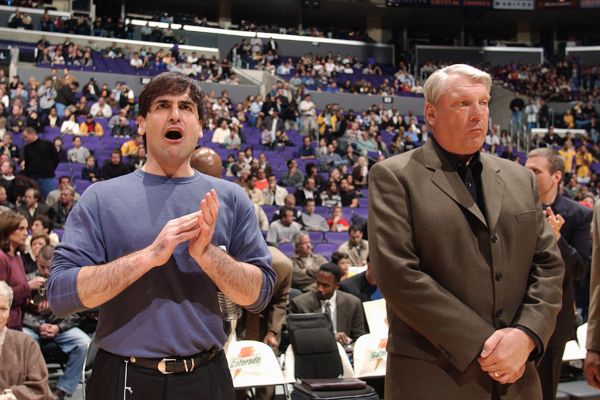
This is probably only interesting to NBA nuts and Mavs fans, but the transcript from the Cuban/Nelson arbitration hearing has been released, and there are some interesting tidbits of information. Like the story of how the Mavs almost drafted Pavel Podkolzin at #5 (instead of Devin Harris) in 2004.
But as June’s draft loomed, Nelson testified that he had no reason to believe he wouldn’t continue to lead that process, noting that he had selected standout Josh Howard with the 29th pick of the previous year’s draft.
On draft day, the Mavericks acquired the No. 5 pick from Washington. Nelson testified that as he settled into the draft room to talk to team scouts, he was surprised to hear son Donnie, the team’s vice president of operations, discuss taking “this big Russian” with the No. 5 pick.
The player’s name is redacted from the arbitration transcript, but it is clear that Nelson was referring to 7-foot-5 Pavel Podkolzin.
“I said, ‘Donnie, I cannot take that Russian five,’ ” Don Nelson testified. “And he asked me if I would go in the men’s room. I went in the men’s room with him, and he informed me that I wasn’t in charge of the draft.
“And I said, ‘Oh, really? Well, who is?’ He said, ‘I am.’ And I said, ‘Well, it’s nice of somebody to tell me.’
“And I said, ‘Well, if that’s the case, then as your father I’m asking you don’t draft [redacted].’ … And Donnie didn’t. He took Devin Harris.”
Later in that draft, the Mavericks sent a future first-round pick to Utah for the rights to No. 21 pick Podkolzin – who never played a regular-season game for Dallas.
The article also discusses how the Mavs failed to match Phoenix’s offer to Steve Nash, and how that affected the franchise.
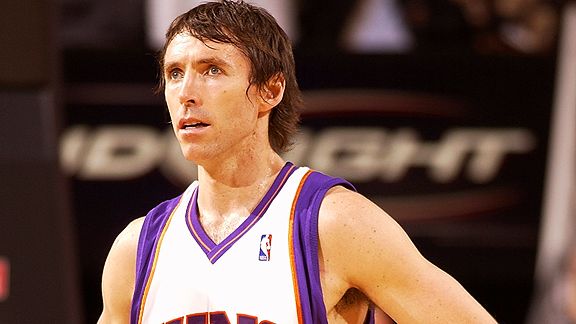
Two-time MVP Steve Nash has agreed to a two-year extension with the Phoenix Suns.
After receiving an improved offer last week and taking a few more days to deliberate, two-time NBA Most Valuable Player Steve Nash notified the Phoenix Suns over the weekend that he is accepting their two-year extension offer worth an estimated $22 million, according to team sources.
The Suns offered Nash a two-year, $20 million extension two weeks ago in addition to the $13.1 million he’s owed next season, then bumped it higher in a meeting in Las Vegas last Wednesday attended by Suns owner Robert Sarver, president of basketball operations Steve Kerr and Nash’s agent Bill Duffy.
When the Suns traded away Shaquille O’Neal, it seemed to indicate that the franchise was ready to start the rebuilding process. But with this extension, GM Steve Kerr appears to be building around Nash and, for the time being at least, Amare Stoudemire. I’m not sure what Kerr’s long-term plan is, and I’m not confident that even he knows.
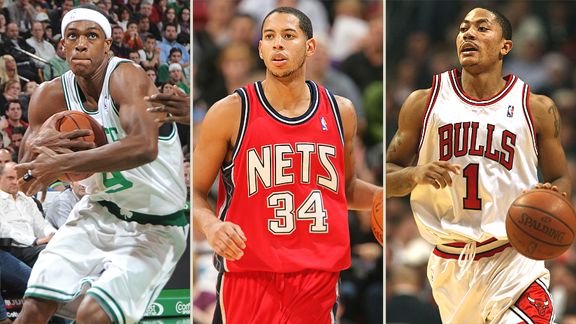
We hear it all the time. NBA analysts call one point guard “pass-first” and another “shoot-first.” Or they say one guy is “turnover-prone” while another “takes care of the ball.” But really, what makes a player a “pass-first” point guard? How carefree must he be with the ball to be considered “turnover-prone”?
Taking an analytical approach to these questions, I decided to bust out an Excel spreadsheet and try to come up with some answers. Below you’ll see a graph that attempts to classify the top point guards in the league. But first, a little background…
I chose to categorize each player based on two stats. First, to determine if he’s “shoot-first” or “pass-first,” I calculated the shot-to-assist ratio for each player. The bigger the number, the more of a “shoot-first” mentality the player has. Second, to determine whether or not a player is “turnover-prone,” I calculated each player’s assist-to-turnover ratio. I thought about using turnovers per 48 minutes, but I like the idea of including assists so that playmakers are rewarded for the positive as well as the negative. Next, I calculated each player’s Efficiency Per Minute (EPM) to see if there is any correlation between these other statistics and the overall efficiency of the player in question.
FOLLOW US!

CATEGORIES
© 2026 The Scores Report – The National Sports Blog
Theme by Anders Noren — Up ↑