Tag: Devin Harris (Page 3 of 6)

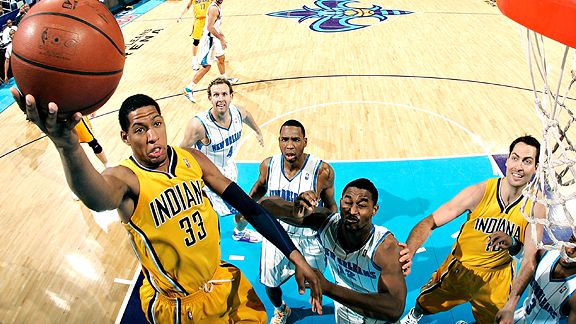
Danny Granger wins Most Improved Player

Danny Granger has been named the 2009 NBA Most Improved Player. Last month, I wrote the following in my “Predicting the 2009 NBA year-end awards” post.

Most Improved
This is always a tough one. Usually, it goes to a player that entered the league without a lot of pomp and circumstance (i.e. they were non-lottery picks) that makes the jump from role player or starter to star or superstar. The last eight winners are: Hedo Turkoglu (16th pick), Monta Ellis (40th), Boris Diaw (21st), Bobby Simmons (42nd), Zach Randolph (19th), Gilbert Arenas (31st), Jermaine O’Neal (17th) and Tracy McGrady (9th). A few of the names being bandied about are Devin Harris (5th), Danny Granger (17th), Kevin Durant (2nd), Nene (7th), Thaddeus Young (12th), Brandon Roy (6th) and Roger Mason (31st). Durant, Harris, Roy, Young and Nene all came into the league as lottery picks, a fact that works against them in this case. They’ve all made leaps this season, though I think everyone was expecting Durant, Harris, Roy and Young to make those jumps. Nene is more of a comeback player than an MIP. He’s been battling injuries his entire career, so the fact that he’s playing well while healthy is no surprise. The last few winners indicate that the MIP usually goes to a player who makes an unexpected leap, so I think it will go to Danny Granger, though his late season run in 2007-08 works against him. He averaged 22.4 points in March of ’08, and 24.8 ppg in April of ’08, so if you dig into the numbers a little, his play this season isn’t as big of a surprise. Still, I don’t think that he had the same expectations as Durant, Harris and Roy, so I think he’s our guy. Mason might be the darkhorse.
My choice: Granger
My prediction: Granger

Devin Harris finished a close second (364 to 339). The bottom line is that it’s tough to win the MIP if you were a former lottery pick; it hasn’t been done since T-Mac won it back in 2001.
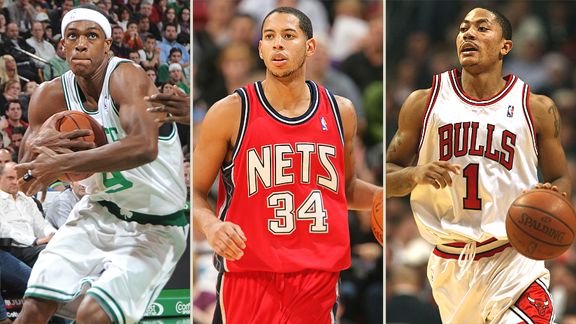
What kind of point guard is he?

We hear it all the time. NBA analysts call one point guard “pass-first” and another “shoot-first.” Or they say one guy is “turnover-prone” while another “takes care of the ball.” But really, what makes a player a “pass-first” point guard? How carefree must he be with the ball to be considered “turnover-prone”?

Taking an analytical approach to these questions, I decided to bust out an Excel spreadsheet and try to come up with some answers. Below you’ll see a graph that attempts to classify the top point guards in the league. But first, a little background…

I chose to categorize each player based on two stats. First, to determine if he’s “shoot-first” or “pass-first,” I calculated the shot-to-assist ratio for each player. The bigger the number, the more of a “shoot-first” mentality the player has. Second, to determine whether or not a player is “turnover-prone,” I calculated each player’s assist-to-turnover ratio. I thought about using turnovers per 48 minutes, but I like the idea of including assists so that playmakers are rewarded for the positive as well as the negative. Next, I calculated each player’s Efficiency Per Minute (EPM) to see if there is any correlation between these other statistics and the overall efficiency of the player in question.

Continue reading »

Bill Simmons’ trade value column

Yes, it’s 12 days old and the trade deadline has passed, but if you haven’t had the chance to check out his annual trade value opus, it’s a good read. He ranks the top 40 players by total trade value (i.e. age, upside, salary, talent, etc.). Here’s what he has to say about Tim Duncan:

4. Tim Duncan
His finishes in the Trade Value column since 2001: No. 2, No. 3, No. 1, No. 2, No. 1, No. 3, No. 3, No. 4. Uncanny. Speaking of consistency, check out his 12 regular seasons (including this one) split into groups of three seasons …

Duncan (first three years): 22-12-3, 52 percent FG, missed eight games.

Duncan (next three years): 23-13-4, 51 percent FG, missed eight games.

Duncan (next three years): 21-12-3, 50 percent FG, missed 31 games.

Duncan (last three years): 20-11-3, 52 percent FG, missed five games.

Then, remember that he also played 155 playoff games and averaged a 23-13-4 with 50 percent shooting, plus first-class defense and leadership. And sprinkle in the little fact that no Duncan team has ever lost even 30 games in a regular season. Translation: Greatest power forward ever, most consistent superstar ever and you cannot sleep on him in May and June.

I do take issue with a few of his rankings…

Yao at #7? Too injury prone.
KG ahead of Deron Williams? Garnett is too old.
Nash at #23 (ahead of Rondo, Devin Harris, Mayo, Kevin Martin)? Seems awfully high for a 35 year-old.

There are a few others, but I’m not going to nitpick.

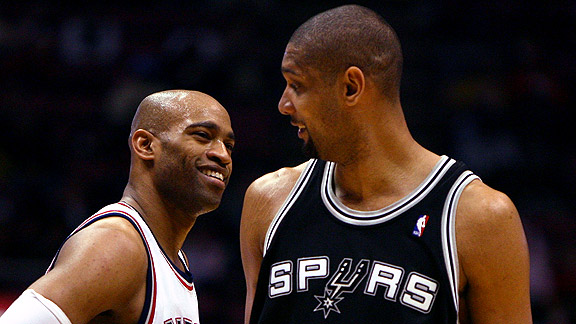
Should the Spurs trade for Vince Carter?

There has been some talk of late that the Spurs are interested in acquiring Vince Carter.

Duncan says he would love to have Carter as a teammate, and why not? At age 32, Carter remains one of the NBA’s most productive small forwards, averaging 20.8 points, 5.1 rebounds and 4.9 assists.

Duncan hedges when the price for Carter reportedly includes Roger Mason Jr., Bruce Bowen, George Hill and Fabricio Oberto.

“I’d hate to see that many guys go,” Duncan said after an All-Star appearance he enjoyed, largely because of its brevity.

If general manager R.C. Buford can find a way to get Carter from the Nets without including so many rotation players — a Robert Horry sign-and-trade could be part of such a solution — it is easy to imagine Duncan giving such a deal the blessing Popovich likely would seek.

Here’s a look at the proposed trade in the ESPN Trade Machine. Kurt Thomas could also be substituted for Oberto.

Of the four Spurs that would be heading to New Jersey, the team would miss Roger Mason, Jr. the most. He’s playing over thirty minutes a game and has hit several clutch/game-winning threes this season. In fact, he’s shooting almost 45% from long range; he’s exactly the kind of player that the Spurs need to space the court for Duncan, Ginobili and Parker in crunch time. There is no doubt that Vince Carter is a better player, but he’s also a different player, and that’s what should scare Spurs fans about this deal. San Antonio is 26-9 since the beginning of December and they are arguably the second-best team in the West. Their current roster is capable of giving the Lakers fits if the two teams were to meet in the playoffs, so is it worth the risk to add Carter to the mix?

Hill is the piece that San Antonio is most likely to miss in the long term. He has played very well in his rookie season and has finally given the Spurs a proper backup to Parker. He looks like he’ll be a starting-caliber point guard in a year or two, so they’d be giving up on his potential as well. Bowen can still defend in spurts and hit the corner three and Oberto is a big, beefy backup on the front line (though he isn’t playing much this season).

Without those four, the Spurs would have a rotation that would include Duncan, Ginobili, Parker, Carter, Finley, Thomas, Bonner and Udoka. I think Gregg Popovich trusts those eight guys, but what happens if one of them gets injured? Does he have faith in any of the other guys further down the bench?

My guess is that the Nets would do the deal if Mason, Hill and (maybe) a first round pick were included. It would give the team incredible cap flexibility in the summer of 2010. With Devin Harris and Brook Lopez already on board, New Jersey would become an attractive landing spot for one (or two) of the big name free agents that should be available that summer.

« Older posts Newer posts »