Page 416 of 2956

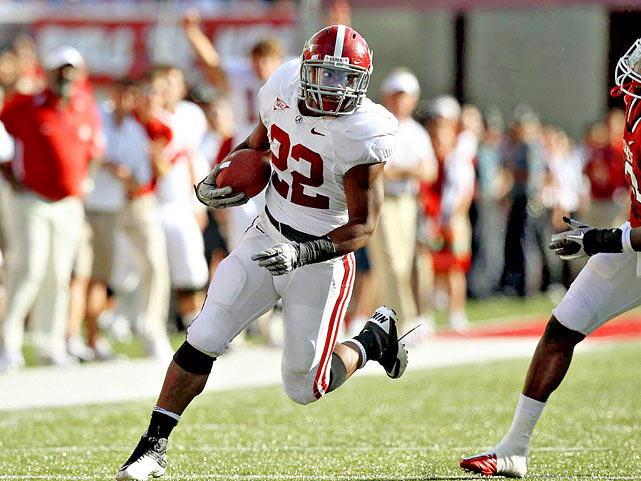
How worrisome is Mark Ingram’s 40-time?

Mark Ingram ran a 4.62 in the 40-yard dash at the NFL Combine, which is considered to be on the slow side of average. In fact, the average 40-time for a RB since 2005 is 4.56, and that’s from a sample size of 163 RBs over six years.

Seven of the top eight rushers in the NFL — Chris Johnson (4.24), Jamaal Charles (4.38), Adrian Peterson (4.40), Maurice Jones-Drew (4.39), Michael Turner (4.49), Steven Jackson (4.45), Rashard Mendenhall (4.41) — ran a sub-4.5 in the 40-yard-dash.

There was one notable exception, and it was the top rusher of 2010, Arian Foster. He reportedly ran a 4.69 at his pro day, which just goes to show it doesn’t take elite speed to rack up yards.

Still, with so many of the top rushers with good to excellent speed, isn’t it worrisome for a team thinking about drafting Ingram? I posed this very question to our NFL guru, Anthony Stalter, who currently believes Ingram will go #15 to the Dolphins, and here is what he said:

There are a lot of fans and draft pundits who get too caught up in 40-yard dash times. When I watched Ingram last year, I saw a physical back but one that has great short-area quickness when he went through holes. It’s true, he doesn’t have great top-end speed and he’ll never be a back that can rely on straight-line speed (which is what the 40-yard dash measures). That said, Ingram is a very solid prospect.

I think one of the most overrated factors when sizing up a running back prospect is speed, with vision being the most underrated attribute. When I watch Ingram play, he reminds me of Emmitt Smith. The former Cowboy didn’t have great straight-line speed like Chris Johnson or Adrian Peterson, but he was a natural runner with tremendous vision, instinct and balance. I’m certainly not suggesting that Ingram is the next Emmitt, but he bears a resemblance to Smith when he runs.

That said, as John has pointed out, speed kills and the proof is in the pudding. When all of the elite running backs in the league are running in the 4.3s or 4.4s (or in CJ’s case, a freakish 4.2), it makes you wonder whether or not Ingram can be an elite back in the NFL. Then again, I haven’t heard one analyst deem him an elite prospect, so it’s all relative. It would be great if every top 15 pick were elite, but the draft remains the ultimate crapshoot. If the Dolphins were to take him at No. 15 and he wound up being a solid feature back for the next 6-8 seasons, went to 1-2 Pro Bowls but was never considered an elite player, wouldn’t their selection of him be considered successful?

After running a 4.62 forty at the combine, there’s a good chance that Ingram could drop into the bottom half of the first round. I still like him at No. 15 to Miami, but some teams are overly reliant on the forty so I could see him potentially falling come April. It would be too bad too, because I think he’s a nice overall player who has worked hard to shed some weight in the offseason.

Foster is the exception that proves the rule: Speed kills. It’s great that the undrafted Foster landed in a good situation in Houston and made the most of it. But Ingram is widely regarded as the top prospect in a weak RB draft, and in all likelihood will be a first round pick. If the Dolphins are drafting him in the middle of the first, isn’t it their expectation that he’ll be elite? And what are his chances of becoming elite without top-end speed?

Francisco Liriano-to-Yankees talk heating up

Over the weekend, Bob Nightengale of USA Today reported that the Yankees were keeping a close eye on Twins’ starter Francisco Liriano. On Monday, Nightengale told Jim Bowden of MLB Network Radio that he thinks Liriano will be traded to New York sometime in the next two weeks.

From Rotoworld:

Minnesota Twins starting pitcher Francisco Liriano throws against the Chicago White Sox in the third inning at U.S. Cellular Field in Chicago on August 12, 2010. UPI /Mark Cowan

We’ve heard discussion about the Twins possibly trading Liriano from a variety of sources, so it appears this rumor has legs. The Yankees have an obvious need in their rotation, but the Twins would be trading away the closest thing they have to an ace at the moment. According to Nightengale, the Twins would acquire either Ivan Nova or Joba Chamberlain, in addition to other pieces. Stay tuned, because it sounds like things are about to get very interesting.

If the Twins acquire Chamberlain, I wonder if they’ll consider him a starter or a reliever. Because obviously the Yankees’ brass doesn’t feel that he’s a starter or else he would be mentioned along with the other 25 candidates that are trying out for the No. 4 and No. 5 spots in New York’s rotation.

If they do wind up trading Liriano, it’s hard to like Minnesota’s chances in the AL Central this year. The White Sox and Tigers have retooled and the Twins’ bullpen took some big hits in the offseason. Getting healthy seasons out of Justin Morneau and Joe Mauer would become even more vital given the losses the Twins have (or will) absorbed in their pitching staff.

Assuming Liriano could handle pitching in the Bronx, he would give immediate hope to the Yankees’ pitching situation. Now all of a sudden, less would be expected of A.J. Burnett and Phil Hughes, which is huge in the case of Burnett (who succumbed to the pressure last season after pitching well in 2009).

Whatever happened to all the dominant Duke big men?

Duke head coach Mike Krzyzewski (L) questions a call by an official during the second half of his team’s NCAA basketball game against Temple University in Durham, North Carolina February 23, 2011. REUTERS/Ellen Ozier (UNITED STATES – Tags: SPORT BASKETBALL)

Let me throw out a few names: Danny Ferry, Christian Laettner, Cherokee Parks, Elton Brand, Carlos Boozer and Shelden Williams — what do they have in common? Yes, they all played for Duke, and they all averaged at least 17.7 points and 7.4 rebounds in their final years in Durham. On average, this group posted 19.6 points and 9.0 boards in those years. Ferry, Laettner, Brand and Williams were named First Team All-Americans, while Boozer made the Third Team. Parks could have been an All-American as well had Mike Krzyzewski not missed most of of his senior season due to back surgery and exhaustion. Williams was the last “dominant” Duke big man, and he graduated in 2005-06.

Since then, Duke has seen a string of highly-touted big men come through Cameron, including Shavlik Randolph (who played with Williams), Josh McRoberts, Brian Zoubek, Miles Plumlee, Mason Plumlee and Ryan Kelly. Randolph, McRoberts, Mason Plumlee and Kelly were all McDonald’s All-Americans coming out of high school. Other than maybe McRoberts (13.0 points and 7.9 rebounds), none of these guys have even approached the numbers and success of the aforementioned group.

What has happened to big man development in Durham?

Continue reading »

Will the Bears target a DT in the first round after releasing Tommie Harris?

Tommie Harris told the media in early February that he wouldn’t be a distraction like Albert Haynesworth has been with the Redskins when it came to the uncertainty of his future with the Bears. Of course, he wasn’t around long enough to be a distraction because the team cut him on Monday.

Chicago Bears defensive tackle Tommie Harris walks off the field after warmups before a preseason game against the Oakland Raiders at Soldier Field in Chicago on August 21, 2010. UPI/Brian Kersey

The Bears apparently had some interest in bringing the former Pro Bowler back next season, but only if he were willing to take a sizable paycut. He wasn’t, and the Bears had little choice but to release him seeing as how he was owed a $2.3 million roster bonus. His play has declined over the last several years and despite the addition of Julius Peppers to the defensive line last season, Harris finished with just 13 tackles and two sacks in 15 games.

There is no shortage of teams looking for defensive tackle help, so Harris will certainly resurface somewhere. Seeing as how he was just released, it’s difficult to narrow down a list of potential suitors for him, so the more intriguing question at this point is how this move could affect the Bears’ draft plans.

Chicago holds the No. 29 overall pick and it must upgrade its offensive line. Depending on how the first round plays out, Wisconsin’s Gabe Carimi, Mississippi State’s Derek Sherrod, Boston College’s Anthony Castonzo, Colorado’s Nate Solder and Villanova’s Benjamin Ijalana are all possibilities for the Bears at No. 29. But what if the decision to release Harris prompts GM Jerry Angelo to go in another direction?

Angelo has had a difficult time building an offensive line over the years and struggles to draft in the first round. He has an eye for defensive talent, however, so maybe he’ll stick with what he knows best. Releasing Harris opens a hole at defensive tackle and Chicago Sun-Times writer Neil Hayes recently suggested that Illinois’ Corey Liuget could be the Bears’ top pick.

Liuget’s stock appears to be on the rise the closer we get to April’s draft. Behind Nick Fairley and Marcell Dareus, Liuget is the best three-technique tackle in the draft. (Temple’s Muhammad Wilkerson is somewhere in the mix, too.) Liuget, who isn’t even 21 yet, racked up 12.5 tackles for loss and 4.5 sacks as a third-year junior in 2010, leading the Illini in QB pressures as well. He’s quite the talent, although I’m not sure if he’ll fall to the Bears at No. 29. He’s expected to go somewhere late in the first, but I have the Rams taking him at No. 14 (which seems high now, but if Liuget’s stock continues to climb then maybe No. 14 won’t seem like such a reach come April).

Either way, the Bears’ draft plans just got a little more interesting.

« Older posts Newer posts »