Page 395 of 2956

2011 NFL season to be uncapped once the lockout ends?

National Football League Players’ Association’s (NFLPA) Executive Director DeMaurice Smith arrives to continue negotiations between the National Football League (NFL) and NFLPA in Washington March 11, 2011. The parties were still negotiating a range of sticking points, including how to divide more than $9 billion in annual revenues, but the players’ union insist one issue, the NFL’s proposal to add two more games to the regular season, was off the table. REUTERS/Joshua Roberts (UNITED STATES – Tags: EMPLOYMENT BUSINESS SPORT FOOTBALL)

The Washington Post is reporting that the 2011 NFL season would likely be played with no salary cap if the players succeed in ending the owners’ lockout.

That would mean there would be no player-payroll maximum or minimum for NFL teams. Players with expired contracts would need six years of NFL service time to be eligible for unrestricted free agency, rather than the four seasons required when the salary cap system was in effect; players with expired contracts and three to five seasons of NFL experience would be restricted free agents. Each team would have an extra transition-player tag, in addition to the one franchise-player or transition-player designation allowed per club under the salary cap system, to restrict players’ movement in free agency, and there would be limits on the free agent activity of last season’s final eight playoff teams.

The reason that system would be used, sources said, is that it might have a better chance of withstanding an antitrust challenge by the players, given that the union previously agreed to those rules for an uncapped year in collective bargaining. Attorneys for the players’ side have said they would challenge in court any rules put in place by the league if the lockout is lifted.

The NFL is a victim of its own success. After making the game extremely popular over the last decade, fans are rightfully ticked off about this lockout. I don’t know about anyone else, but I’ve reached a point where I hope neither the players nor owners get what they want in the end.

An uncapped year would be great because the players ultimately won’t get what they want. The union has always wanted players to reach free agency as quickly as possible so that they can cash in great seasons. But as the Post points out, in an uncapped year players with expired contracts would need six years of NFL service to quality for free agency – not four like it would be under a cap. So there would be no “cashing in.”

In the end, both the players and owners will come to realize that their best bet was just to compromise months ago. Now they’re in a hell of their own making and I wouldn’t mind seeing both sides get burned in the process.

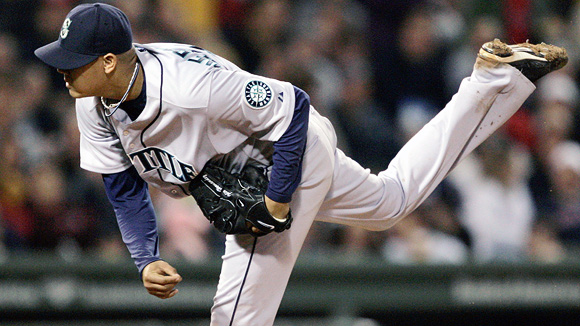
Should the Mariners and Yankees talk Felix Hernandez?

Aside from Ichiro and Felix Hernandez, there’s not much to see when it comes to the Seattle Mariners. They’re in a real bind because even in a wide-open division, they don’t have enough to compete in the AL West but they also don’t want to trade away their best talent and not have anything to attract fans to the ballpark this season.

But at this point, it might not be a bad idea for GM Jack Zduriencik to get Brian Cashman on the phone.

After missing out on Cliff Lee this winter, the Yankees still need pitching. If A.J. Burnett comes around and Phil Hughes gives the club another quality season, then the Bombers could make do. But this is the Yankees: They don’t want to “make do,” they want to win championships. That’s why they might be willing to sell the farm in order to acquire a piece like King Felix.

Ken Rosenthal of FOX Sports talked about this very topic in one of his latest columns. He writes that Zduriencik might be able to acquire farm names such as Jesus Montero (who was the centerpiece of the Yankees’ offer to the Mariners last summer before Seattle sent him to Texas), Manny Banuelos, Dellin Betances, Ivan Nova, Hector Noesi and Eduardo Nunez. As Rosenthal points out, the M’s wouldn’t be able to acquire all of those players, but considering Hernandez is coming off a Cy Young-winning season, is only 25 and is under team control through 2014, there’s not much Zduriencik couldn’t at least ask for.

But again, would the M’s be willing to part with a player such as Hernandez when it’ll make them weaker now and the Yankees stronger? King Felix may wind up spending the next 10 years beating them in New York and then what was this all for? To acquire some prospects that may or may not turn out?

That said, the M’s need a lot of players and New York could certainly help them in that area. If Seattle were able to acquire five great to very good prospects, they might be able to compete for a championship themselves in the near future. Nothing is guaranteed of course, but what if in one phone call Zduriencik could make his club a serious contender in two or three years? All he has to do is sacrifice a lot right now to possibly acquire a lot more down the road.

If you’re Zduriencik, do you make the call?

What makes a Final Four team?

Duke Blue Devils forward Kyle Singler (R) celebrates with his team after beating the North Carolina Tar Heels during their NCAA men’s basketball championship game at the 2011 ACC Tournament in Greensboro, North Carolina March 13, 2011. REUTERS/Chris Keane (UNITED STATES)

When filling out your bracket, it’s not a bad idea to start with your Final Four picks and work backwards. I looked at the last seven Final Fours to get an idea of the profile of a Final Four team and discovered the following:

25 out of 28 FF teams (89%) finished the tournament with adjusted offensive and defensive efficiencies (i.e. points per possession adjusted for strength of schedule) in the Top 30 (LSU ’06, George Mason ’06, Butler ’10). Teams currently in the Top 30 in both categories: Ohio St., Duke, Kansas, Texas, Pitt, SDSU, Kentucky, Purdue and Syracuse. Teams that could play their way into a Top 30 ranking by the end of the tournament: Louisville, BYU, North Carolina, UConn, Belmont, Illinois, West Virginia.

24 of 28 FF teams (86%) finished the tournament with a Pythagorean win ranking in the Top 10 (#23 George Mason ’06, #14 Villanova ’09, #12 Butler ’10, #23 Michigan State ’10).
Teams currently in the Top 10: Ohio St., Duke, Kansas, Texas, Pittsburgh, SDSU, Kentucky, Purdue, Wisconsin and Notre Dame. Teams that could play their way into the Top 10: Syracuse, Louisville, BYU, North Carolina, Washington, Utah St., UConn, Belmont and Florida.

23 of 28 FF teams (82%) were elite (in Top 7) in either offensive or defensive efficiency (George Mason ’06, Michigan State ’09, Villanova ’09, West Virginia ’10, Michigan State ’10). Teams currently in the Top 7 in either category: Ohio St., Duke, Kansas, Texas, Pitt, SDSU, Kentucky, Wisconsin, Notre Dame, Louisville, North Carolina and Utah St. Teams that could play their way into the Top 7: BYU, Washington, Clemson and Purdue.

Teams currently on all three lists: Ohio St., Duke, Kansas, Texas, Pitt, SDSU and Kentucky.

Teams that could play themselves onto all three lists:
Purdue, BYU, Louisville and North Carolina.

When picking your Final Four teams, it would be wise to stick to these 11 teams. Moreover, five of the last seven overall winners were Top 5 in both offensive and defensive efficiency, while the other two were #1 in offensive efficiency. Only Ohio St. and Duke currently qualify for “overall winner status.” Kansas is #4 in offensive efficiency and #12 in defensive efficiency, so they could potentially play their way into Top 5 status in both categories (or the #1 overall offensive efficiency). Pittsburgh, Wisconsin, Notre Dame and Kentucky round out the Top 7 in offensive efficiency. In other words, you shouldn’t pick an overall winner that isn’t listed here.

Want to see who I picked?

Need help filling out your March Madness bracket? (Part 2)

The Kansas Jayhawks celebrate after defeating the Texas Longhorns in the 2011 Phillips 66 Big 12 Men’s Basketball Tournamentat the Sprint Center in Kansas City, Missouri on March 12, 2011. UPI/Jay Biggerstaff

If you want to see my record as a March Madness prognosticator along with an outline of my methodology, click here. If you just want to see my picks, read on.

FIRST FOUR

I wouldn’t normally pick the play-in games, but this season there are a pair of #12 seeds and a pair of #11 seeds that are playing on Tuesday and Wednesday for the right to advance to the first round on Thursday and Friday.

All four games are fairly easy to pick since they all of spreads of 3+ in Sagarin rating. My four winners are NC-Asheville, Clemson, UT-San Antonio and USC.

FIRST ROUND

Most of the picks are made by taking the Sagarin/Pomeroy favorite. Here are the first round games that are tighter statistically along with the reasoning for my picks.

George Mason/Villanova
Nova is a 1.8-point Sagarin favorite, but George Mason is a very slight Pomeroy favorite. Basically, it’s a statistical toss-up. I’m going with George Mason because Villanova has lost five straight games and 10 of their last 15. Wow. The Giant Killers blog likes the Patriots as well, even though this doesn’t technically qualify as a GK game.

Michigan/Tennessee
These are two pretty similar teams statistically. Michigan is a 1.1-point Sagarin favorite and Pomeroy says they have a 57% chance of winning this game. I do wonder if Tennessee’s season had gone differently had Bruce Pearl not been suspended. This is a toss-up, so I’ll go with the Wolverines, who have played a little better of late (9-4 in last 13 games).

Continue reading »

Need help filling out your March Madness bracket?

Ohio State Buckeyes guard David Lighty cuts off a piece of the net after the Buckeyes defeated the Penn State Nittany Lions to win the NCAA Big Ten men’s basketball tournament championship game in Indianapolis March 13, 2011. REUTERS/Brent Smith (UNITED STATES)

Want to skip my resume and methodology and see my picks? Click here.

Hundreds of writers will write hundreds of columns/articles/posts about the 2011 NCAA Tournament, so you may be wondering, why should I listen to this clown?

In 2007, I picked the winner (Florida) along with one other Final Four team (#2 seed Georgetown). In 2008, I picked the winner (Kansas) along with two other Final Four teams (#1-seed UCLA and #1-seed North Carolina). That was enough to line my pocket with a little cash in both years.

2009 was another story. Even though I am on record saying that if Ty Lawson’s toe were 90-95% healthy that North Carolina would have been my pick, I ultimately didn’t have enough confidence in Lawson’s health — special thanks Dick Vitale for calling it “cartoonishly” swollen, stoking my fears — to pick the Tar Heels last season. I picked only one Final Four team (#1-seed UConn) and my winner (Pitt) lost in the Elite Eight to Villanova.

In 2010, I got off to a rough start, but picked both Duke and West Virginia in the Final Four and would have won my pool had the Mountaineers managed to upend the Blue Devils. I’d also like to note that I ignored evidence that Duke (along with Kansas) was one of the two clear favorites to win the title last season. I would have won my pool had a I taken the Blue Devils over the Mountaineers. Sigh.

Here’s my method for March Madness: First, I pull in Jeff Sagarin’s regular season rankings. I also consider Ken Pomeroy’s offensive and defensive efficiency stats, along with his Pythagorean win percentage.

Over the last four years, teams with a 2+ point advantage in Sagarin’s “predictor” rating have won 156 of 198 games (78.7%). Over the last two years, if a team had at least a 65% expected win rate according to Pomeroy’s Pythagorean calculation, they won 61 of 76 games (80.2%). So I won’t stray too far from these two indicators if they both agree that a certain team is going to win.

But not every game is so clear cut. Over the last four years, if there were 198 games that had a Sagarin favorite of at least three points, that means that there were 51 games that did not. My research has found that a Sagarin advantage of 0-2 points yields a 27-24 record and an advantage, so if the Sagarin advantage is less than two points, the game is basically a toss up.

For these games, I’ll look at other factors, like location of the game, offensive and defensive efficiencies, matchups, injuries, current play, and how each team fits the Giant Killers profile. In short, if a game is a toss up, it pays to go with the underdog because most people are going to go with the favorite.

I guess I should mention that I played for Bo Ryan (current coach of the Wisconsin Badgers) at UW-Platteville and started on the 1995 team that went undefeated and won the NCAA Division III National Championship. So I know a little bit about basketball.

Typically, my brackets struggle in the early rounds and then come on at the end. I’m in a regular pool that has 30-35 people in it every year. I’ve placed in the money twice in four years and am always still alive heading into the Final Four. That’s all you can ask for, right?

Click here for my picks.

« Older posts Newer posts »