
The world is a mess. Osama Bin Laden is still at large, the U.S. economy is in a recession and our country is still fighting two different wars on two different fronts.
But I can’t control any of that. On the whole, 2008 has been a pretty good year for Team Paulsen. My wife and I had our first child, a happy and healthy son (97th percentile in height = future 6’10” power forward), and I still have a job and a roof over my head.
I write about sports, so in the spirit of Christmas, which – let’s be honest – is really about getting, not giving, I scribbled down a few things that I’d like to see gift-wrapped underneath the tree.
So, without further ado, all I want for Christmas…
…is a college football playoff.
This drives me nuts and I know I’m not alone. I’m a casual fan of college football and I only watch maybe 10-15 games the entire year, including one bowl game – the BCS title game. If there were an eight-team playoff, I would make a point to watch every single one of those seven games. Not only that, but I’d start watching more of those late-season games that feature teams that are fighting for a playoff berth. I know money is a big issue with the BCS, but if casual fans are going to increase the number of games they watch by 50-70%, how can this not bring higher ratings and more ad revenue? This whole situation is mind-boggling.
…is Sunday Ticket for all fans.
I live in a condo and my patio doesn’t have a view of the southern horizon, so I can’t get DirecTV. And since I can’t have DirecTV, I can’t get NFL Sunday Ticket. Whenever the package is up for sale, the NFL continues to sell the exclusive rights for Sunday Ticket to DirecTV. The cable companies are part of the problem – they can’t seem to join forces and get a combined offer together – but the NFL is mostly to blame for not doing everything in their power to bring as much NFL action as possible to their fans. The increase in the number of subscriptions would offset the loss in profit from selling the “exclusive rights,” or at least I think it would. I don’t really care. I just want to get Sunday Ticket in my condo that has no view of the southern horizon and I’m guessing there are millions of fans that are in the same boat.
…is every game in HD.
The NFL is on board. But there are still some sports that are slow to move to the HD format. The NBA Season Pass is a perfect example. Sure, I can watch any NBA game I want, but the picture is always crappy. Wouldn’t it be great if all the major sports – NFL, CFB, CBB, MLB, NBA and NHL – broadcast every game in high def?
…is a NBA “Fourth Quarter Channel” that bounces around to the best action.
DirecTV’s Red Zone Channel is great. Every Sunday, they jump from game to game and bring us all the scoring plays and red zone possessions. Why doesn’t the NBA Season Pass create a similar channel? It wouldn’t have to operate on days where the league has a light schedule – say, less than five games – but when there are five or more games, why not have a channel (in HD, of course) that brings us all the action, especially all the nail-biting drama in the fourth quarter? The NBA has an advantage over the NFL in that the start times are staggered due to the different time zones, so when there is a full slate of games, there should be plenty of good action and exciting finishes to choose from.
…is a salary cap in Major League Baseball.
I’m not asking for a hard cap, like the NFL, though that would be optimal. I just want some sort of a salary cap with a 50% luxury tax that pays the small-market, fiscally conservative franchises and allows them to be profitable. Say we have a cap of $100,000,000. That way, when the Yankees roll out their $250,000,000 payroll, they have to pony up another $75,000,000 to be divvied up amongst the small market teams. Maybe that would make them think twice before buying up every good player on the market. Before you throw the Tampa Bay Rays in my face, let’s see where they are in four or five seasons. Small market franchises can put together a competitive team for one or two seasons, but it’s impossible to keep it up over the long haul because the Yankees or the Red Sox are inevitably going to come in and sign all their good players.
…are shorter MLB, NBA and NHL seasons.
I know this is a moneymaker for each league, but these seasons are so long that they barely even matter. Long seasons are all right as long as the playoffs aren’t too inclusive, but the NBA and NHL have 82-game seasons and over half the teams make the postseason. This adds up to relatively meaningless regular season games. I’d cut the regular season for all three sports in half and eliminate back-to-back games, at least in the NBA and NHL. This would improve the quality of play and make the regular season important again. Anytime people refer to your regular season as a “grind,” it’s time to start thinking about paring it back.
…are more Saturday NFL games once the college season is over.
College football is pretty much dead the entire month of December yet the NFL is reluctant to schedule more than the occasional Saturday game. This seems like a missed opportunity to me. I know the NFL likes to own Sundays, but what’s wrong with scheduling a few of the better matchups on Saturday so the entire country can see them?
…is a two-year minimum (or an age-limit of 20) before players can declare for the NBA.
These “one and done” players are making a joke out of college basketball. It’s wreaking havoc for college recruiters and there is little continuity in many of the major collegiate programs. In a perfect world, this would be the rule: 1) high school players can declare themselves eligible for the NBA Draft immediately after graduation or 2) they can go to college (or the NBDL or overseas) for a minimum of two seasons before making themselves eligible for the draft. Almost two years ago, I wrote a column that went into great detail about how high school draftees have a better chance of making it in the pros than college or international players do. Almost two-thirds (64%) of high school players drafted in the first round went on to become superstars, stars or starters in the NBA. Compare that to the one-third (32%) of college and international players drafted in the first round that went on to have similar success. It’s clear that high school players are capable of being successful in the NBA, but I understand why the league would like these players to get a year or two of coaching and experience on the college level before making the jump. Under my proposal, if a player does not get drafted, he could still go to college for two seasons and make himself eligible again. If a high school player is drafted but is a bust, he can play in the NBDL or overseas until he’s seasoned enough to return to the NBA (and the league should have an office that helps these players find a new basketball home). The best players successfully make the leap, the fringe players have two years of college before the NBA and the so-called busts have the safety net of the NBDL and/or playing overseas until they’re good enough to return.
But enough about me – what sports-related gifts would you like to see under the tree?
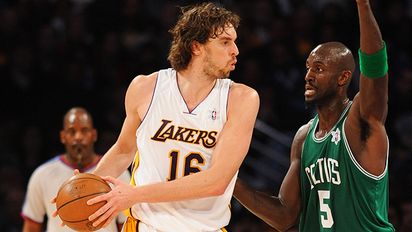 Kobe Bryant said this was a “statement game” and it seemed that the Lakers were taking it a little more seriously than the Celtics were. Not that C’s weren’t focused — they were — but there’s a certain swagger that comes with being the defending champs; you’re going to get everyone’s “A” game, but it’s important to remember that one regular season does not a championship make. That seemed to be Boston’s mindset.


