Page 173 of 2955

2012 NFL Draft: Breaking down the Running Backs

Throughout the next couple of months I’ll take a look at each position group leading up to the 2012 NFL Draft. After previewing the quarterbacks last week, today I break down the running backs.

Alabama Crimson Tide running back Trent Richardson (3) scores a 34 yard touchdown in the second half of the BCS College Football Championship at the Mercedes-Benz Superdome in New Orleans, Louisiana, on January 9, 2012. Alabama won the game 21-0. UPI/David Tulis

The Best in Class: Trent Richardson, Alabama
At 5-foot-11 and 224 pounds, Richardson is built to withstand the pounding at the NFL level. He has strong legs, a muscular lower half, and runs with a combination of power and explosion. He essentially is everything a power running team looks for in a lead back, which is why some believe he’s the best running back prospect to come out since Adrian Peterson. As of this date, Richardson is the only running back in this year’s class that is projected to be selected in the first round. He’s the real deal and can be viewed as a workhorse in Year 1.

The Challenger: David Wilson, Virginia Tech
Honestly, there is no “challenger” to Richardson. It’s Trent Richardson and then there’s everybody else, although that isn’t intended to be a knock on the rest of the backs in this year’s draft. There are several backs that are projected to go in the second round or third round that could contribute as rookies. Wilson, for example, isn’t a very big back at 5-foot-10 and 205 pounds, but he runs stronger than you’d think for a guy his size. He has excellent explosion, balance and quickness, and runs a 4.42 to Richardson’s 4.52. While he’ll need to work on being a more patient runner, Wilson should contribute as a rookie and could start in his second year assuming he learns how to pick up the blitz.

Don’t Sleep On: Cyrus Gray, Texas A&M
Gray will likely never be an every down workhorse in the NFL like Richardson is projected to be, but that shouldn’t matter much. The NFL is a passing league now and a backfield committee approach is quickly becoming the norm. Gray isn’t very dynamic but he’s a natural runner with very good instincts who can decipher information quickly. He also possesses good balance and has the size to take a pounding at the next level. Again, he may not be a lead back but he can be productive as the second runner in a two-back system. He’s projected to go somewhere in the third round.

Mid-Round Sleeper: LeMichael James, Oregon
More quick-footed than fast, James will draw comparisons to Falcons’ 2011 fifth-round pick Jacquizz Rodgers because of his scat back abilities. James will be severely limited as an inside runner but put him in the hands of a creative offensive coordinator and he could be a weapon on third downs. He’s a natural pass catcher and his vision allows him to find daylight quickly. He constantly makes defenders miss in open space and he also has experience on special teams as a return man. Oregon’s all-time leader in rushing (4,923) and rushing touchdowns (52), James is worth a flier in the middle rounds (fourth – sixth) for a team looking to add more playmakers on offense.
Yoenis Cespedes’ deal with A’s has Billy Beane written all over it

Billy Beane, general manager of MLB’s Oakland A’s arrives at the gala presentation for the film ‘Moneyball’ at the 36th Toronto International Film Festival September 9, 2011. REUTERS/Mike Cassese (CANADA – Tags: ENTERTAINMENT SPORT BASEBALL BUSINESS)

Billy Beane and the Oakland A’s shocked the MLB world on Monday when they agreed to a four-year, $36 million contract with free agent outfielder Yoenis Cespedes from Cuba. The move was rather surprising considering the A’s weren’t mentioned among the group of teams that were interested in signing Cespedes over the last few weeks.

The deal was also surprising when you consider that the A’s are supposed to be a cap-strapped organization. While there’s no doubt that a relative unknown like Cespedes is worth the risk for an Oakland club that is desperate for offense, the A’s have multiple holes to fill before they’re competitive again. Thus, it raised some eyebrows that Oakland was willing to give Cespedes more money than what the Reds handed Aroldis Chapman ($30.25 million over six years) back in January 2010. Chapman, of course, was the last Cuban player that was pursued by MLB teams.

Then again, this Cespedes deal has Beane written all over it.

Ken Rosenthal tweeted on Tuesday that Cespedes’ contract with the A’s does not include a no-trade clause. So in other words, if he becomes a star player down the road and Oakland doesn’t think it can re-sign him long-term, Beane can dangle the outfielder in front of as many teams as he wants. If Cespedes becomes an All-Star, Beane can complete one of his trademark deals where he unloads one player for multiple prospects, all while saving the Oakland organization money in the process.

There’s a chance that the A’s are starting to loosen the Kung fu grip they have on their checkbooks and want to build a competitive team centered around Cespedes and their young pitching. But knowing how Oakland and Beane have operated over the years, it wouldn’t be surprising if Cespedes’ name came up in trade talks sooner rather than later.

Has the NBA Truly Regained Popularity?

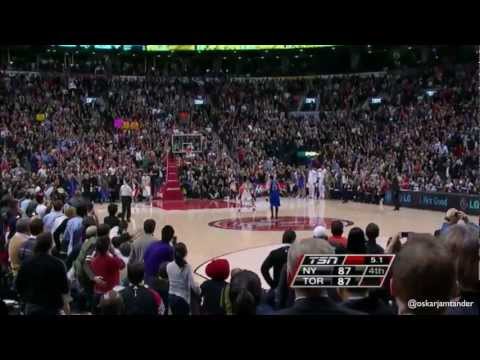
Toronto Raptors forward Jamaal Magloire grabs a rebound against Washington Wizards forward Rashard Lewis (R) during the first half of their NBA basketball game in Toronto February 3, 2012. REUTERS/Mike Cassese (CANADA – Tags: SPORT BASKETBALL)

It was only just a few months ago that the NBA appeared to hit a new low. The planned opening night for the 2011-12 season had come and gone, but instead of competing on a court the league’s star players were going in and out of the negotiation room, desperately trying to make a deal with the owners without sacrificing any of their revenue or salary cap demands. These negotiations appeared to prove fruitless. The strike dragged on and on. As the two sides continued to remain as far apart as ever, the vitriol began to flow in the media and across the arbitration table. The owners appeared determined to sacrifice the season to make a point. The players, meanwhile, wouldn’t budge.

All the while, the NBA enjoyed some pretty dismal PR among its fan base. On message boards and sports news sites, articles about the ongoing lockout were repeatedly met with indifference and outright scorn. Good riddance!, said one such comment. Couldn’t care less, read another.

Fast forward a few months, and the shortened NBA season is nearing its halfway point. The quality of play has been mediocre, many of the top players are sidelined and wearing knee braces, and the negotiation settlement didn’t do anything to curb player or owner greed. Despite all this, an interesting development occurred in the interim: the NBA became more popular than ever. TV viewership has risen 23 percent on ESPN and 50 percent on TNT. Attendance through the first 325 games has averaged 17,095 across the league. That equates to 89 percent capacity and reflects a bump from 17,057 at this same time last year.

How can we read these numbers? Has the NBA actually regained – and even surpassed – its previous popularity after a bitter and protracted strike?

The short answer, based on the above stats, generally appears to be yes. Numbers don’t lie, and there’s no denying that a substantial bump in television viewership and a small increase in attendance reflect that the sport hasn’t lost its popularity, at the very least. But a closer analysis reveals a more mixed picture. While the attendance for the top ten teams remains unchanged from this same time last year, the bottom of the attendance pack has strung out considerably. Among this group the average attendance has dropped and several teams – mainly the Rockets, Nets, and Pistons – are reporting dismal numbers. Furthermore, attendance analysts suggest that the numbers for this season are all positively skewed; due to the warm weather that has dominated much of the nation this winter, a lack of snowy conditions has made it far easier for fans to get to the game.

As for the rise in TV viewership, much of that can be explained by the condensed schedule of play. Normally, the NBA season starts in the fall and needs to compete with professional and college football for a substantial portion of its season. This year, however, the strike helped the NBA avoid the peak period of competition and instead begin play during a down period for other major sports. Another important factor is that many of the most successful teams are located in the biggest metropolitan areas. These teams cover most of the major U.S. markets and are responsible for a huge chunk of television viewership.

So it’s undeniable that the NBA has returned strongly from the strike and that the bad blood and PR of the summer and fall has largely evaporated. But the numbers should certainly not be taken to mean that the league has returned stronger than ever.

Randy Moss says he’s coming back but the question is: Will anyone want him?

Tennessee Titans receiver Randy Moss watches from the sidelines during warm-ups prior to their NFL football game against the Miami Dolphins in Miami, Florida November 14, 2010. Moss makes his debut with the Titans after being claimed on waivers. REUTERS/Hans Deryk (UNITED STATES – Tags: SPORT FOOTBALL)

Try to contain your excitement while reading this…

Randy Moss is coming back to the NFL.

“I just wanna go to a team and play some football,” Moss said in an announcment to “true Moss fans” on his 35th birthday via his Ustream.tv channel this morning. “The real Moss is on his way back to the NFL,” he said. “I didn’t want to make no splash, that’s why I left it on Moss TV.”

Well, good thing he made the announcement on “Moss TV” seeing as how he didn’t want to make “no” splash. I’m sure the 12 people who tuned in will keep the situation on the down low for Randy.

I know some are thinking, ‘Hey, for one year I’d see if Moss has anything left in the tank.’ But let’s be realistic for a moment: Which team really wants him?

First and foremost, nobody was interested in his services two years ago when he managed to get booted off two teams in one season. So why would anyone be interested now? Because he’s older and wiser?

There are plenty of receiver-needy teams that might be willing to kick the tires on Moss this offseason. But general managers of these receiver-needy teams would be better off trying to develop young talent than shoehorning Moss into the lineup for one season. After all, one year of Randy Moss isn’t going to solve any team’s receiver issues.

Winning has been the only thing that has kept Moss from being a distraction over his career. Chances are he would keep quiet for one last chance to play for a winning franchise, a la Plaxico Burress last season. Thus, Moss may be worth the risk for a good team like the 49ers, who oh-by-the-way will be searching for a wideout this offseason.

But have you seen the receivers that could be available this year? Vincent Jackson, Wes Welker, Reggie Wayne, DeSean Jackson, Dwayne Bowe, Marques Colston, Steve Johnson, Brandon Llyod, Robert Meachem, Mario Manningham, Laurent Robinson and Mike Wallace (restricted) are just a handful of the receivers whose contracts are expiring this offseason. Early Doucet, Harry Douglas, Legedu Naanee, Eddie Royal, Andre Caldwell, Roy Williams and Jerome Simpson could be available as well.

So why on earth would any team take on a potential headache like Moss when they could get a younger, potentially much better receiver on the open market?

I think it’s great that Moss is feeling rejuvenated on his 35th birthday. But if he wanted to play football so badly then he should have shut his mouth and trusted that the Patriots would give him a new contract in 2010. Instead, he pouted (just like he did in Oakland) and managed to completely fall off the radar.

“Faith, family, and football, that’s my M.O., bro,” Moss said. “Your boy be back for the upcoming season.”

We’ll see, Randy.

« Older posts Newer posts »