Perhaps more so than in previous years, there is an overwhelming notion that this year’s NFL draft is littered with risks – especially among the top 10 picks.
Is Matt Ryan the clear-cut best quarterback? Can Darren McFadden really handle a full rushing load in the pros? Is Jake Long truly the best overall prospect?
Having one of the first ten picks in the NFL Draft can be a curse in disguise. Take a bust and you’ll eat up cap space for years to come. That’s why it’s so important to get a good player early in the first round.
That said, what are the safest positions to draft in the top 10? Can previous drafts provide a glimpse of how this year’s top 10 will fare? Our numbers guy, John Paulsen, offered to help put a system together to provide some answers.
JP: I suggested to Anthony that we look at the relationship between position and NFL success. We compiled a list of the 100 players selected in the top 10 of all the drafts between 1996 and 2005. We didn’t include the last two drafts because it’s just too early to predict how good those players will be.
Anthony graded each player on a scale of 1 to 10, with a “1” representing a bust that is no longer in the league (or barely hanging on) and a “10” representing a probable or sure Hall of Fame player. A “5” represents a middle of the road starter – a player that would rank somewhere from 10th to 20th at his position. A “6” or a “7” represents a good starter – a player that is in the top third at his position. An “8” is a great starter – a Pro Bowl player or one that is on the verge. A “9” is a multiple Pro Bowl player and a possible Hall of Famer.
The players were placed into seven position groups: Quarterbacks, Running Backs, Wide Receivers/Tight Ends, Offensive Line, Defensive Line, Linebackers and Defensive Backs. Anthony’s grades were averaged for each position and we also calculated the odds of drafting a player with a “6” or higher (a solid starter), an “8” or higher (a star) and a “4” or below (a marginal starter, backup or bust). Here are the results:
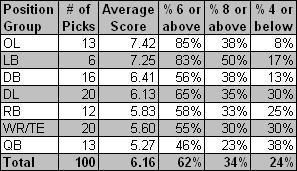
Anthony will provide the analysis.
OFFENSIVE LINE ANALYSIS
Why are offensive linemen chosen in the top 10 more likely to pan out? One theory is that the position is easier to learn while prospects attempt to make the transition from college to the pros. But if that’s the case, why haven’t running backs chosen in the top 10 fared better? Running back is widely viewed as the position with the least amount to learn coming out of college because it’s more about reaction and reading holes than it is about the playbook and reading defenses.
A more accurate explanation is that it’s easier for teams to identify whether or not an offensive lineman will pan out because their strengths can be seen on tape and at the combine. Does he have good size? What about good leverage? Is he too stiff? What about his reach? These qualities are easier to determine than those at the skill positions and therefore, great o-linemen are essentially easier to spot.
LINEBACKER ANALYSIS
Due to the small sample size, the average success of linebackers isn’t as dependable. There were only six linebackers taken in the top 10 since 1996 and three of them were graded at an 8 or higher, which might make the numbers look a little inflated.
But even with the small sample size, linebacker could still be considered a safe position to draft in the top 10. You can’t argue with the fact that of the six linebackers rated, five of them went to at least one Pro Bowl and one (Brian Urlacher) might become a Hall of Famer some day.
DEFENSIVE BACK ANALYSIS
The defensive back numbers are a little surprising considering that it’s easily one of the hardest positions to play in the pros. NFL rules are designed to give wide receivers an edge and, more times than not, DBs are often placed on an island, which is a tough place to be.
Perhaps the most interesting thing to take out of the grading of defensive backs is that only two players rated under a 5. That means almost every DB taken in the top 10 since 1996 has been a serviceable starter. Now, that isn’t exactly what teams want out of a top 10 pick, but at least the bust factor is very low when taking a DB that high.
DEFENSIVE LINE ANALYSIS
Much like their offensive counterparts, a defensive lineman’s skills can be picked up on film or at the combine. It’s probably easier to determine which d-linemen are more relentless and quick off the ball than it is to figure out which quarterback has the stones to lead a team in the fourth quarter.
With that said, the bust factor is still a bit high. Thirty percent of the linemen graded out to a 4 or below, which means they are/were fringe starters at best, or worse, they were complete busts.
Don’t tell the Browns that drafting defensive linemen isn’t a risky endeavor, seeing as how both Courtney Brown (first overall pick in 2000) and Gerard Warren (third overall pick in 2001) burned them in previous drafts.
RUNNING BACK ANALYSIS
One would think that running back should be the easiest position to grade seeing as how it’s mostly about speed, agility and size. But what can’t be judged at the combine is whether or not they have good vision and awareness to see a hole and quickly run through it. A player could be 210 pounds and run a 4.4-40, but if he can’t diagnose running lanes, he’s not going to make it.
Unlike the other skill positions, however, at least 58% of the time teams are getting a serviceable starter when they chose a running back at the top of the draft. Again, that’s not what teams want out of a top 10 pick, but players like Thomas Jones, Ronnie Brown and Cadillac Williams are all above average starters (and in the case of Brown and Williams, they might be more some day).
WIDE RECEIVER/TIGHT END ANALYSIS
Wide receiver is the most overrated position on draft day – period. Compare the amount of quality receivers taken in rounds 3-7 over the past 10-12 years compared to those chosen in the first round and the results are staggering.
Want to know how to screw up a team for years? Look at what Matt Millen did to the Lions when he took Charles Rogers, Roy Williams and Mike Williams in the top 10 in the 2003, 2004 and 2005 drafts. While Roy Williams did pan out, there’s only one football to go around and the Lions have sunk too much salary cap space into one position. (This is especially true when you consider they also chose Calvin Johnson in last year’s draft.)
Yes, hindsight is always 20-20, but how much better served would the Lions be today had they concentrated on defense during those drafts? Millen still might have blown the picks, but at least he would have shown at least a shred of competency.
Ask guys like Donald Driver, T.J. Houshmandzadeh and Marques Colston if there are any good receivers available late in the draft.
QUARTERBACK ANALYSIS
Is it any surprise that of the 13 quarterbacks chosen in the top 10 since 1996, only 23% got a rating of an 8 or above? If it is, it shouldn’t be.
Presumably, most teams drafting in the top 10 are doing so because they’re habitually bad, are coming off a down year or are rebuilding. So it should be no surprise when a young player is handed the keys to a franchise and the pressure consumes him.
Guys like David Carr, Joey Harrington, Akili Smith and Tim Couch were probably asked to do too much too soon. Quarterback is the hardest position to learn and when you throw the weight of a struggling franchise on a rookie’s shoulders, it’s easy to see how they could fold.
Granted, players like Peyton Manning, Carson Palmer and Donovan McNabb did rescue poor franchises, but taking a QB that high is still an incredible risk. Again, it’s harder to tell on tape or at the combine whether or not a young player can lead a team and have the confidence to overcome all of the pressure. He might be able to throw the ball 90 yards while sitting down, but if he doesn’t have the mental fortitude to survive, then he’ll be selling life insurance by age 25. This is why a “lock” like Ryan Leaf was out of the league in only four years.
It’s amazing how most fans and even some national pundits will get focused on the skill positions when the draft roles around. We get infatuated with a strong-armed quarterback, a speedy wide out or a bruising tailback, but the positions that probably deserve the most attention are often placed on the backburner when ESPN kicks off their draft coverage.
Look at the numbers again: players chosen in the top 10 that have had the most success come from the offensive line and defensive positions. Even though fans love high scoring contests and highlight reel catches, football hasn’t changed much over the years – games are still won in the trenches and on defense.
So if your favorite team doesn’t land Darren McFadden or Matt Ryan in the top 10, don’t gripe too much. They might be better off with guys like Jake Long, Chris Long, Glenn Dorsey, Sedrick Ellis and Vernon Gholston. Those picks aren’t as “sexy,” but they’re probably better decisions in the long run.
Photos courtesy of Flickr


