Offseason Movement: The team acquired Ron Artest from the Kings in exchange for Bobby Jackson and draftee Donte Greene. Trading for Artest is a risky move, but one that the Rockets pretty much had to take. The window is closing on the Tracy McGrady/Yao Ming combination and the team had to make a bold move to shake things up. And any move that puts Ron Artest on your roster is a bold move. The Rockets also re-signed forward Carl Landry, who was very productive in limited minutes last season.
Keep Your Eye On: The Rockets’ injury report
If T-Mac, Yao Ming and Ron Artest can all play 75+ games and are healthy for the playoffs, this team will be very competitive. But as history has shown us, that is a HUGE “if.” Yao hasn’t played more than 57 games in any of the last three seasons and McGrady is averaging 61 games played over the same span. So the Rockets can’t really hope that the duo will stay healthy, they just have to hope that whatever injuries T-Mac and Yao do sustain aren’t of the season-ending variety.
The Big Question: Assuming health isn’t a factor, how will Ron Artest fit in?
With the acquisition of Artest, three of the Rockets’ top four players are actually small forwards. Luckily T-Mac can play off guard and Shane Battier can play a little power forward and come off the bench. Known for his…um…fiery personality, Artest rehabbed his image while with the Kings, and for the most part he was a pretty good citizen. Anytime you add a player of his caliber, the other guys are going to have to make an adjustment. The silver lining to the T-Mac and Yao injury concerns is that the team will probably need Artest to play a major role at some point this season.
Outlook: Along with T-Mac, Artest, Battier and Yao, the Rockets have a nice group of role players that helped the team catch fire last season after they lost their center. Luis Scola gave the team inside scoring and rebounding (though he was absolutely lost on defense) and Landry provided some much-needed toughness in the paint. Brent Barry provides some outside shooting, while Aaron Brooks is developing into a nice backup for starter Rafer Alston. The team can go nine deep, which gives them the necessary depth to withstand a short-term injury to one (or both) of their stars. If everyone is healthy for the playoffs, watch out for the Rockets. If T-Mac or Yao sustains another season-ending injury, the Rockets might elect to blow the team up and start from scratch.
Category: NBA (Page 419 of 595)
So I was sitting at my favorite sports bar (Rudy’s in Newport Beach), knocking down a pitcher or two with some teammates after a big rec league basketball win, and the subject of home court advantage came up. Each guy had his own take on what sport gave the home team the biggest advantage, and like most of these “sports bar” conversations, an idea for a column popped into my head. Why not take a look at each of the four “major” sports (NFL, NBA, MLB and the NHL) and see which one has the biggest home field/court/ice advantage?
I wanted a decent sample size, but I also wanted the data to be relatively current, so I compiled the home wins and losses over the last three regular seasons for each league. (By the way, on the whole, Yahoo! Sports seems to have the best home/away “split” data, though for some reason its NHL data is incomplete. Luckily, NHL.com had what I needed.)
Here’s a summary of the W/L data:

The NFL, NHL and MLB are all very close (within a 1.7% range), while the NBA has by far the biggest home court win percentage with a stellar 59.8%. Why is this?
The first thing that jumps to mind is the proximity of the fans. NFL, NHL and MLB are separated from the action by one thing or another, whether it’s distance in football and baseball or the protective glass in hockey. NBA fans are basically right on the court and are therefore more able (though not always willing) to change the course of a game. They can do it three different ways:
 1. NBA officials sometimes get caught up in the emotion of a lively home crowd.
Due to the high number of possessions in basketball, officials are forced to make more decisions than any other sport, and are therefore more able to change the game’s outcome. (Just ask Tim Donaghy.) So NBA crowds can directly impact the outcome of a game.
2. The proximity of the fans makes their reaction to non-calls more immediate.
It seems like there are more “late whistles” during the course of a NBA game than there are “late flags” in the NFL. Since the fans are sitting closer, their negative reaction to a no-call gets to the official more quickly, which makes it more likely that the official will reconsider and blow his whistle.
3. The proximity of the fans can affect the opposing players.
As a former collegiate basketball player myself, most guys do a pretty good job of blocking that stuff out. Still, when you’re talking about taking a game-winning shot, there is probably more in-your-face noise and distraction for a basketball player than there is for any other sport.
Travel also has a big impact on the NBA. In baseball, teams generally stay in a city for a two- to four-game series, while NBA teams are hitting a different city every (or every other) night. This doesn’t explain the difference between the NHL and NBA; both leagues play 82 games and have somewhat similar travel schedules.
Monotony may also play a factor. While the NBA and NHL regular seasons are kind of a drag, every game in the NFL season holds significant importance. In football, the season is shorter, so there is more riding on each game, especially because the playoffs are less inclusive (than the NBA and NHL).
The baseball season is certainly monotonous, so why don’t road teams lose focus? Well, the baseball season can certainly be a drag, but it’s more about the length and the sheer number of games. The stakes are raised over the second half of the season as there are only eight playoff spots up for grabs. Plus, much of the competitiveness of baseball rides on the pitchers, who usually get several days between starts and are therefore focused when they do pitch. Throw in the lack of parity in baseball and you have a lot of good clubs that can go win some games on the road.
 Also, there just aren’t as many “key moments” in baseball. In football or basketball, the crowd is going to get loud for each third down, free throw or when the home team goes on a scoring run. Other than the occasional big at-bat, baseball crowds are usually pretty quiet. The more laid back the crowd, the less impact it’s going to have on the game.
All right, enough about win percentage. The other factor I wanted to look at was point differential. Here’s the breakdown:
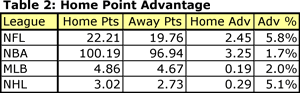
From a points per game perspective, NFL home teams have the biggest advantage. It works out to almost a 6% increase for the home team in terms of advantage in relation to total points per game. It’s unclear why this doesn’t translate to a bigger home win percentage, but the NFL is second in that category, so maybe it has more to do with the characteristics of the NBA than it does with the NFL.
Regarding the NBA’s last place finish in this category, it sort of goes with the league’s reputation. They say that you don’t have to watch the first three quarters of a NBA game, because it will probably be close at some point in the fourth quarter. Momentum swings wildly in basketball, more wildly than in any other sport, and if a team gets complacent, its opponent will probably go on a run. So while a 3.25-point advantage is significant, it doesn’t seem like a lot given the total number of points scored per game. But it is.
The more I dig into this, the more I want to see how home field/court/ice advantage translates to the playoffs. It seems like focus and travel issues would be eliminated, and we might get a clearer picture of which sport has the biggest home field advantage.
But that’s another column for another time.
Offseason Movement: The Suns signed Matt Barnes to a one-year contract. Barnes had a nice season for the Warriors two years ago (averaging 9.8 points and 4.6 rebounds), but fell out of favor in Golden State and saw his minutes cut. He’s a decent three-point shooter (37% in ’06-’07) and is otherwise an energy guy with a pretty good handle. The team drafted Robin Lopez, the more defensive-minded of the Lopez twins from Stanford. (You know, Sideshow Bob.) He may be the future at center once Shaq hangs ‘em up.
 Keep Your Eye On: Shaquille O’Neal
Shaq’s scoring numbers have been in a freefall since the ’04-’05 season. At that point in his career, he was averaging 22.9 points and 10.4 rebounds. In 28 games with the Suns, he averaged 12.9 points and 10.6 boards. Clearly, Shaq can still rebound when he wants to. He shot 61% from the field with the Suns, but his blocks have slipped from 2.3 four seasons ago to 1.2 last season. If he is committed mentally and physically, there’s no reason that he can’t play 60-70 games at a 15/10 clip. If the Suns can get to the playoffs with everyone healthy, they’ll be a factor. If Shaq is out of shape and the knees start to bother him, the Suns season is pretty much over.
The Big Question: Will trading away Marion ultimately pay off?
GM Steve Kerr took a big risk last season when he traded Shawn Marion to the Heat for Shaq. Two years ago, the Suns were a couple of bench-clearing infractions away from upending the eventual-champion Spurs. The franchise could have kept that group together, but Marion was an offseason headache and Kerr ultimately decided to take a couple of aspirin last year. We’ll never know what would have happened had he kept that group together, but it did seem like the window was closing as the Marion drama affected the team’s chemistry.
Outlook: Cautiously optimistic. If we’re talking about getting to the Finals, the Suns are one of those teams that needs everything to break the right way. The team should benefit from a half-season and a training camp with Shaq, and if he, Steve Nash and Amare Stoudemire can all stay relatively healthy, the team has the juice to go a long way in the West. But Nash is 34 and Shaq is 36, so chances are one will miss significant time, and that can’t overlap with the playoffs. The Suns have spent the last few years giving away most of their draft picks, so they are pretty much “all in” this season. If they don’t make a serious run, Kerr might decide to blow the team up and start over with Stoudemire as his centerpiece.
 Offseason Movement: The Sixers probably had the biggest “get” of the offseason when they signed Elton Brand to a long-term deal. So the same team that gave the Pistons a good run in the playoffs is now adding an All-Star caliber player who, along with Kevin Garnett and Chris Bosh, might be the best power forward in the East.
Keep Your Eye On: Thaddeus Young
At just 19 and largely ignored, Young had the highest PER of any rookie in the league who played at least 1,000 minutes. He only saw limited minutes in the first two months of the season, but by February, he was seeing 29 minutes a game and was posting an average of 11.2 points and 4.7 rebounds per game while shooting a stellar 56% from the field. He has an improving long-range jumper and, simply stated, Young has “future star” written all over him.
The Big Question: Can Brand (and Andre Iguodala) lead this team to the Finals?
The Brand signing was a coup for the Sixers, and now that they’ve locked up both Brand and AI2 to big, long-term contracts, one wonders if they hitched their wagon to the right pair of horses. Both guys are very good NBA players, but neither guy has proven that he can be “The Man” on a championship-caliber team. The next two or three seasons will be each player’s best chance to win a title, and it’s going to be interesting to see how this young team develops over this span.
Outlook: Upbeat. While the Brand acquisition looks great on paper, it’s tough to add such a big name and expect everything to go smoothly from the get-go. Brand is coming off a nasty Achilles injury, and while he played well in limited action last season, there’s no guarantee that he’s back to 100%. Still, if they are able to gel, they look like a legitimate contender in the East. They have a strong starting five (including Young, Andre Miller and Samuel Dalembert) and a good bench, and even without Brand, they proved they could compete with the Pistons in the playoffs. All signs point to a nice year.
 Offseason Movement: The Pistons’ biggest offseason signing was Kwame Brown. That’s right…Kwame Brown.
Keep Your Eye On: The Pistons’ age
Chauncey Billups (32), Rip Hamilton (30), Rasheed Wallace (34) and Antonio McDyess (34) are all at the end of or past their respective primes, so the Pistons are going to hit the wall, it’s just a matter of when. Will it be this season? The team does have some youth in Tayshaun Prince (28), Rodney Stuckey (22), Jason Maxiell (25) and Amir Johnson (21), but Prince is the only completely dependable player on that list. Stuckey has a chance to be a star, but he’s going to be playing behind Billups and Hamilton for the foreseeable future.
The Big Question: Does this group have another run in it?
After last season, it looked like the Pistons were going to make some big changes, but after a few rumored trades fell through, they’re left with pretty much the same roster as last season. So this leaves the Pistons in a tough spot. They’re good enough to (easily) make the playoffs, but are they good enough to make another Finals appearance?
Outlook: Fruitless. Unless everything breaks their way, it’s hard to see the Pistons making the Finals with this group. I like the roster, and when they’re firing on all cylinders, they’re very tough to beat. But they are at times complacent, and they’re just not good enough anymore to be giving games away in the playoffs. They almost lost to an upstart Philly team due to a lack of focus. Once again, they’ll make the playoffs and, once again, they’ll probably win their first round series, but barring a big leap by one of their young players, that’s probably as far as they’ll go.
FOLLOW US!

CATEGORIES
© 2026 The Scores Report – The National Sports Blog
Theme by Anders Noren — Up ↑