Category: NBA (Page 38 of 595)

David West to enter free agency — impact on Chris Paul?

New Orleans Hornets forward David West (30) celebrates as his team defeated the Toronto Raptors 85-81 during their NBA basketball in New Orleans, Louisiana January 17, 2011. REUTERS/Sean Gardner (UNITED STATES – Tags: SPORT BASKETBALL)

Once David West went down with a season-ending ACL tear, I thought he would surely play out the final year of his contract (for $7.5 million) to prove to everyone that he was healthy and cash in next summer. But the 30-year-old forward must feel good about his rehab, because he has decided to opt-out of his deal and enter free agency a year early.

West told the Times-Picayune that he has not ruled out staying with the Hornets, who might benefit from new rules in the next collective bargaining agreement that are expected to make it even more beneficial than it has been for free agents to stay with their current teams.

“Definitely not, definitely not,” West said. “When I signed the original (contract), my intention was always to opt out. With my knee, I had to examine things a little more closely. But after going through the rehab and feeling good about where my knee will be, we decided to stay on course with what I originally intended to do.

The Hornets were something of a surprise this season, taking the defending champion Lakers to six games in the first round of the Playoffs. That would have been encouraging had Kobe and Co. gone on to win another title, but with the way they were swept by the Mavs has to leave the Hornets wondering if they are on the right track.

As always, the key is Chris Paul. Can the Hornets convince him to stay? After some grumbling last summer, CP3 put his big boy pants on and brilliantly filled the role of franchise point guard. But now he’s just one year away from free agency and his sidekick could be playing elsewhere next season.

Unfortunately for the Hornets, West’s possible departure doesn’t leave the team with a whole lot of wiggle room to sign anyone else, so their best bet is to overpay West to stay. That puts the franchise in the same position they were in this season — good enough to make the Playoffs, but not good enough to do anything once they get there.

The writing is on the wall: Provided Paul stays healthy, the Hornets will win 40+ games again this season, but he’ll enter free agency next summer and be playing elsewhere in 2012.

NBA heading down same path as NFL

NBA Commissioner David Stern speaks at the state of the league press conference during the NBA All-Star game weekend in Los Angeles, February 19, 2011. REUTERS/Danny Moloshok (UNITED STATES – Tags: SPORT BASKETBALL HEADSHOT)

There’s a good chance that both the NFL and NBA will be under lockout once the NBA’s current CBA expires on June 30. There hasn’t been much progress made in the NBA labor negotiations.

At Tuesday’s meeting, the union proposed a five-year deal in which the players would receive $100 million less per season in salaries, and the owners countered with a proposed 10-year deal that would set a target of $2 billion in player salaries each season — a reduction from the $2.17 billion the players earned in the 2010-11 season.

The same story says that the two sides are “several billion dollars apart” but it appears that the players are offering a $100 million per season reduction (for five seasons), which was deemed “modest” by commissioner David Stern, while the owners want $170 million per season (for 10 seasons). That’s a total difference of $1.2 billion ($70 million * 5 years + $170 million * 5 years) if one assumes that the players aren’t willing to give back any salary for years 6-10.

The NBA as a whole would benefit if contracts were shorter (max of four years instead of six) and weren’t fully guaranteed. A team should be able to cut an underperforming player and save (say, 50%) on the remaining years of his contract. That way, the player still benefits from the deal, but his contract isn’t an albatross that keeps the team from contending.

I’d also like to see a hard cap in the NBA. The NFL has a hard cap and there isn’t a league with better parity. Small market teams like Cleveland, Sacramento and Milwaukee have a tough time competing in today’s environment unless they luck out and land a player like LeBron James in the lottery. San Antonio and Oklahoma City are examples of how small market teams can compete, but the Spurs were lucky to win the #1 overall pick to draft Tim Duncan while the Thunder were fortunate to have Kevin Durant fall into their laps at #2. Without those two picks those franchises wouldn’t be any better than the Bucks or Kings. (Give credit to the Spurs and Thunder for not screwing up those picks, but those were pretty much no-brainer picks at the time, unlike the Bucks’ selection of Andrew Bogut at #1.) The soft cap enables big spenders like Mark Cuban continue to add salary until he finds the right mix of talent to win a title.

Kyrie Irving, Derrick Williams…then what?

Kemba Walker of the University of Connecticut speaks to reporters at a media availability session ahead of the 2011 NBA Draft in New York, June 22, 2011. The 2011 NBA Draft will be held June 23 in Newark, New Jersey. REUTERS/Mike Segar (UNITED STATES – Tags: SPORT BASKETBALL)

As expected, Kyrie Irving went #1 overall to the Cavs, and Derrick Williams went #2 to Minnesota, a sign that the T-Wolves could not swing a satisfying trade for the Arizona forward. If he’s not moved in the next few days, he’ll be asked to play small forward alongside Kevin Love and Darko Milicic on the front line.

Conventional wisdom had Brandon Knight headed to Utah, but the Jazz went with Turkish big man Enes Kanter instead, which is odd considering the presence of Paul Millsap and Al Jefferson on the Utah front line. The Cavs went with Texas freshman Tristan Thompson at #4. Apparently, he played Williams to a standstill in a recent workout and that won over the Cleveland brass. He plays the same position as J.J. Hickson, so I’m not exactly sure how the two are going to develop together. (For what it’s worth, John Hollinger’s Draft Rater had Thompson ranked #3.)

The Raptors surprised no one at #5 by going international with Lithuanian big man Jonas Valanciunas, who has the potential to provide some rebounding alongside softy Andrea Bargnani. At #6, the Wizards went with Jan Vesely, a Czech swingman with a penchant for dunking…hard…on people.

At #7, the Kings took Bismack Biyombo (of Congo) but it appears that he’s part of a three-team trade with the Bobcats and the Bucks. Biyombo is probably headed to Charlotte, while the Bucks’ pick at #10, Jimmer Fredette, is headed to Sacramento. For their part, the Bucks acquired Stephen Jackson to replace John Salmons (on his way to Sacramento) and Corey Maggette (on his way to Charlotte). Milwaukee needs scoring and Jackson brings that while also playing good defense on the other end of the floor. The Bucks are also expected to acquire #19 pick Tobias Harris (of Tennessee) in the deal.

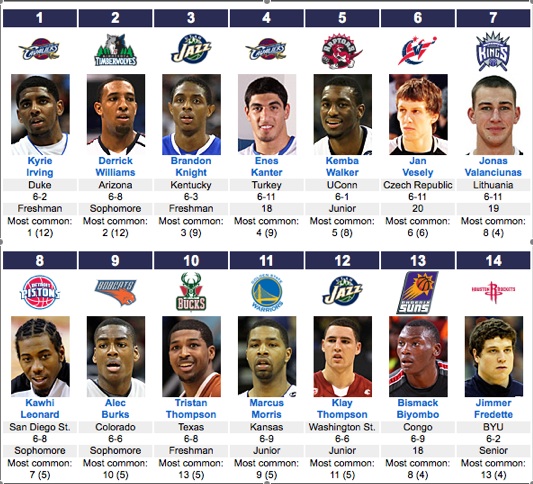
Consensus Mock Draft (Updated 6/22)

Here is the latest consensus mock draft from NBA.com.

In their draft preview, the folks over at Grantland described the draft this way…

There is no way to discuss this particular draft without stating the obvious — it is bombed out and depleted. Outside of Kyrie Irving and Derrick Williams, the two players vying for the honor of joining the Dan Gilbert hate-train, this year’s class is a collection of low-ceiling college guys and complete unknowns. What’s worse, the teams in this year’s lottery are all at least two, and sometimes as many as five, quality guys away from winning a playoff series.

John Hollinger’s Draft Rater agrees that Irving and Williams are clearly the top two players in the draft (at this point), but believes there’s value to be had in Tristan Thompson (whom Hollinger ranks #3) and Jonas Valanciunas (#4). He also believes that Kawhi Leonard and Kemba Walker have a great chance to turn into at least solid rotation players because the Draft Rater does such a good job predicting the upside of wings (as opposed to big men, who are tougher to gauge).

Unless there is a trade, it appears that Irving will go #1 to the Cavs while Williams will go #2 to the Timberwolves. It’s not a perfect fit for Minny, but they’d be dumb to pass on Williams if they can’t trade down. If nothing else, it would give them a good trade chip down the road.

The Jazz are looking for a point guard, and apparently aren’t sold on Devin Harris. Brandon Knight could be the pick there — he is a high character guy who had a 4.3 weighted GPA in high school.

If the Cavs take Irving #1 (which they should), it makes sense to go big at #4. J.J. Hickson is a solid prospect at power forward, so if Cleveland can land their center of the future at #4 (perhaps Kanter or Valanciunas), they’d be in reasonably good shape with a core of Irving, Hickson and Kanter/Valanciunas. Then again, they do have Anderson Varejao, but he is very limited offensively. Kanter is the polar opposite. He can score, but hasn’t shown much of a commitment to defense.

Walker to the Raptors makes a lot of sense. Unless they are planning to build around Jerryd Bayless or Jose Calderon, they need a point guard and Walker would be the best one available at #5. The Wizards could go any number of directions as they need help everywhere outside of point guard, where John Wall is the future. The draft is very fluid from #4 on and even the Jazz could surprise at #3 and take someone like Jan Vesely to play small forward.

Scouting Report: Kyrie Irving

First, watch these highlights of Irving’s stint at Duke…

Irving reminds me a little of Chris Paul. He has that same speed and ball control, and while his vision may not be on par with Paul’s, it’s pretty close. He’s great on the break and does a nice job of making the right decision in transition or when he dribbles into the lane. He made 18-of-39 three-pointers (46%) while at Duke, which isn’t a huge sample size, but it appears that he has an NBA-ready jumper. He also nailed 90% of his free throws and shot a terrific 53% from the field.

NBADraft.net says Irving is “a facilitator who shows the ability to make those around him better … Great vision and passing skills … Great burst. Has the blow by speed to get past defenders off the dribble … Good decision maker. Looks to make the right play instead of always trying to dazzle.” Conversely, the site says that Irving’s durability is a concern and that he “could struggle with the transition to the NBA game with just 8 games of NCAA experience under his belt.”

Meanwhile, DraftExpress says that Irving is “not as blazingly fast with his first step as Derrick Rose, John Wall, or even Kemba Walker, Irving plays at a very unique pace that keeps defenses consistently off-balance and allows him to get to the basket seemingly whenever he needs to. Able to drive left or right almost equally well, he has excellent timing on his drives, very good body control, and the ability to operate at different speeds.”

It may take a while for Irving to mature into a franchise point guard, but he has all the tools to get there. The Cavs need a player to build around and Irving is that guy.

« Older posts Newer posts »