Category: MLB (Page 10 of 448)

Dr. CliffLee or: How we Learned to Stop Worrying and Hate the Win

It’s 2012, in case you hadn’t heard, and by now I’d think most baseball fans are well aware that a pitcher’s win-loss record is worthless. It’s simply not a reliable way of charting performance. Wins, like RBI, are a function of opportunity, not ability. We know that, on the forefront of our consciousness. But then why does R.A. Dickey’s record of 11-1 give me such a sense of smug satisfaction? And why is Cliff Lee’s 0-4 line troubling Phillies’ fans, and more importantly, the pitcher himself?

Well, because behind the facade, our perception of baseball, like so many things, is rarely guided by the parts that help make us calm, rational, or logical. That much was made perfectly clear over the weekend when Bill Baer, who writes for ESPN and runs the Phillies blog Crashburn Alley, began re-tweeting some “phan” responses to Lee’s most recent performance. You don’t need to scroll through to figure out the message, most involved the pitcher’s name and a certain four-letter word, so I’ll give you one swear-free highlight: @GutterTheGreat said, “I think the man love for Cliff Lee needs to end – don’t give me this run support shit or about the poor fielding.”

Baer, being of sound mind, gave him something a little more in-depth. On Monday, he published an analysis of Lee’s performance, arguing that the pitcher’s woes have not all been of his own design. Baer gets plenty specific and sabermetric, but it’s simple enough to know that when a pitcher goes 10 innings without giving up a run, as Lee did on April 18, he should have at least one win. The article led to a retort from ESPN’s David Schoenfield entitled “Maybe Cliff Lee hasn’t been all that good,” I’ll wager you can figure out what that one was about on your own.

Baer’s piece began with a response to another, more collected tweet. User @alexrolfe said, “what’s weird to me is that the no wins makes people reevaluate lee instead of reevaluating wins. why is that?” You’ll get all the coverage you need on Lee specifically from Baer and Schoenfield, so here’s where I’m going with all this: Indeed, random internet person, why is that?

Let’s start by considering what a win is. MLB official rule 10.17 defines the winning pitcher as one “whose team assumes a lead while such pitcher is in the game, or during the inning on offense in which such pitcher is removed from the game, and does not relinquish such lead.” Of course, the rule is different for starters. In a game that goes the full nine innings, a starter has to pitch at least five to get a win.

You know you’ve got a silly statistic when it’s perfectly reasonable (number-wise) that Jon Rauch can have three wins and Lee none. Yet fans, players, and front offices still give the win-loss record a tremendous amount of undeserved influence. Even if every fan thought the way Bill Baer does, you better believe Cliff Lee would still be pissed off about his lack of a win. If concentrating on getting one is a good way for Cliff to self-motivate, so be it. But it shouldn’t go any farther than that.

There a million different stats and sabermetrics out there, but the Cy Young Award is given to the “best pitcher” in each league. It’s one of the game’s few simplicities. Want the Cy Young? Be the best. That’s it.

In 2004, Roger Clemens won the NL Cy Young because of his 2.98 ERA, 1.16 WHIP, and 218 strikeouts in 214.1 innings pitched. He was the best. Supposedly. We’re sane, we know that wins are entirely out of a pitcher’s control. Clemens was the best so he won the honor, right? In any other year perhaps, but not 2004. That was the year, Ben Sheets‘ line looked like this: 2.70 ERA, 0.98 WHIP, 264 strikeouts and just 32 walks in 237 innings pitched. Along with his 8:1 strikeout to walk ratio, the league’s best by a mile, Sheets outpitched Clemens based on every major pitching stat. He was in fact, though not in name, the best. So what gives?

Well, he outpitched Clemens in every major pitching stat but one, and I think you know which. Sheets had a record of 12-14, while Clemens was 18-4. Yet Sheets’ Brewers went 67-94 that year, while Clemens and the Astros brought home a record of 92-70. Given that, any sane person might consider Sheets’ 12 wins on that miserable squad to be the more impressive count. But the trophy sits on Clemens’ shelf, along with his other six Cy Youngs, and, I imagine, the cream and the clear. Try and tell me wins didn’t influence the voting, or that the best pitcher won.

We like to think we’re living in a more civilized time. Everyone loves to point out that Felix Hernandez brought home the AL Cy Young in 2010 despite a 13-12 record. But 2004 wasn’t all that long ago, and the rabbit hole goes far deeper than awards.

You all know how I feel about closers, and “saves.” Well, I was wrong when I wrote that piece. Don’t worry, the notion of a closer is still ridiculous, but I shouldn’t have said “a save situation is the only time a manager makes a decision based on arbitrary numerals rather than what’s going to help his team win.” Wins will do that too. Imagine this scenario: your team’s up 8-2, the starter’s on the mound with two outs in the fifth when he suddenly gives up four runs that were inarguably his fault, and there are still a couple men on base. Any other pitcher gives up four runs in an inning and he’s getting the hook. But nine times out of ten your manager will leave him in there for a while longer, hoping he can get that third out and be in line for a win. Suddenly, the pitcher getting a win is more important than the team getting one.

Better offense, pitch counts, specialized relievers, and a thousand other changes have all contributed to the ever increasing worthlessness of the win-loss record. But the stat still affects contracts, awards, All-Star selections, fan opinion, and sometimes even a pitcher’s self-worth. It’s 2012, yet there are still those among us who give wins the respect they were due in 1912. To those people, listen closely: wins are a relic of a different era, whether or not it was a better era is entirely subjective, but the present can only be right now. And right now, wins and losses should not be anywhere but the periphery of statistical analysis.
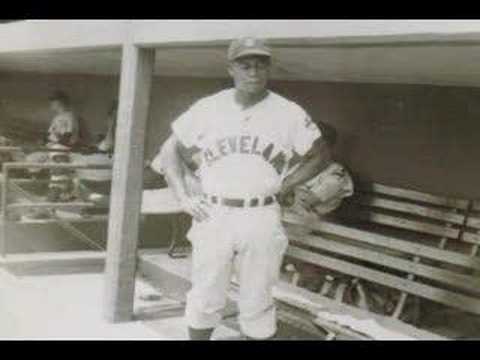
Larry Doby was another pioneer

Jackie Robinson rightfully has his place as one of the icons of our national pastime, but Larry Doby is also an important pioneer who deserves significant recognition as well. Doby was the first African American ballplayer in the American League and the second after Jackie Robinson in Major League Baseball. And like Robinson, Doby proved to be an incredible ballplayer along with being a great person. His accomplishments were recognized in 1998 when he was selected to the Baseball Hall of Fame by the Veterans Committee.

Cleveland Indians by their owner Bill Veeck signed Doby in 1947, eleven weeks after Jackie Robinson broke the color barrier. Doby was a part of two incredible Indians teams. The Indians won the World Series in 1948 against the the Boston Braves. Then the Indians won a staggering 111 games and the American League pennant in 1954. Unfortunately they were swept by Willie Mays and the New York Giants after Willie’s iconic over-the-shoulder catch in Game One of that series. For obvious reasons, Doby remains a revered figure in Cleveland. Bill Veeck also deserves credit for his bold move. The video above offers a nice retrospective even if the narrator totally mangles the pronunciation of Veeck’s name.

Doby endured many of the same hardship endured by Robinson when he entered the league. But he also had the character to handle all of the adversity. In the end, his play on the field became the focus of his career. Doby hit .283 for his career and he slugged 253 home runs and drove on 970 runs in a career that spanned 1,533 games. He led the American League in dingers twice with 32 in 1952 and 1954m and he had a streak of at least 20 homers in each season from 1949–56.

Doby had some other interesting milestones as well. He was the third American to play professional baseball in Japan’s Nippon Professional Baseball league. And, in another interesting twist, he was also the second black manager in the major leagues after Frank Robinson got the Cleveland job. It was the legendary Bill Veeck who also made this move, hiring Doby to manage the Chicago White Sox.

It’s a shame that sometimes Doby’s accomplishments are overshadowed by Jackie Robinson, but true baseball fans are very aware of what this man did for the game.

Can We Talk About R.A. Dickey?

The Texas Rangers drafted R.A. Dickey with the 18th overall pick in the 1996 Major League Baseball Draft. Back then, his stuff was dime-a-dozen. His fastball could hit the high-80’s, he had a breaking ball when he needed it, and a forkball he called “The Thing.” Dickey first broke into the bigs in 2001. Between then and 2006 he posted a 5.72 ERA in 266 innings.

A lot of people thought 2004 was going to be the turning point in Dickey’s career. He started that season 4-1, but when things were all said and done he’d gone 6-7 with an ERA of 5.61. Dickey first began experimenting with the knuckleball in 2005, and Texas gave him a chance to use it as a starter in 2006. In his first time on the mound that year, Dickey gave up six home runs. Six. Matching the record of another knuckleballer, Tim Wakefield. He never pitched for the Rangers again.

Fast forward to 2010. The New York Mets are making their first spring cuts, and the 35-year-old Dickey, who’d been trying to latch on as the team’s last guy out of the bullpen, is sent to minor league camp.

Alright, let’s fast forward again, to last night, when the very same Dickey (well, he’s 37 now) threw his second one-hitter… in a row. To top it off, he did it against Buck Showalter’s Baltimore Orioles. Guess who was managing the Rangers when Dickey gave up those six home runs. Guess whose idea it was for Dickey to start throwing the knuckler.

“I would be remiss if I didn’t say thank you to [Showalter]. He’s the one that gave me the opportunity to cultivate that pitch at the foundational levels down in the minor leagues with the Texas Rangers. He believed I could do it. Now, it took a while for me to get it. He gave me the… I’m trying to think of the right word. He gave me the canvas to be able to operate on. He was the guy; he and Orel [Hershisher] kind of pushed me in that direction. I’m thankful they did,” Dickey told ESPN.

Now get this: it’s the first time since 1988, when Dave Stieb of the Toronto Blue Jays did it, that any Major Leaguer has thrown two consecutive one-hitters. The last time a National Leaguer did it was in 1944, 65 years ago, when Jim Tobin of the Boston Braves accomplished the feat. Only 10 pitchers have allowed one hit or fewer in consecutive games since 1900. And R.A. Dickey? R.A. Dickey is the only man in the history of modern baseball to throw back-to-back one-hitters with at least 10 strikeouts in each. Last night, Dickey fanned 13 Orioles, and on June 13 in Tampa Bay, the man struck out 12.

R.A. Dickey was a “bust” of a first-round pick who had an RADickeylous (sorry) name for his forkball. Was. Now, with 68 games (or 42 percent) of the season in the books, R.A. Dickey is the leading candidate for the NL Cy Young. He’s also the Mets’ ace, which might not mean much if their roster didn’t contain the two-time Cy Young winning, no-hitter throwing, Johan Santana. But it does.

Dickey is now 11-1, no other Mets pitcher has ever reached 10 games over .500 so quickly. While Dickey did it in 68 games, the previous Met record belong to Tom Seaver, who reached 13-3 in the 77th game of the Mets’ 1969 season. Dickey already owns the Mets record for most consecutive scoreless innings with 32 2/3, but he’s also gone 42 2/3 innings without giving up an earned run, the second best streak in franchise history. The team record is Doc Gooden’s, who went 49 innings in 1985.

But enough about the Mets. Dickey’s 11 wins lead the majors, and he’s tied for the league lead in ERA (2.00), strikeouts (103), and complete games (three). And for those who complain about baseball being a “slow” game, last night’s contest took all of 127 minutes.

Anything could happen from now until October, but R.A. Dickey is the best pitcher in the majors this season, and 42 percent is by no means insignificant.


Roger Clemens not guilty

You have to wonder about the government’s competence in these cases they’re bringing against athletes. A jury acquitted Roger Clemens today, leaving another black eye for prosecutors after the Barry Bonds fiasco.

The “beyond a reasonable doubt” standard in court was obviously to high. That said, the Rocket’s reputation is in tatters following his appearance before Congress in 2008.

Fortunately, the steroids era seems to be behind us.

The Washington Nationals are Doing it Right

In case you haven’t heard, the Washington Nationals are a thing now. No, really. At 36-23, they’ve got the second best record in baseball, the best team ERA, and as much as it pains me to say it, this little thing called Bryce Harper, luckily sans “skullet,” which makes it hurt a little less.

Here’s the thing about the Nats though, after Harper they don’t hit very well, or at all really. They’re at the back end of the majors with 230 runs (25th), a .243 batting average (24th), and a paltry .311 on base percentage (24th). How then are they at the top of the NL East, one of the league’s most contentious divisions, by a comfortable three games over the Braves and five over the Mets and Marlins? Well if it’s not the hitting…

Let’s talk about this Nats pitching staff. As mentioned, their 2.98 ERA is the best in the majors, they’ve also got a league best 1.14WHIP  and .220 batting average against. Here’s the thing about their rotation, Edwin Jackson (he of the 3.02 ERA) is their number four starter. Four. Ahead of him they’ve got Jordan Zimmermann (2.91), Gio Gonzalez (2.35), and phenom Stephen Strasburg (2.41). So if your team’s playing the Nationals on any given night, there’s an 80 percent chance they’ll be trying to hit a guy with an ERA of 3.02 or less. Think about that for a second. And as much as I love Johan Santana and R.A. Dickey, no team in the league has a 1-2 punch better than Strasburg and Gonzalez, who Grantland’s Shane Ryan called “the most dynamic Washington duo since Mondale-Ferraro fever swept the District in ’84.”

With a rotation like that, they’ve probably got an awful bullpen, right? I mean everyone’s got an awful bullpen. Nope. National relievers have the NL’s fourth best combined ERA, 3.12. But that’s OK, their closer’s injured and having a good closer means everything, right? Wrong. Even if closer was a worthwhile baseball position and not just a money-making tool, the absence of Drew Storen (the team’s first-round pick in 2009), who had 43 saves and a 2.75 ERA last year, hasn’t hurt the Nationals any. Since stepping into the role Tyler Clippard is eight for eight in save opportunities. As if that wasn’t enough, he’s got guys like Sean Burnett (1.35 ERA, 23 K’s in 20 innings pitched) and Craig Stammen (1.80 ERA, 32 K’s in 30 innings pitched) behind him.

But up there, when I said “the Washing Nationals are doing it right,” I wasn’t really talking about any of this stuff. Well, except the wins. What I really meant was the way the Nats are handling things behind the scenes. There’s only one way for a team that won 69 games in 2010 and 59 in 2009 and 2008 to be this good this year: making the right draft choices, spending money on free agents when it’s called for (without wasting it when it isn’t, well besides Jayson Werth), and pulling the trigger, without spending too much, on high-risk high-reward pick ups. Edwin Jackson is a perfect example of the final strategy, the journeyman has bounced around the league and had a few successful seasons here and there, but he’s never been able to really pull it together. But Jackson is only 28, and now he’s having his best year ever, so an appropriate suffix for the previous sentence just might be “until now.”

Despite the record and accolades, the Nationals are in the bottom third of MLB payrolls (20th, $81,336,143). Furthermore, three of the team’s four best hitters: Harper, Ryan Zimmerman, and Ian Desmond, as well as Strasburg and Zimmermann (note the second “n”) are homegrown. It took a while for the Nats to get their shit together following the move from Montreal, but it’s happened, and now the team is here to stay. Don’t be surprised if you see them in the playoffs (or at least the NL East hunt) for the next few years.

« Older posts Newer posts »