
I thought the other one was getting pretty dated, so I like the new design. What do you think?

Category: Fantasy Basketball (Page 22 of 274)
The Phoenix Suns have stuck to their no-trade stance with regard to Steve Nash, Marc Stein reports.
Here’s Alvin Gentry’s take:
“The only reason you would ever even remotely consider trading Steve is if he came to you and said, ‘I think I need to move on somewhere,’ ” Gentry says. “That would be the only reason. But to us, making that decision to trade him, I don’t see why we would even think about it. You guys can keep talking about it, but we’re not going to trade him. He’s playing at such a high level. Why would we?
“How you gonna get value for him? Unless you’re gonna go get Deron Williams or Chris Paul or somebody like that, tell me how. Why do we have to bottom out to rebuild our team? I don’t see why you would want to bottom out and spend the next five years trying to get good again.”
So Gentry’s position is that you don’t trade Nash unless he gets to the point where he comes to the team and says that he wants to move on. But Nash is a throwback NBA star…
“Maybe I’m old school,” Nash said, “but I signed a contract to play here and I want to honor it. I feel like I owe it to my teammates and the city and everybody to keep battling until they tell me it’s time to go.”
…so he’s not going to ask for a trade even if deep down he’d rather play for a contender.
Gentry asks how the Suns would get value for him. A few days ago, I outlined three different trade scenarios that would help the Suns rebuild. Gentry wonders why a team has to bottom out, but what’s going to happen when Nash eventually retires? Of course you aren’t going to get a player of Nash’s caliber in return, but the point is to get a younger asset or two (and/or draft picks) that will help the team in five years, when Nash is retired.
Team president Lon Babby is of the same mind:
“I don’t see how it makes any sense for us to move him,” Babby said. “I know that people think we ought to look to the future. And we’re doing that. But if you look at the history of the teams that have sort of blown it up, as the expression goes, how successful have they been in recapturing [elite status] and how long does it take?
“I’m willing to put more faith in Grant Hill, Steve Nash and the players that we have than I am in a lottery ball,” Babby continued. “It’s easy to say blow it up, but show me the teams that have successfully done it and how long it took and how much luck was involved, because luck’s involved in everything. I don’t want to depend on fortuity. I’d rather depend on a two-time MVP.”
So because there’s luck involved in rebuilding a team shouldn’t do it? At some point, the Suns aren’t going to have any choice — Nash will retire and they’ll have to try to get good again. Isn’t that easier when you have a couple of extra good young players to build around?
To answer Babby’s question, the Magic were 21-61 when the won the lottery and drafted Dwight Howard. They were a 50-win team four seasons later. The Seattle Supersonics were 31-51 the year before they drafted Kevin Durant, and they were a 50-win team three years later. The Cavs were 17-65 the season before they landed LeBron James and they were a 50-win team three seasons later. Sure, those teams were fortunate to get those players in the draft, but it’s a lot easier to find a superstar at the top of the draft than it is at the bottom of the lottery.
The bottom line is that the Suns are going to be mediocre as long as Nash is playing, because he’s that good. But by taking this “no-trade” stance, they’re only delaying the inevitable. They’re going to bottom out eventually, and by holding onto Nash they won’t have the young assets to rebuild quickly and efficiently. By trading him now they’d give him an opportunity to play for a contender and by getting a few good young pieces they would increase the chances that the rebuilding process won’t be a long and painful one.
Trading away the face of the franchise is a tough thing to do, but Nash deserves to play for a contender, and the Suns lost that status when Amare Stoudemire signed with the Knicks last summer.
The Carmelo Anthony trade saga took another turn recently as Yahoo! Sports is reporting that he’ll only sign an extension with the Knicks.
Several sources told Yahoo! Sports that Carmelo Anthony’s agent, Leon Rose, has recently begun informing teams that the All-Star forward is interested in signing a contract extension with only the New York Knicks. The stance has weakened the Denver Nuggets’ leverage in trying to deal Anthony, not only to other teams, but also the Knicks.
The sources said the Knicks don’t feel pressed to present a substantial trade offer to the Nuggets because they think they can also sign Anthony after the season if he opts out of his contract, as expected.
“If you’re New York, you just sit and wait until the offseason,” one general manager said. “That’s where it’s likely to go. Why give up assets to get him now when you can wait and get him next season?”
The unnamed GM asks an interesting question, but a lot can happen in a few months. If the Knicks elect to wait until the summer they run the risk of Carmelo changing his mind about where he’ll re-sign. Maybe he gets irked about the fact that the Knicks wouldn’t trade for him, forcing him to sign a deal for less money. Maybe he gets traded to the Mavericks as a rental and the team gels and makes a run to the Finals, forcing him to rethink his priorities. Who knows.
If the Knicks wait, they’ll also pass on having Carmelo for a possible playoff run this season, and they’ll be pushing off the inevitable chemistry development into next season.
Ideally, the Knicks would acquire Carmelo by the trade deadline for next to nothing, but signing him outright this summer would save the Knicks assets and money, since an extension would cost more than a new free agent contract. It’s just a risky proposition to wait, because the summer is a long way away.

Check out Antonio McDyess’s tip-in at the buzzer to beat the Lakers last night at Staples Center.
Was it goaltending? Lakers fans think so, but a quick read of the NBA’s goaltending rules leads me to believe that it wasn’t:
Section I-A Player Shall Not:
a. Touch the ball or the basket ring when the ball is using the basket ring as its lower base.
EXCEPTION: If a player near his own basket has his hand legally in contact with the ball, it is not a violation if his contact with the ball continues after the ball enters the cylinder, or if, in such action, he touches the basket.
b. Touch the ball when it is above the basket ring and within the imaginary cylinder.
c. For goaltending to occur, the ball, in the judgment of the official, must have a chance to score.
The view from the side shows that the ball was coming off, but I think it was still in the imaginary cylinder when McDyess’s hand touched it. However, as part “c.” states, if the official did not think it had a chance to score (which it didn’t), then it cannot be goaltending. This appears to supersede the fact that the ball may have been in the cylinder.
Spurs win.
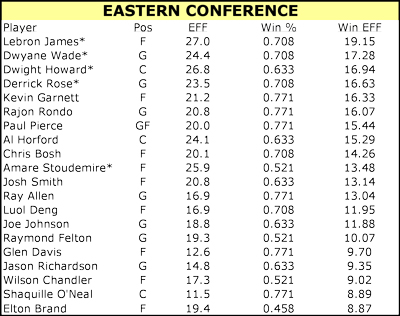
Since the All-Star reserves will be announced tonight on TNT, I thought I’d try to come up with some sort of formula to calculate who should make the All-Star Game.
What’s important in an All-Star? Well, to me, it comes down to two things: stats and wins. So I took my favorite (and flawed) all-encompassing stat, efficiency, and calculated it on a per-game basis for each player. Then, I multiplied each player’s efficiency with his teams win percentage to come up with a new stat: Win Efficiency. (Please note that rebounds are easier to come by than assists, so big men tend to do better in overall efficiency than guards do.)
From there, picking the All-Stars would be simple. Take out the five starters for each conference, and fill out the roster with three guards, three forwards and a center. Surprisingly, the results came out pretty well. (By the way, I put an arbitrary minimum of 35 games played.)
Here’s a look at the top 20 players from the Eastern Conference:
FOLLOW US!

CATEGORIES
© 2026 The Scores Report – The National Sports Blog
Theme by Anders Noren — Up ↑