Category: Fantasy Basketball (Page 108 of 274)

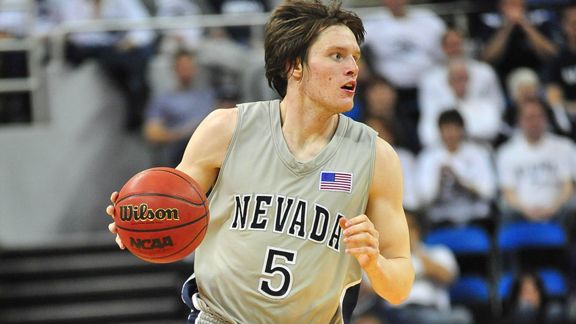
Luke Babbitt on the rise

Chad Ford writes that this year’s Tyler Hansbrough is Nevada forward Luke Babbitt.

Babbitt measured around 6-9 in shoes with an 8-9 standing reach. That doesn’t blow you away. However, he had an impressive 6-11 wingspan and essentially measures up with Griffin (6-10 in shoes, an 8-9 standing reach and a 6-11 wingspan).

But Griffin is way more athletic, you say? Not according to the combine numbers.

Babbitt had a 37.5-inch max vertical, a 3.2-second sprint and an impressive 10.98 lane agility score. Griffin’s numbers were 35.5, 3.28 and 10.95, respectively.

Griffin clearly had the strength advantage, benching a 185-pound bar 22 times to Babbitt’s 15. But 15 reps is still an impressive number.

What about production on the court? Griffin clearly had Babbitt bested here. Griffin averaged 22.2 ppg and 14.1 rpg in 32 mpg his sophomore year. Babbitt averaged 21.9 ppg and 9 rpg in 37 mpg his sophomore year. However, Babbitt does bring two things to the table that Griffin doesn’t — 3-point shooting and ball-handling ability. Babbitt shot a blazing 43 percent from beyond the arc this past season and showed excellent ball-handling skills for a big man in the combine.

Of course, Babbitt isn’t as good of a prospect as Griffin was. That’s why we’ve had Babbitt No. 12 on our mock draft for two straight weeks. However, we might have him too low. Based on what I’m hearing, Babbitt could be in play as high as No. 9 to the Jazz.

There’s a difference between averaging 22-14 in 32 mpg against Big 12 competition and averaging 22-9 in 37 minutes in the WAC. Ford’s point is that athletically, Babbitt is right there with Griffin.

Here is what DraftExpress had to say about Babbitt back in February:

On the offensive end, Babbitt possesses an extremely high skill level to go along with an outstanding feel for the game, assets which allow him to score easily and efficiently from all over the floor. The smooth left-handed shooter is hitting with deadeye accuracy from the free-throw (89%) and three-point lines (41%), while also showing strong ability off the dribble, namely with his mid-range jumper.

Using a combination of ball fakes and jab steps along with rangy strides with the ball and excellent footwork, Babbitt does a very good job getting separation for his jumper in spite of his limited athletic ability. Getting open inside the arc, he shows very good ability to hit jumpers on the move, going left and right, with a hand in his face, and fading away from the basket.

Babbitt’s shot has consistent mechanics and a high release point, while he also has NBA three-point range. His ability to hit shots in a variety of situations if very impressive for a player his age, though there are concerns about how his off-the-dribble shots will translate to the next level against longer, more athletic defenders.

I put those two phrases in bold because it seems Babbitt’s athleticism has always been something of a concern. I wonder — is it because he’s white? Maybe scouts see a white player and automatically start to question his athleticism until proven otherwise.

But Babbitt showed at the combine that he’s every bit the athlete Blake Griffin is, at least according to the numbers. Given his ability to score and basketball IQ, this will make him an interesting name to watch in the first round.
D-Wade’s “free agent summit” good for the Knicks?

Marc Berman of the New York Post thinks Dwyane Wade’s upcoming meeting with LeBron James, Chris Bosh and Joe Johnson is a good thing for the Knicks.

The Knicks’ only shot at James is if he can convince Bosh — or Wade or Johnson — to come along for the ride. The Knicks are the only club that has cap room to sign two maximum contracts — with $34M in space.

Even if James stays in Cleveland or heads to Chicago, the Knicks would take any pair — Wade and Bosh, Johnson and Bosh, even Johnson and Wade.

I tend to agree. The only way the Knicks land two big-name free agents is if there is communication amongst the group and two players commit at the same time. The more communication, the better the chances of this happening.

That said, the Knicks are not the only team in position to sign two big-name free agents. If they can dump Michael Beasley’s salary, the Heat will have room to sign two big names and re-sign Dwyane Wade. It wouldn’t be as easy, but if the Bulls can use Luol Deng or Kirk Hinrich in a sign-and-trade for a max free agent, they could add two big names as well.

In other words, if a treaty agreement is reached at the summit, and two or more players agree to go to a certain team, then they can probably make it happen. For example, the Bulls could sign LeBron outright and work out a sign-and-trade with Toronto for Bosh. Why would the Raptors agree to this? Well, if Bosh decides that’s who he wants to sign with, then the Raptors are in a tough spot — either work out a trade with the Bulls and get something in return, or Bosh walks (to another team) via free agency.

How a simple box out can win a game

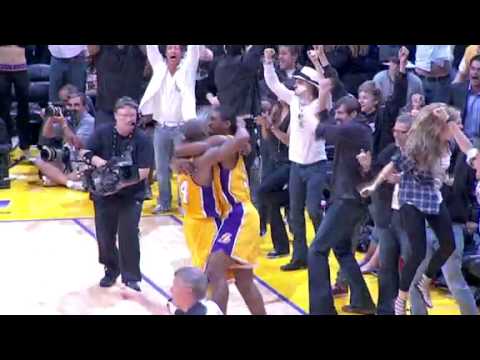
By now, you’ve probably heard about Ron Artest’s game-winner last night in pivotal Game 5 against the Suns, but what you might not know is exactly how it happened.

In the video below, you’ll see Kobe catch the ball on the sideline and chuck up a horrible shot. But what you need to pay attention to is Ron Artest and Jason Richardson on the other side of the court. Watch as Richardson turns, stands and watches Kobe’s shot. He’s supposed to be boxing out Artest, but instead, he’s about as useless as you or I am sitting at home.

Did this play look familiar? Watch Pau Gasol’s easy route to the bucket to score his game-winner against the Thunder in the first round.

This happens time and time again. It even happened to Hakeem Olajuwon in the 1983 NCAA title game when Lorenzo Charles snuck in behind “The Dream” and dunked home the game-winner…

Once a last-second shot goes up, the tendency is for players to stop and watch, especially when they think the game is over. But with 3.5 seconds to play, there is plenty of time for a shot to go up and for a tip in on the miss. That’s what Jason Richardson, Jeff Green and Hakeem Olajuwon failed to realize in these clips.

It does no good to stop and watch. After Kobe’s desperation shot attempt, the only way the game doesn’t go to overtime is if Richardson or one of his teammates fails to box out his man. In that situation, he should be seeing both Artest and Kobe (in his peripheral vision), and when the shot goes up, he needs to make contact with Artest and do whatever it takes to keep him away from the rim. If he had even slowed Artest by a half second, the game would have gone into overtime.

And that’s how a simple box out can win a game.

WCF Game 5: Ron Artest goes from goat to hero

After Ron Artest almost blew the game with an ill-advised shot, he ended up winning it for the Lakers. With 1:01 remaining and the Lakers up three, Ron Artest bricked a 20-foot jumper. Pau Gasol cleared the offensive rebound and passed it out to Artest, who (ponderously) took a three with 0:56 remaining. Phil Jackson gave him an earful during the timeout, and after Jason Richardson banked home the game-tying three with 0:03 to play, it looked like the game was heading to overtime, barring a Kobe Bryant miracle shot, of course.

Bryant got his shot, but it was a terrible look, and there was enough time left on the clock for Artest to collect the rebound and put it back in. It sure seems like there is so much attention paid to Kobe that everyone’s watching him shoot instead of getting into position for the defensive rebound. It was Richardson who failed to box out Artest.

Has Artest finally validated the Lakers’ decision to sign him instead of re-signing Trevor Ariza?


Photo from fOTOGLIF

Were the Celtics’ technicals justified?

There has been much discussion about the three technicals called on Kendrick Perkins (2) and Rajon Rondo (1) in Game 5 of the Magic/Celtics series. Here are my thoughts on each one:

1. Perkins elbows Gortat.
It looked to me like Gortat was checking on Pierce who took a hard fall and Perkins felt the need to throw a little elbow into Gortat’s chest. Gortat also deserved a technical for knocking the ball out of Perkins’ hand after the elbow. There’s no need for any after-the-whistle shenanigans, and Perkins lost some credibility with the officials when he said that he “didn’t do anything.” Yeah, right. Verdict: Justified

2. Perkins upset after a foul call. (1:10 mark)
I thought the foul call was iffy, and Eddie Rush compounded the problem by overreacting to Perkins’ overreaction. I think officials should give a little more leeway to a player after a close call like the one in question. That said, Perkins wouldn’t have been called for a “T” had he handled the call better. Verdict: Unjustified

3. Rondo called for a technical. (3:00 mark)
First of all, Rondo was dead wrong on the call. Jameer Nelson’s feet were outside of the restricted area, though the video doesn’t show it. He continued to complain through the timeout and tried to get the attention of the official who made the call. An always emotional Joey Crawford stepped in and told Rondo to go to his bench and gave him a warning. Rondo said something — we don’t know what — and that’s what led to the technical. Since we don’t know what he said, we don’t know for sure if the technical was justified, but Rondo needs to understand his audience. Joey Crawford once tossed Tim Duncan out for laughing on the sidelines, so everyone knows he has a short fuse. Don’t mess with him by continuing to talk to him after he’s already given you a warning to go to your bench. If Rondo hadn’t said anything over his shoulder, he wouldn’t have gotten the technical. Verdict: Justified

Note: I don’t really care who wins this series, so I consider myself an objective observer. I do feel that there is too much complaining to officials during NBA games and it needs to be curtailed. As for Crawford and Rush “having it in” for the Celtics, I don’t buy it. Two technicals were called on Orlando as well (Gortat, Matt Barnes).

« Older posts Newer posts »