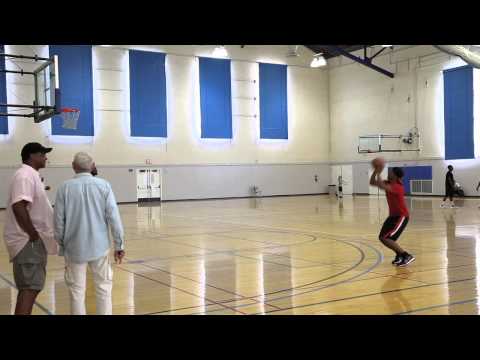
Keep an eye out for Ron Artest bringing the ball up the court. Pretty funny…
Category: External Sports (Page 74 of 821)
Eagles (1-0) @ Falcons (0-1), 8:20PM ET
Outside of Chargers-Patriots or maybe Bears-Saints, there isn’t a juicer matchup on the schedule this week. The Falcons should be embarrassed by the way they performed last week in Chicago but they have zero time to wallow in self pity because Michael Vick and the Eagles come storming into the Georgia Dome this weekend. Andy Reid has had major ownage on the Falcons over the years, as Philly is 9-2-1 against the spread in its last 12 games against Atlanta, which includes a 4-1-1 ATS mark on the road. With defensive tackle Jonathan Babineaux set to miss over a month with a knee injury, the Falcons’ defense is in major trouble. An 0-2 start for the defending NFC South champions is a big-time reality.
THE ODDS: EAGLES –1.5
Chargers (1-0) @ Patriots (1-0), 4:15PM ET
Two teams picked by many to win their respective divisions will square off in New England on Sunday when the Pats host the Chargers at 4:15PM ET. These two teams met in San Diego last October and despite dominating the first half, the Bolts fell to the Pats, 23-20. The underdog is 6-2 against the spread in the last eight meetings between these two teams, while the under is 4-1 in the last five meetings. That said, the over is 4-1 in the last five meetings in New England and after watching Tom Brady dissect the Dolphins on Monday night, it’s hard to envision a low-scoring game this Sunday at Foxboro.
THE ODDS: PATRIOTS –7
When the NBA and NBAPA left today’s negotiation session, all they spoke of was doom and gloom, but as CBS Sports’ Ken Berger writes in his excellent column about the status of the negotiations, things aren’t as bad as they seem.
The only thing both sides agreed on after this latest round of posturing and semi-negotiating was that the players had come to the table with economic concessions the owners and NBA negotiators could live with — or at least could envision writing into a new CBA. Though no written proposals were formally exchanged, hidden amid all the rhetoric and doomsday prognosticating was something extraordinary for how lost it became: the NBA and its union are on the verge of solving the biggest dispute between them, as in how much money each side gets.
Great, right? Well, sort of. The issue now is that the owners are demanding a hard salary cap and the players aren’t going to go for it.
The owners want significant salary concessions, which they’re on the verge of receiving, and they want a more restrictive cap system to go with it. They can’t have both, say the players. It’s straight out of the cake-and-eat-it-too negotiating handbook.
“We don’t want a system where players come in, they have no security and you have two or three marquee players who get a guarantee — and not a full guarantee as they have proposed, but a limited guarantee — that everybody else would not have,” Hunter said. “And these guys would be on one- or two-year deals and at any whim of any given owner or GM or whatever, they’d be out the door. And so we’re saying, ‘No way.'”
I’m in favor of a hard cap because it encourages parity and allows small market teams to compete on equal footing with teams in New York and Los Angeles. But Berger argues that revenue sharing can fix that issue. I supposed that’s true, but the level of revenue sharing has to be high enough to allow the small market teams to spend as much as the big market teams. (For example, if the hard cap is $20 million over the soft cap, then the small market team needs to receive $20 million in revenue sharing to make things equal. That’s not going to happen.) High profile free agents already prefer to play in a big market because of the impact it has on their Q Rating — a soft salary cap only exacerbates the advantage that the big market teams have over their competition.
People will point to the San Antonio Spurs, the LeBron-era Cleveland Cavaliers and the Oklahoma City Thunder as small market teams that have managed to compete year in and year out, and it’s true, those teams have done a fine job, but they all have one thing in common — they were fortunate enough to have a #1 (or #2) pick in a year when a no-brainer superstar was available at the top of the draft. Without lucking into Tim Duncan, LeBron James or Kevin Durant, the Spurs, Cavs (R.I.P.) and the Thunder would be no better off than the T-Wolves or the Bucks.
Granted, the T-Wolves and the Bucks (and Bobcats, Raptors, Pacers, Grizzlies and Kings) had their chance to land a superstar with their lottery pick(s), but a small market team shouldn’t have to make mistake-free personnel decisions to compete. If the big market teams screw up, all they have to do is slash salary and then they’ll eventually be able to lock up a superstar — just look at the Knicks.
Anyway, Berger thinks the two sides are closer than they seem and wonders if they’re willing to throw the baby out with the bathwater in their pissing match over a hard cap.
Are the owners, having essentially received the economic concessions they were seeking, really willing to sacrifice $4 billion of revenues (roughly half of which they’d get, depending on how the deal ultimately is written) in order to impose a hard cap that may or may not allow Charlotte Bobcats to make the conference semifinals?
Are the players, having fought back the owners’ quest for what Hunter called Tuesday “total capitulation,” willing to cut off paychecks for more than 400 players for a year so that Corey Maggette can make more money than he deserves until his contract finally can be dumped into a voodoo-math NBA trade at some future deadline?
These are good questions.
Hey, I’m guilty of it. We’re all guilty of it. We see a player get seriously injured and one of the first statements out of someone’s mouth is, “This may be career-threatening.”
The latest example of this is Peyton Manning. He recently had his second neck surgery in less than five months and at least one clown in the media wrote last week about how the Colts may wind up with Andrew Luck in next year’s draft. We live in a world where present news is old news and everyone has a blog nowadays so getting a jump on a story often takes precedence. But the media (and fans too, because they’re just as guilty even though the media provides a nice patsy for them) could learn a thing or two about Manning’s situation from Tom Brady.
As I watched Brady carve up the Dolphins for 517 yards and four touchdowns on Monday night, I had to laugh thinking about Matt Cassel’s 2008 season. He was so good that year that some wondered if the Pats should trade Brady and go with the younger Cassel at quarterback.
The idea wasn’t that far-fetched either. At the time, there was no timetable set for Brady’s return after he had season-ending knee surgery earlier in the year. Nobody knew when he would return in ’09, or if he would return at all. Cassel was also set to become a free agent, which further complicated the situation. If the Pats traded him or allowed him to leave via free agency, they risked not having an experienced quarterback for 2009 if Brady couldn’t recover.
Aaron Rodgers still has to contend with Tom Brady before we anoint him as the best quarterback on the NFL. Tonight Brady put on a show in Miami:
Brady shook off a rare turnover to throw for a team-record 517 yards and four touchdowns, including a 99-yarder to Wes Welker, and the New England Patriots started with a victory for the eighth consecutive season Monday night by beating the Miami Dolphins 38-24.
Chad Henne threw for 416 yards in the shootout, but he missed on a critical fourth down play on the 1-yard line.
FOLLOW US!

CATEGORIES
© 2026 The Scores Report – The National Sports Blog
Theme by Anders Noren — Up ↑