Category: College Football (Page 42 of 296)

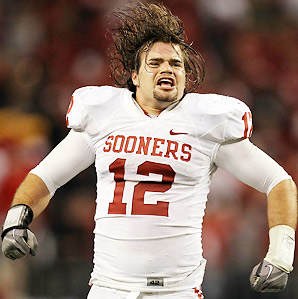
Oklahoma linebacker Austin Box found dead

The Oklahoma football program was rocked on Thursday with the news that middle linebacker Austin Box has died at the age of 22.

According to SI.com, a spokeswoman for the state Medical Examiner’s office confirmed the death. El Reno Police Chief Ken Brown says officers and medics responded this morning to a call of an unresponsive male who was identified as Box. The senior linebacker from Enid was then taken to an El Reno hospital before being transferred by air ambulance to an Oklahoma City hospital where he later passed away.

A police report obtained by KOKH FOX 25 in Oklahoma City shows that Box’s death was “probably” related to an overdose. The report doesn’t reveal what Box took, but it does say that it was a “controlled dangerous substance.” I would caution, however, not to read too much into this report until more details are released. The use of the word “probably” is sketchy at best and the link provided is to the site’s Facebook page (which doesn’t exactly scream “reliable information”). Still, I included the link because of the mention of the police report.

Whatever the cause of death, this is a tragedy and it’s a sad day for Box’s family and friends, as well as the Oklahoma and college football world. At 22 years old, the he had his entire life ahead of him and it’s sad that a young person perished so soon.

My thoughts go out to Box’s family.

Ohio State athletic director Gene Smith still backing Jim Tressel

Ohio State University head coach Jim Tressel directs his team against Marshall University during the fourth quarter of their NCAA football game in Columbus, Ohio, September 2, 2010. REUTERS/Matt Sullivan (UNITED STATES – Tags: SPORT FOOTBALL)

For those wondering if Ohio State athletic director Gene Smith has been distancing himself from Jim Tressel because he may eventually fire the embattled football head coach, Smith has made it clear that that’s not the case.

From ESPN.com:

“Oh, definitely, no question,” Smith said. “I haven’t changed, I haven’t changed. But I’m not talking about the case beyond that.”

Smith noted last month in an interview with The Associated Press that Tressel should have apologized at the infamous March 8 news conference, where Tressel acknowledged he failed to notify Ohio State officials of emails he received about some of his players receiving improper benefits.

Smith has also talked about the high legal costs Ohio State is dealing with, calling the ongoing NCAA situation “a nightmare,” and confirmed Wednesday that Tressel is responsible for his own lawyers. Tressel, who makes around $3.5 million per season, has hired Gene Marsh to represent him before the NCAA’s committee on infractions on Aug. 12 in Indianapolis. Marsh, a member of the NCAA’s infractions committee for nine years and chairman for two, is an Ohio State graduate. He has said he never attended a Buckeyes football game during his years as a student.

I’m not sure if this is considered “newsworthy” but look around – there’s not much going on these days in football (thank you, NFL).

My question is, did Tressel just get the dreaded vote of confidence? The, “Hey big guy, we’re still behind you 100%,” right before the axe falls? I may be naive, but I still don’t think he’ll get fired over “Tattoogate.” I reserve the right to change my opinion if Ohio State suffers even more embarrassment over these next couple of months (like, you know, if players were caught buying cars for $0 or something), but I tend to believe Smith when he says he still supports Tressel.

We’ll find out soon enough.

Forcier changes mind, won’t enroll at Miami

University of Michigan quarterback Tate Forcier looks for his receiver during the second half of their NCAA football game against Ohio State in Ann Arbor, Michigan Michigan November 21, 2009. REUTERS/Rebecca Cook (UNITED STATES SPORT FOOTBALL)

Former Michigan quarterback Tate Forcier has changed his mind and will not enroll at the University of Miami according to SI.com.

A person familiar with his decision told The Associated Press on Friday that the former Michigan quarterback broke off contact with the Hurricanes about six weeks ago because undisclosed personal matters were overshadowing football. The person spoke on condition of anonymity because Forcier has not publicly revealed the decision.

ESPN.com first reported Forcier would not attend Miami. A message left for Forcier’s father by the AP was not immediately returned Friday.

Miami added another transfer quarterback earlier this spring, when South Florida native Ryan Williams left Memphis after one season to join the Hurricanes. Returning quarterbacks Jacory Harris and Stephen Morris will vie for Miami’s starting job for 2011 in training camp, and Williams would have to sit out until 2012 unless the NCAA grants a waiver saying otherwise.

As SI.com points out, the last 10 or so months of Forcier’s collegiate career has been rocky. He lost the full-time starting quarterback job to Denard Robinson last year and despite his insistence that he would remain a Wolverine throughout his career, he announced his decision to transfer shortly after being ruled academically ineligible for Michigan’s trip to the Gator Bowl.

After considering Kansas State, Washington, Arizona and Montana, he signed an aid agreement with the Hurricanes in February. But after backing out with Miami, his playing status remains in flux.

Forcier has always reminded me of Jeff Garcia thanks to his ability to buy himself more time by moving around in the pocket and finding open receivers. He doesn’t have out-of-this world natural talent but given the right situation, I think he could succeed as a full-time starter somewhere. Of course, in order for that to happen he has to settle on a school and make sure he stays academically eligible.

Carroll: NCAA should be more proactive than reactive when it comes to problems

Former USC NCAA college football head coach Pete Carroll speaks after resigning to become head coach of the NFL’s Seattle Seahawks in Los Angeles January 11, 2010. REUTERS/Lucy Nicholson (UNITED STATES – Tags: SPORT FOOTBALL)

Pete Carroll might make his home in the NFL now, but he’ll always have ties to the NCAA (some good, some bad).

That’s why when he was recently asked about the way the NCAA monitors and enforces its rules, Carroll was more than willing to share his opinion on the topic.

From the Seattle Times:

Carroll said he believes the NCAA starts with the objective of finding wrongdoing, something that is reactive rather than trying to protect the game from outside influences to prevent problems. He pointed out that schools are being punished for actions of people who aren’t even affiliated with the university.

“If you notice, it’s people from outside the community of the actual working body of the university,” Carroll said. “In our situation at USC, it was absolutely that. What are we doing about that? How are we dealing with that?”

Instead, the focus is on after-the-fact punishment.

“You can only spank them so many times,” Carroll said. “I don’t think that has anything to do with making things right.”

As for paying college players? “No,” he said. “I’ve never thought that. That’s not the issue. They have a great life.”

When you think about it, college players are already being paid to play. They get free room and board, free tuition, free tutoring and free books. Granted, they also have the pressure of playing a collegiate sport, but let’s not act like these kids aren’t getting something in exchange for their services.

And as far as what Carroll is saying about the NCAA being reactive – he’s right. The NCAA should be spending most of its time trying to prevent these agents, tattoo owners and car dealers from luring players in with free goods and services instead of constantly having to crack the whip. The best way to avoid diseases is prevention.

Of course, that’s easier said than done and I don’t have any solutions here. There’s only so much coaches can do before they have to trust that these players will get it through their thick skulls not to accept improper benefits. The same goes for the NCAA, which can only do so much in order to steer athletes in the right direction.

Still, as Carroll points out, it wouldn’t hurt for the NCAA to get more proactive than reactive. Instead of waiting for these athletes to mess up and then flexing its muscles, how about the NCAA gets more involved in order to prevent these bad influences from penetrating its programs? What’s that old saying: If you’re not part of the solution, you’re part of the problem?

More trouble for Ohio State? School looking into players’ car deals.

Ohio State head coach Jim Tressel watches from the sideline during the second half of their NCAA football game against the University of Michigan in Ann Arbor, Michigan November 21, 2009. REUTERS/Rebecca Cook (UNITED STATES SPORT FOOTBALL)

The Columbus Dispatch is reporting that Ohio State has launched an investigation into used-car purchases made by athletes and their families from two different dealerships in the past five-to-six years.

Ohio State University’s chief enforcer of NCAA rules said yesterday that he will investigate used-car purchases made by dozens of OSU athletes at two Columbus car dealers to see if any sale violated collegiate rules.

The investigation was initiated after The Dispatch found in public records that at least eight Ohio State athletes and 11 athletes’ relatives bought used cars from Jack Maxton Chevrolet or Auto Direct during the past five years. The investigation will involve outside experts and examine at least 50 sales, focusing on whether the athletes received improper benefits.

The school is specifically looking into an issue involving a salesman named Aaron Kniffin, who worked at both dealerships and is responsible for many of the transactions. At this point, Ohio State doesn’t know if the players received improper benefits, but is concerned (and rightfully so) that so many of its athletes and their families purchased cars from the same salesman.

In its report, the Columbus Dispatch specifically mentioned linebacker Thaddeus Gibson, who apparently purchased a car for a whopping $0.

The purchases reviewed by The Dispatch were made when Kniffin worked at Maxton between 2004 and 2009 and then at Auto Direct between 2009 and 2010.

Public records show that in 2009, a 2-year-old Chrysler 300 with less than 20,000 miles was titled to then-sophomore linebacker Thaddeus Gibson. Documents show the purchase price as $0.

Mauk could not explain it. “I don’t give cars for free,” he said. Gibson said he was unaware the title on his car showed zero as the sales price. “I paid for the car, and I’m still paying for it,” he said, declining to answer further questions.

Kiffin claims that the sales prices were “much more than that” and is disputing the prices in the public records. But he no longer works for the dealerships in question, making the situation even more intriguing.

I don’t want to overact because this report is probably just the tip of the iceberg, but I think it’s safe to say that Jim Tressel has a big freaking problem on his hands. Not only were his players swapping memorabilia for free tattoos, but it also appears some of them were driving around in cars that they didn’t pay for. Now, is it conceivable that he didn’t know about the car situation? Of course. But he knew about the tattoos so was he also tipped off about the cars? If he was and he didn’t tell the school, then I don’t think Ohio State has a choice but to terminate his contract. I’ve long held the belief that the tattoo situation wouldn’t get him fired but he would have caused the school too much embarrassment if he also knew about the cars.

Suddenly, Michigan’s issues in Ann Arbor don’t look so bad.

« Older posts Newer posts »