Author: Christopher Glotfelty (Page 50 of 67)

Will Scott Boras ruin the Major League Baseball Draft?

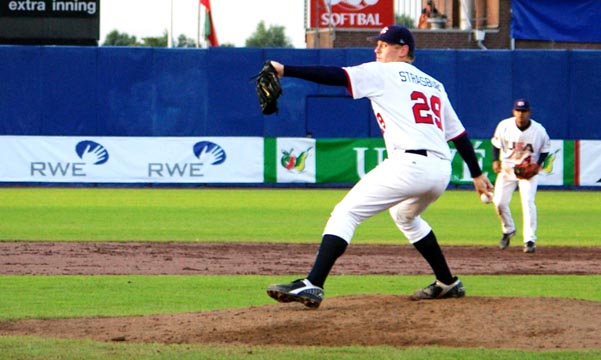
stras

Well, Michael Rosenberg from Fox Sports thinks so. When the MLB Draft kicks off tomorrow, the Washington Nationals are expected to take top pitching prospect Stephen Strasburg from San Diego State University as the No. 1 pick. Unfortunately, his agent is evil mastermind Scott Boras who is already throwing out a ludicrous asking price.

Boras has floated a $50 million signing-bonus demand for Strasburg to the media. The number is absurd, of course, and Boras knows it, but he doesn’t care. By leaking the $50-million figure, Boras has created an artificially high starting point for negotiations — and keeps the Nationals from claiming they did not know Strasburg would be so expensive. Boras has already built public pressure on the Nationals to pay Stephen Strasburg a ton of money.

Major League Baseball needs a true slotting system — not just a ridiculous, unenforceable commissioner’s recommendation. It needs a system like the NBA, where the top pick is locked into a certain figure and the contract values diminish with each subsequent pick. The only way to get one is to negotiate it into the next collective bargaining agreement.

The draft is just the first domino. Consider: in recent years, the Detroit Tigers paid above the commissioner’s recommendation for draftees Cameron Maybin, Andrew Miller and Rick Porcello. Not long after, they sent Maybin and Miller to the Florida Marlins for a package that included Miguel Cabrera. If the Tigers had not paid above their slot, they probably would not have acquired one of the best hitters in the game.

The NFL Draft has a similar problem — signing bonuses for the top players have gotten so huge that nobody wants the top three or four picks. Those picks are supposed to be the most valuable commodity that any losing team has. Instead, they often become anchors.

The problem is worse in baseball, because at least bad NFL teams get some marketing juice out of the draft. Most baseball prospects don’t play in the majors for at least two years.

This should be a rare chance to give losing teams an advantage, but it isn’t. Teams routinely pass on superior talent because of signability concerns, and with the economy in the toilet, that may be worse than ever this year.

It is past time to take the draft out of Scott Boras’s hands.

Rosenberg couldn’t be more dead on. Baseball does need a slotting system like the NBA. It’s truly ridiculous for a college phenom to be offered a multi-year or multi-million dollar contract. Baseball players seem to be the most fickle of athletes. They can have an amazing year in their early twenties, then teeter off, then come back and perform amazingly in their late 30s. This is why the Rays and Dodgers deserve some respect for the way they’ve cultivated their teams. Neither organization offered their prospects big money out of the draft and instead monitored them closely in their farm system. The Nationals offering Strasburg a huge contract would be idiotic despite the current problems with their organization. Pitchers, more than any position, are more prone to career-ending injuries and young guns aren’t often able to continue pitching at a top level. Tim Lincecum is an exception while Fausto Carmona is not.

The Nationals should make the correct decision and give Strasburg a decent two-year contract that lets him develop in their farm system. If he performs well there against older players, then see how he does in the bigs. Young pitchers should have two successful consecutive seasons in the majors before they’re expected any significant arbitration. If the Nationals don’t want to follow this plan, then they should let another team take Strasburg’s (supposedly) huge contract.

What does Roger Federer’s win at the French Open really mean?

Tim Joyce from Real Clear Sports feels that Roger Federer’s recent win at the French Open shouldn’t matter as much as most think. Joyce believes that, because of Rafael Nadal’s absence in the final, Federer doesn’t deserve the high praise.

When a Grand Slam tournament loses its star player and main attraction, there’s often a tendency for a sepulchral mood to cloak the on-court proceedings following such a shock to its system. This feeling usually lasts a day or two before the tournament reboots itself and seemingly gains a new destiny and sense of purpose.

But … would such a victory without having any obstacles – that is to say Nadal – detract from the accomplishment? Yes and no. It’d be patently unfair to diminish the achievement on the grounds that his draw opened up. No one seemed to complain when Agassi beat journeyman Andrei Medvedev for his only Paris crown (but then again Agassi did have to defeat defending champion Carlos Moya in the fourth round en route to the French title). There have been many Slam titles won in the Open era where the eventual champion was the beneficiary of an easy draw. And Roger has after all been to the last three finals at Roland Garros so he’s been ever so close – except in the finals when he has made nary a dent in Nadal’s clay armor. So logic would dictate that he’s due a lucky year, that he’s put in the grueling work on clay and he does have several Masters Series titles on the red dirt.

However, a Federer triumph would lack the drama that this achievement would warrant, in fact demand. Would Nadal finally winning at Wimbledon have been as dramatic and important if he had defeated Djokovic or Murray in as close a contest? No, not even close. The fact that he beat Federer on The Roger’s sacred turf is what made last year’s epic match so eternal and wondrous. It was fitting, correct and poetic that Nadal’s win last year on the sport’s biggest stage came against his chief rival.

I appreciate Joyce’s reasoning as he gives an even-handed approach to Federer’s success. If Federer had faced Nadal in the final, the match would definitely not have gone in three sets, and Federer might not have raised that trophy in the pouring rain. (Who knows, due to the lack of a retractable roof, they may have had to postpone a longer match until tomorrow.) Also, I believe that if Nadal were completely healthy during this tournament, he would have eliminated Soderling and given Federer an excellent effort in the finals.

Nevertheless, this is the best tennis I’ve seen Roger Federer play in a long time. It’s funny, because in the quarter and semifinals he didn’t seem to really come alive until the third sets, when he was behind. In the finals against Soderling he was at the top of his game. He even added a seemingly new drop shot at the front of the net which fooled Soderling all day. He displayed the type of dominance we’re used to seeing in Federer.

Joyce makes an interesting point, though: Nadal’s victory at Wimbledon on Federer’s beloved surface was truly amazing, and competition at it’s finest. Nobody expected Nadal to outmatch Federer in England that day, but he did. To this day, Federer has not beat Nadal in the finals at the Spaniard’s favorite Grand Slam. Because of this, Joyce has a valid argument. Federer was the best player at this year’s French Open, but it is a qualified win. Federer beat Soderling, who had a really tough time against Nadal. Thus, Federer making easy work of Soderling does make one think: Nadal has gotten the best of Federer over the last two years (except at the 2007 Wimbledon) and has dominated at Roland Garros. If Nadal loses to Soderling, something is terribly wrong.

Understandably, this debate can lead to a myriad of statistics that aren’t, in my opinion, practical to tennis. Federer’s older, Nadal’s younger, Federer’s healthy now, Nadal is injured, who was better in their prime, blah blah. Federer played incredibly at this year’s French Open and he is deserving of the championship.

What we should all be looking forward to is this year’s Wimbledon. With Federer’s confidence at a current high and Nadal coming back from giving his knees a break, it should be another beauty. That assumes, of course, that the two meet again. There’s always Andy Murray and one of America’s finest (sarcasm intended) standing in their way.

French Open: Men’s Finals Preview

fed

Tomorrow morning, Roger Federer will attempt to not only win his first French Open title, but also tie Pete Sampras’ record of 14 career Grand Slams. Federer will face No. 23-seeded Robin Soderling of Sweden. Soderling, who has never before made it to even a Grand Slam semifinal, has had a fantastic run this year at Roland Garros, defeating both No. 1-seeded Rafael Nadal and No. 12-seeded Fernando Gonzalez. This will also be Soderling’s first clay-court final. Unfortunately, he’ll be facing crowd favorite Roger Federer who is playing in the fourth French Open final of his career.

Federer has handled Soderling easily in the past. Not only that, but Federer has the Grand Slam experience and knows the courts at Roland Garros better than any player not named Nadal. Though it’s safe to say Federer will win tomorrow, props are in order for Robin Soderling who has handled some of tennis’ best stars with skill and poise.

Nevertheless, I did want to point out that I’m not surprised with Federer’s success at this year’s French Open. In March, I wrote an article questioning whether Roger Federer would ever win another Grand Slam. My conclusion was that, yes, Federer, would win but given a completely healthy Nadal, Federer’s best chance is at the U.S. Open where he has been dominant for years. I took a lot of unreasonable heat for that piece, but the fact is that we all should have expected Federer to win upon learning of Nadal’s weakening condition. With news that Nadal is pulling out of next week’s grass-court tournament at Queen’s Club it’s obvious that his knees are catching up with him. He’s played in nearly every tournament on the ATP Tour (and winning most of them) leading up to the French Open while Federer has taken loads of time off to save his strength. If Nadal competed at 100% I think this tournament would have gone a different way. Still, it’s his own fault for pushing himself too far. Federer has played exceptionally well and I hope he’s caught up to Pete when the clay settles.

You can watch the men’s final tomorrow at 9 AM ET on NBC.

French Open: Women’s Finals Preview

For the second time in five years, we are going to have an all Russian women’s final at the French Open. The match will pit #1-ranked Dinara Safina against #7-ranked Svetlana Kuznetsova. That stat isn’t that vexing, actually, when we look at the current complexion of women’s tennis. Of its top-ten ranked players, four are Russian (Dinara Safina, Elena Dementieva, Vera Zvonareva, and Svetlana Kuznetsova). Popular Russian Maria Sharapova made a strong campaign into the quarterfinals, but she is currently unranked.

Given a victory, this would be Safina’s first Grand Slam title, though she’s reached the finals twice, including her loss last year at the French Open to Ana Ivanovic. Kuznetsova is no stranger to high-pressure tennis as well as she captured the 2004 U.S. Open championship and was runner-up to Justine Henin at the 2006 French Open and 2007 U.S. Open.

Safina hasn’t been playing her best tennis, but I would count on her coming out on top. The big thorn in her side has been Serena Williams who was eliminated in the quarterfinals.

You can watch the final Saturday at 9 AM ET on NBC.

Sizemore heads to the DL

sizemore

Cleveland Indians all-star outfielder Grady Sizemore has been placed on the 15-day disabled list with left elbow inflammation. The Indians have called up utilityman Chris Gimenez from Triple-A Columbus.

Sizemore had struggled at the plate and not played much in the field recently because of the injury. He went 1 for 4, hitting his team-leading ninth homer Saturday night against the Yankees, but is hitting only .223 overall.

“We couldn’t take it any further,” said manager Eric Wedge, who had tried to keep Sizemore’s normally productive bat in the lineup by using him as a designated hitter.

The two-time Gold Glove center field had played in the field only three times in his past 12 appearances, all in an interleague series in Cincinnati.

“The first couple of days, it looked like Grady was getting better, then it leveled off. We didn’t want to push it and hurt it even more,” Wedge said.

Wedge said an MRI exam showed no structural damage and that Sizemore would not swing a bat or do any throwing for two weeks.

A year ago, Sizemore had career-highs of 33 homers, 90 RBIs and 38 stolen bases.

I find it strange that all these guys who were putting up big numbers last year are not only getting hurt but having poor seasons. On the flip side of that coin, some guys who have been unproductive in past years are having great years but are also getting hurt.

Grady Sizemore, Geovany Soto, and Alexei Ramirez are all having poor to mediocre seasons. Sizemore and Soto have battled nagging injuries and it’s showing. However, Jason Bartlett is having a phenomenal year and has never shown this talent before. Still, he’s young and hurt. I don’t get how these young guys are so easily injured.

« Older posts Newer posts »