Author: John Paulsen (Page 517 of 937)

There’s a lot on the line for Kobe, LeBron, Melo and Dwight Howard

Duh.

There’s always a lot on the line in the Conference Finals. But this year it seems like there is more at stake for the superstars still standing. Let’s start with…

KOBE

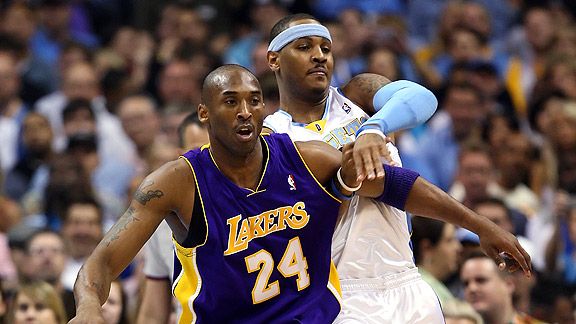
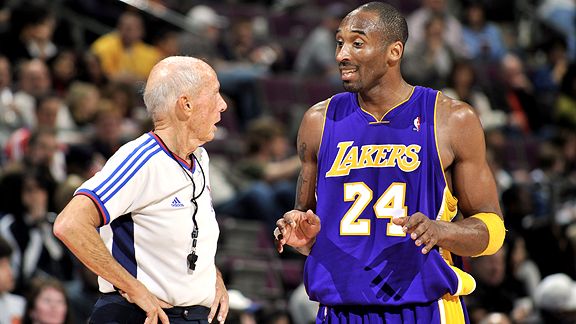
Kobe Bryant has made it abundantly clear that his #1 priority is to win another title. This focus is not unusual for players that haven’t won a ring, but Kobe has three, so why is he so determined to win a fourth? Simply stated, for the sake of his own legacy, he has to win a title without Shaq.

If he fails, he will be viewed by history as a great player who won a few titles as Shaq’s sidekick. This is not the legacy that Kobe wants to leave. Barring a two- or three-peat, he’s not going to be able to catch Michael Jordan, but if he is able to win a ring this year — and he’s the first to admit that this is his best chance — then he’ll do it as “The Guy” on a championship team. There’s no Shaq wreaking havoc in the middle, just a collection of players deemed too soft (Pau Gasol, Lamar Odom) or too young (Andrew Bynum, Jordan Farmar, Trevor Ariza) that Kobe led to the Promised Land.

And the clock is ticking. Kevin Garnett could come back strong next season, LeBron is getting better by the year, and there are a few up-and-coming teams (Orlando, Houston, Portland, etc.) that are looking to knock Kobe off of his perch.

The time is now. Kobe’s window is closing, and he knows it.

Continue reading »

NBA officials out of control? Not so much.

John Hollinger writes that the uptick in free throws this postseason is nothing new.

This phenomenon has gone on since prehistoric times as clubs enforce the no-layups policy with greater zeal, and garbage-time situations become fewer and farther between. These playoffs’ free-throw rates have increased over the regular-season rates similar to past seasons’ rates, even though high-foul teams are overrepresented this time around.

Denver led the NBA in free-throw attempts per field goal attempt this season by a wide margin.

Orlando averaged .351, good for third in the league, with center Dwight Howard leading the league in free-throw attempts.

Sum it up, and that’s six conference finals games with an above-average number of fouls, but we also have a far greater sampling of 67 games from the first two rounds of the playoffs. And in those two rounds, we had no deviation from the historic trend whatsoever. The only noteworthy development is a phenomenal increase in the frequency of technical fouls, with 1½ being called a game in this postseason, compared to less than one per night just here years ago.

But as far as live-ball action goes, the evidence for the “refs gone wild” theory is skimpy at best. Basically, we’re getting all bent out of shape over a six-game sample when a sample of 10 times as many games shows the opposite conclusion.

The bottom line is that teams and players don’t care if the refs call it close or loose, they just want consistency throughout the game. Officials can’t “let guys play” in the first quarter and then start calling ticky-tack fouls late in the game. The players adjust based on how the game is being called early on, but if that changes throughout the course of the game, all hell breaks loose.

23-5 run keys Laker win in Game 5

The Denver Nuggets were in position to win Game 5. They were up 71-64 with 6:31 to play in the third quarter and they had the Lakers on their heels. If they had shown patience and executed, they could have pushed the lead to double digits or at least have a modest lead going into the fourth quarter. But the Lakers tightened up their defense, and the Nuggets committed four straight turnovers late in the third to let L.A. back into the game.

The Nuggets were stuck on 76 from the 2:25 mark in the third quarter until the 7:52 mark in the fourth. That’s almost six and a half minutes without scoring a single point. The Lakers deserve some credit for playing pretty good defense, but the Nuggets were sloppy with the ball and took a ton of bad shots.

Lamar Odom finally showed up. He posted 19 points, 14 rebounds, four blocks and three assists, and was the single biggest reason that the Lakers won this game. I grow tired of hearing how talented of a player he is and then watch as he misses bunny after bunny at close range. Shannon Brown also played well of the Laker bench. He and Odom were on the floor when L.A. made its run.

The series moves back to Denver for Game 6, and the pressure is squarely on the Nuggets, as they face elimination.

The NBA rescinds Dwight Howard technical

Wisely, I might add…

The NBA announced Wednesday that it has rescinded Howard’s sixth technical foul of the playoffs, which he was given for taunting Anderson Varejao after a layup in the fourth quarter of the Magic’s 116-114 overtime victory Tuesday night. Cleveland’s forward had draped his arms around Howard in a failed attempt to stop him from scoring.

Howard’s total of technicals for the postseason is thus back down to five. Players receive a one-game suspension after reaching seven technical fouls and further one-game suspensions for every other technical thereafter.

I don’t like taunting, but what Howard did wasn’t taunting. He didn’t stand over Varejao for any length of time or show him up. He made a nice play and celebrated; he should be allowed to glance at the player he just worked over for a split second. Heck, the refs let Mo Williams whip the ball at Howard in Cleveland, and he didn’t get a tech.

Bucks to exercise “financial discipline”

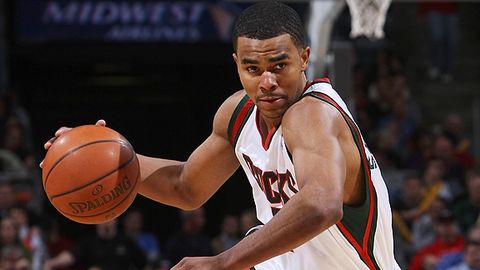
I’m not sure that this is what I wanted to hear, but Bucks GM John Hammond says he’s going to be careful with the payroll this summer.

The team’s financial discipline will affect the future and, more specifically, restricted free agents Charlie Villanueva and Ramon Sessions, and possibly European player Ersan Ilyasova. It will affect whom the Bucks select in the draft and whether they will be able to sign a free agent this summer, which right now appears highly unlikely.

The upside, though, is that if the Bucks are able to maintain that discipline now, as difficult as it might be, it will afford them the flexibility in a year or two to make some major moves and deal from a position of power rather than with their backs against the wall.

“We need to have discipline moving forward,” said Hammond. “That means that we need to have discipline from the financial side of our decisions. We are a team that is teetering at the (luxury) tax and for us to change our roster and to move the organization in a direction which we feel that we would want to go, we’re going to need some financial flexibility. And in order to get to that position, we have to have discipline here initially.”

In order to maintain the rights to Villanueva, the Bucks will have to present him with a qualifying offer (determined by a formula based on the player’s previous salary and where he was drafted) of $4.5 million. Unless the luxury tax turns out to be higher than anticipated, paying Villanueva that kind of money would take the Bucks into tax territory, which means the Bucks would not make him a qualifying offer. Villanueva would then become an unrestricted free agent and would be able to go to any team with no compensation to the Bucks.

That is where the financial discipline would enter in.

Last season, Villanueva was an asset at the $3.4 million that he was paid. But would he remain an asset at a $4.5 million salary – or even higher, if another team gave him an offer sheet that exceeded that figure – especially if it meant the Bucks would be paying the tax?

The same can be said for Sessions, who was an asset last season at a $712,000 salary. But would he remain an asset if another team offered him a multi-million dollar offer sheet that the Bucks would have to match to keep him?

I have no problem if the Bucks decide to let Villanueva walk. It would be nice to get something in return, but I understand if financial constraints force the team to pass on making him the qualifying offer to retain his rights.

Sessions is another matter. He averaged 12.4 points and 5.7 assists in 27.5 minutes of playing time this season. In 38 games as a starter, he averaged 15.2 points and 7.5 assists in 33.8 minutes of PT. His PER (17.65) is #13 amongst point guards and the fifth-best amongst point guards under the age of 26. His +/- numbers are the best on the team for anyone who played more than 1200 minutes. He has a knack for getting to the rim, which is a skill that has become more and more important since rule changes have reduced the amount of contact defenders can deliver on the perimeter. Since Michael Redd is more of a spot up shooter, Sessions is a good complement.

In short, the Bucks would be nuts to let him go. He’s still flying under the radar, so Milwaukee could probably lock him up for 4-5 years at $3-$4 million per season. If he continues on his current career trajectory, the Bucks could have a top 10 point guard in the next season or two at a very reasonable price.
« Older posts Newer posts »