Author: John Paulsen (Page 19 of 937)

Shaquille Johnson is heading into his senior year, but he’s dunking like a pro. Let’s hope the rest of his game is just as good…
As expected, Kyrie Irving went #1 overall to the Cavs, and Derrick Williams went #2 to Minnesota, a sign that the T-Wolves could not swing a satisfying trade for the Arizona forward. If he’s not moved in the next few days, he’ll be asked to play small forward alongside Kevin Love and Darko Milicic on the front line.
Conventional wisdom had Brandon Knight headed to Utah, but the Jazz went with Turkish big man Enes Kanter instead, which is odd considering the presence of Paul Millsap and Al Jefferson on the Utah front line. The Cavs went with Texas freshman Tristan Thompson at #4. Apparently, he played Williams to a standstill in a recent workout and that won over the Cleveland brass. He plays the same position as J.J. Hickson, so I’m not exactly sure how the two are going to develop together. (For what it’s worth, John Hollinger’s Draft Rater had Thompson ranked #3.)
The Raptors surprised no one at #5 by going international with Lithuanian big man Jonas Valanciunas, who has the potential to provide some rebounding alongside softy Andrea Bargnani. At #6, the Wizards went with Jan Vesely, a Czech swingman with a penchant for dunking…hard…on people.
At #7, the Kings took Bismack Biyombo (of Congo) but it appears that he’s part of a three-team trade with the Bobcats and the Bucks. Biyombo is probably headed to Charlotte, while the Bucks’ pick at #10, Jimmer Fredette, is headed to Sacramento. For their part, the Bucks acquired Stephen Jackson to replace John Salmons (on his way to Sacramento) and Corey Maggette (on his way to Charlotte). Milwaukee needs scoring and Jackson brings that while also playing good defense on the other end of the floor. The Bucks are also expected to acquire #19 pick Tobias Harris (of Tennessee) in the deal.
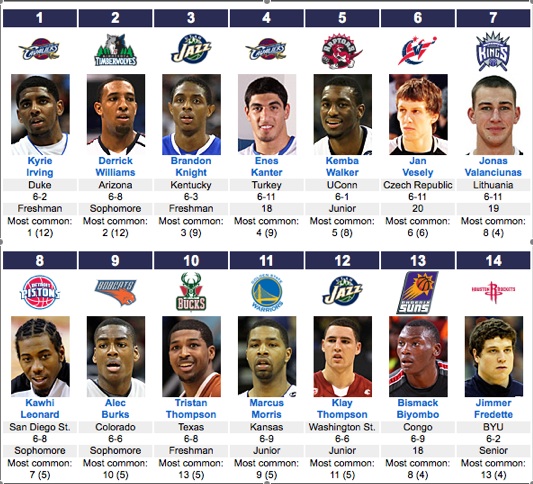
Here is the latest consensus mock draft from NBA.com.

In their draft preview, the folks over at Grantland described the draft this way…
There is no way to discuss this particular draft without stating the obvious — it is bombed out and depleted. Outside of Kyrie Irving and Derrick Williams, the two players vying for the honor of joining the Dan Gilbert hate-train, this year’s class is a collection of low-ceiling college guys and complete unknowns. What’s worse, the teams in this year’s lottery are all at least two, and sometimes as many as five, quality guys away from winning a playoff series.
John Hollinger’s Draft Rater agrees that Irving and Williams are clearly the top two players in the draft (at this point), but believes there’s value to be had in Tristan Thompson (whom Hollinger ranks #3) and Jonas Valanciunas (#4). He also believes that Kawhi Leonard and Kemba Walker have a great chance to turn into at least solid rotation players because the Draft Rater does such a good job predicting the upside of wings (as opposed to big men, who are tougher to gauge).
Unless there is a trade, it appears that Irving will go #1 to the Cavs while Williams will go #2 to the Timberwolves. It’s not a perfect fit for Minny, but they’d be dumb to pass on Williams if they can’t trade down. If nothing else, it would give them a good trade chip down the road.
The Jazz are looking for a point guard, and apparently aren’t sold on Devin Harris. Brandon Knight could be the pick there — he is a high character guy who had a 4.3 weighted GPA in high school.
If the Cavs take Irving #1 (which they should), it makes sense to go big at #4. J.J. Hickson is a solid prospect at power forward, so if Cleveland can land their center of the future at #4 (perhaps Kanter or Valanciunas), they’d be in reasonably good shape with a core of Irving, Hickson and Kanter/Valanciunas. Then again, they do have Anderson Varejao, but he is very limited offensively. Kanter is the polar opposite. He can score, but hasn’t shown much of a commitment to defense.
Walker to the Raptors makes a lot of sense. Unless they are planning to build around Jerryd Bayless or Jose Calderon, they need a point guard and Walker would be the best one available at #5. The Wizards could go any number of directions as they need help everywhere outside of point guard, where John Wall is the future. The draft is very fluid from #4 on and even the Jazz could surprise at #3 and take someone like Jan Vesely to play small forward.
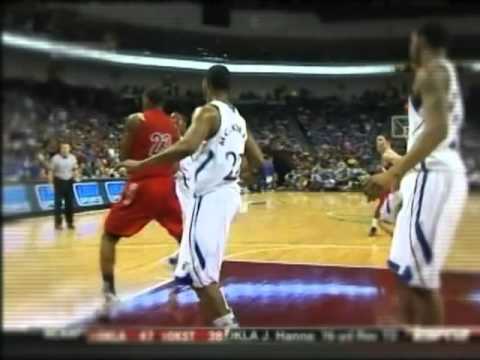
Check out these highlights of Derrick Williams sophomore season at Arizona:
Williams averaged 20/8 and shot 60% from the field in 2010, including an eye-popping 57% (42-of-74) from long range. He stands just over 6-7 in bare feet, but his standing reach of 9-0 is the same as Nick Collison and Tyrus Thomas and just a half inch less than Amare Stoudemire’s (though Stoudemire may have grown a bit since being measured in 2002).
While slightly on the small side, Williams is more of a power forward than a small forward, though he could get by with some minutes at the ‘three’ if need be. This isn’t good for the Minnesota Timberwolves, who already have a very good power forward in Kevin Love. Williams would struggle covering the quicker small forwards if pressed to play big minutes out of position, which is why the T-Wolves are trying to trade out of the #2 spot.
Williams is a terrific finisher in the lane, whether it be a powerful dunk or a nifty double cutch lay-in. He’s especially good at catching the ball off the pick-and-roll and finishing in traffic. He has a high motor and isn’t easily outworked. His range goes out to the NBA three-point line, though his shot isn’t exactly pure.
DraftExpress compares him to Michael Beasley (without any of the off-court issues) and says that “Williams shouldered a heavy load for Arizona this season at 16.4 possessions per game (5th in this group), but was nevertheless the most efficient forward of the players we looked at, scoring 1.16 points per possession. That’s especially impressive considering how heavily defenses keyed in on stopping him, how little playmaking Arizona had besides him, and the way in which he generated his offense.”
Meanwhile, NBADraft.net says he “was a pretty modest defensive player in college, as his lateral quickness is mediocre and his length is just OK, which are respective problems for the SF and PF positions … Definitely has wavering intensity on this end, and will allow baskets without much resistance around the rim, particularly against the bigger, more athletic PF’s he faced.”
FOLLOW US!

CATEGORIES
© 2026 The Scores Report – The National Sports Blog
Theme by Anders Noren — Up ↑