Author: Anthony Stalter (Page 965 of 1503)

Urine sample could prove Bonds used other steroids

Barry Bonds might be able to hide behind his lies for the time being, but he can’t run from damning urine samples.

Citing a person who has reviewed the evidence in the case, The New York Times reported on Wednesday that authorities detected anabolic steroids in urine samples linked to Bonds that they gathered in their investigation.

Bonds testified to a federal grand jury in 2003 that he used the “cream” and the “clear” but did not know that they were performance-enhancing drugs. The urine samples could prove the existence of other steroids in his body.

During that testimony, Bonds was asked if he ever took steroids, and he answered no. The government alleges that Bonds lied under oath. His perjury trial is scheduled to begin March 2.

Before anyone gets up in arms about steroids, steroid use and everything else pertaining to steroids, Bonds isn’t in trouble because he used riods, he’s in trouble because he supposedly lied under oath to a federal grand jury. This isn’t about steroids – it’s about Bonds lying, and it looks like federal investigators are building an airtight case.

Massive amounts of brain damage found in football players

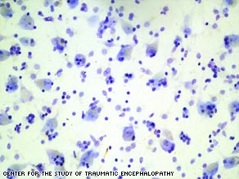
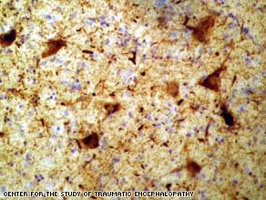
If you watch football long enough, it won’t take you long to realize it’s a brutal game. But how brutal? According to the Center for the Study of Traumatic Encephalopahty (CSTE), football players are suffering massive amounts of brain damage throughout their playing careers.

(The top) image of healthy brain tissue. (The bottom image) is brain tissue of a middle-aged football player. It reveals the intense damage from repeated concussions received on the field. According to Dr. Ann McKee, co-director of the Center for the Study of Traumatic Encephalopathy (CSTE), the damage looks similar to that of an 80-year-old with dementia caused by Alzheimer’s disease. The CSTE have found the condition, called chronic traumatic encephalopathy (CTE), in the donated brains of dead NFL players John Grimsley, Mike Webster, Andre Waters, Justin Strzelczyk and Terry Long. From CNN:

“What’s been surprising is that (the damage is) so extensive,” said Dr. Ann McKee, a neuropathologist at the Veterans Administration Hospital in Bedford, Massachusetts, and co-director of the CSTE. “It’s throughout the brain, not just on the superficial aspects of the brain, but it’s deep inside.”

The damage affects the parts of the brain that control emotion, rage, hypersexuality, even breathing, and recent studies find that CTE is a progressive disease that eventually kills brain cells.

The NFL takes steps to try and prevent damage like this from occurring, but clearly it still isn’t enough. A new wave of helmets have come into the league over the past couple of seasons, but it’ll probably be years before tests can be done to measure their effectiveness. Hopefully as technology grows stronger, new equipment will be invented to save players from major injury. But for now, football is still as brutal as it comes.

Is Tom Cable qualified to be the Raiders’ head coach?

According to sources at ESPN.com, the Oakland Raiders have chosen Tom Cable to become their full-time head coach. The team hasn’t officially announced the decision yet, but it appears like it’s a done deal.

Cable of course coached the Raiders for 12 games last season after Al Davis fired Lane Kiffin. But before those 12 games, Cable had just three years head coaching experience at the University of Idaho (in which he complied an 11-35 record), which begs the question: is he qualified to take over the mess in Oakland?

Cable coached in the collegiate ranks from 1987 to 2005, mostly as an offensive line coach and as an offensive coordinator. In 2006, he took over as the Falcons’ offensive line coach for one season and then coached the Raiders’ O-line in 2007 and six games in 2008 before taking over as interim head coach after Kiffin was fired.

In 12 games last year, the Raiders went 4-8 under Cable, with impressive victories over the Broncos, Texans and Buccaneers over that span. But the team also showed little to no effort in losses to the Falcons, Chargers and Patriots.

Possibly the main motivation behind the Cable hire was that the players seem to favor him. He has become known as a motivator, which is certainly one of the things that the Raiders need. But can he develop JaMarcus Russell? Can he help Davis build a roster via free agency and the draft? Or is he just another “yes man” that Davis can control and that’s the main reason he got the full time gig? (Remember, Kiffin was fired in Oakland largely because he wanted to do run the team his own way and that never sat well with Davis.)

The key to the Cable hire might be whom the team chooses at the coordinator positions. If Cable can find two respected coordinators to run the offense and defense, then he can do what he does best in keeping the team motivated throughout the year.

Regardless of the overall inexperience he has at the NFL level, Cable deserves a shot because he’s built a good relationship with the players and that could go a long way in Oakland. Now he just has to build a competent staff and hope that Davis doesn’t spend another offseason overspending on overrated players.

Dimitroff is classic example of why teams should hire from winning organizations

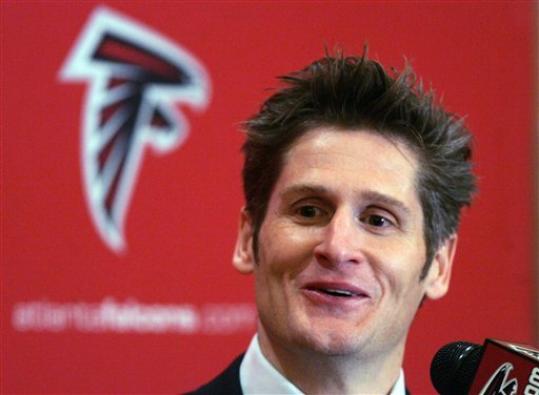
January 13, 2008 was officially the day the Atlanta Falcons turned their misfortunes around. No, that wasn’t the day they drafted Rookie of the Year Matt Ryan (that was April 26, 2008) or the date they signed free agent Michael Turner (March 2).

January 13, 2008 was the day the Falcons hired former Patriots’ director of college scouting Thomas Dimitroff to be their next general manager. Without Dimitroff, there might not have been a Matt Ryan, Michael Turner or Mike Smith, who recently won the NFL’s AP Coach of the Year Award.

On Wednesday, Dimitroff was named Sporting News magazine’s NFL Executive of the Year – and for good reason. Not only was he responsible for hiring Smith, signing Turner and drafting Ryan, but he was also behind trading overrated cornerback DeAngelo Hall to Oakland, releasing aging veterans Alge Crumpler, Rod Coleman and Warrick Dunn, as well as selecting Sam Baker, Curtis Lofton, Chevis Jackson, Harry Douglas and Kroy Biermann in last year’s draft, all of whom were major contributors as rookies in 2008.

There’s no doubt the Falcons were in bad shape in 2007. Michael Vick was arrested and sent to federal prison because of dog fighting, Bobby Petrino quit in the middle of the night and ran back to the college ranks, and players like Hall started to act above the team. Making matters worse, late in the year it looked like Bill Parcells would join the team as the new general manager, but as it turns out he was only using the Falcons as leverage to get the Dolphins’ front office job.

Heading into 2008, the Falcons needed a new general manager (Rich McKay was relegated to team president after the ’07 season), a new head coach and a new direction. So after the Parcells debacle, owner Arthur Blank hired Dimitroff, which turned out to be one of the best decisions Blank has made since buying the team in 2002.

Looking back, it was no surprise Dimitroff had so much success in just his first year. He came from a winning organization in New England, so he knew what it took to build a winner elsewhere. He hired Mike Smith because he knew he had to have a coach he could work with in constructing personnel. He drafted Matt Ryan because he knew most Super Bowl-caliber teams needed a Super Bowl-caliber quarterback. He parted ways with Hall, Crumpler, Dunn and Coleman because he knew their production probably wasn’t going to match their contracts and the team needed a new core group of players. And finally, he built an offense first because he knew dome teams have advantage on that side of the ball and that Smith (the Jaguars’ former defensive coordinator) could do more with less in terms of the defense, at least in their first year until Dimitroff had the chance to bring in better defensive personnel.

But it all comes back to Dimitroff’s previous success. He learned in New England what it takes on a day-to-day basis to win in the NFL. He had hands on experience in helping the Patriots win so when Atlanta came calling, he took that same formula and instilled it into the Falcons. And wouldn’t you know it – it worked.
« Older posts Newer posts »